
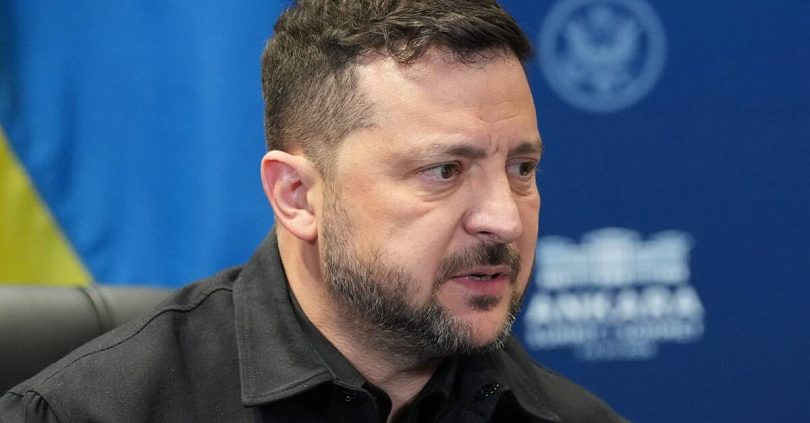
Volodymyr Zelensky has asked European leaders for help to tackle Russia’s ballistic missiles, which have pounded his country in the more than four years since Moscow launched a full-scale invasion.
“Our top priority is anti-ballistic defence,” the Ukrainian president said on social media after arriving in Paris.
Russian President Vladimir Putin was unyielding, vowing emphatic retaliation to Kyiv’s recent long-range attacks on refineries, tankers and terminals which have caused widespread fuel shortages.
“Wherever they attempt to strike Russian territory, we will respond in kind, but our strikes will be several times more powerful,” Mr Putin told a meeting with pro-Kremlin activists.
Mr Zelensky is keen to accelerate plans for jointly developing with European countries anti-ballistic air defences before the winter, when Russia usually intensifies its attacks to deny Ukrainians electricity, heat and water. Russia’s ballistic missiles are harder for Ukraine to stop than drones or cruise missiles.
Ukrainian officials will present a proposed anti-ballistic programme and meet government leaders, national security advisers and defence companies who might take part, Mr Zelensky said.
European foreign ministers are meeting separately in Brussels where they were expected to discuss Ukraine’s needs and Russia’s threats to the continent.
US President Donald Trump’s pledge last week to give Ukraine a licence to produce Patriot air defence systems to counter the ballistic missiles could mark a major breakthrough for Kyiv, but experts and Ukrainian officials warn that turning the idea into reality would probably take years.
Mr Zelensky was meeting French President Emmanuel Macron, while the Ukrainian military will participate in the parade marking Bastille Day, France’s national holiday.
Kyiv and its European backers want to press home Ukraine’s recent successes and compel Mr Putin to negotiate an end to the fighting, although Moscow has shown no willingness to compromise despite peace efforts by the Trump administration.

Kremlin spokesman Dmitry Peskov said Moscow will closely follow the Paris meeting but dismissed its aspirations.
“This is a coalition of warmongers,” he said. “They are driven by the profound delusion that it’s possible to inflict a strategic defeat on our country, so this is a coalition of the deluded, a coalition of those who incite the war.”
Ukraine’s advances in drone technology have given it an edge in recent months, analysts and western officials say. Its strikes on supply routes behind the front have robbed the Russian army of momentum on the battlefield and made its progress slow and costly, they say.
Ukrainian forces struck 105 Russian vessels in the Sea of Azov next to the Crimean Peninsula between July 6 and 13, said Robert Brovdi, commander of Ukraine’s Unmanned Systems Forces.
The vessels included tankers, dry cargo ships, a ferry and tugboats, Mr Brovdi said.
The campaign is part of a broader Ukrainian effort to isolate the Crimean peninsula, which is enduring its worst fuel crisis since it was illegally annexed by Moscow in 2014, and disrupt Russian logistics. Crimea is a key rear base for Russian forces occupying parts of southern Ukraine.
Mr Putin on Monday again acknowledged fuel shortages in Russia caused by Ukrainian strikes on oil facilities but said: “I believe the situation will gradually improve.”

The Paris meeting of the so-called Coalition of the Willing, which brings together more than 30 countries supporting Ukraine, was expected to include about 25 heads of state and government.
The high number appeared to be a demonstration of long-term commitment to Ukraine and a warning to Russia, as Moscow tests Europe’s resilience.
Mr Zelensky’s trip to the French capital followed the death of US senator Lindsey Graham, one of Kyiv’s staunchest supporters in Washington. Legislator Oleksandr Merezhko called Mr Graham “the closest link between Ukraine, our president and Trump”.
The trip also comes amid a major reshuffle of Mr Zelenskyy’s government that saw prime minister Yulia Svyrydenko step down on Sunday.
French foreign minister Jean-Noel Barrot said he would summon the Russian ambassador to France and impose sanctions against Russian hackers. He told BFMTV-RMC the issue is about “a vast cyber campaign aimed at sabotage and espionage, carried out by Russia in about 10 European countries”.
Ukraine’s neighbours have also felt the war’s impact.
In the latest incident, a drone launched during Russian overnight attacks on Ukraine’s Odesa region crashed and exploded on Moldova’s territory, Moldova’s Ministry of Foreign Affairs said on Monday. It said the incident was “serious and unacceptable”.

Ukraine has aimed at targets deep inside Russia with its domestically developed long-range drones and missiles, matching and sometimes exceeding the number used in relentless Russian aerial attacks.
Russian air defences downed 350 Ukrainian drones heading towards Moscow since late Sunday, including 50 near the capital, Moscow mayor Sergei Sobyanin said.
Moscow regional governor Andrei Vorobyov said 81 Ukrainian drones were downed overnight, adding that three people were killed and three injured by the attack in the Pionersky settlement in the western part of the Moscow region.
The Ukrainian air force said Russia had launched 134 long-range strike drones and three guided aviation missiles at Ukraine.
A strike on port infrastructure in Ukraine’s Odesa region set fire to a docked merchant vessel carrying fertiliser under the flag of Togo, killing five crew members and wounding 10, said regional military administration head Oleh Kiper.
Russia’s Federal Security Service said it had thwarted a Ukrainian plan for a drone attack on the Ukrainka air base in the far eastern Amur region and the Shagol air base in the Chelyabinsk region in the southern Urals.
Small drones were smuggled into Russia’s western Bryansk region using air balloons and bigger transport drones, then taken by car near the air bases by Ukrainian agents, who were arrested, the security service said.
The purported plot was part of a series of planned drone strikes on military infrastructure “unprecedented in its scale and the level of threat”, it added.
A Ukrainian covert operation a year ago, dubbed Operation Spiderweb, destroyed or damaged nearly a third of Moscow’s strategic bomber fleet with drones carried secretly into Russia, according to Ukrainian officials.