
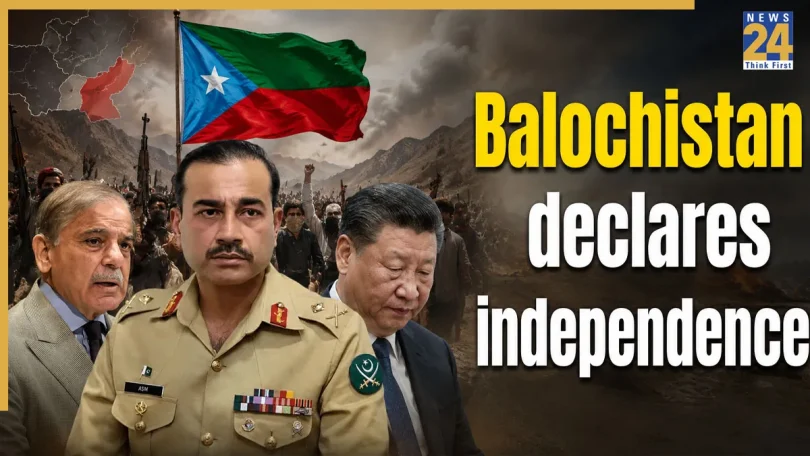
Balochistan independence: Balochistan, Pakistan’s largest yet least populated province, has declared “independence” from Islamabad, though its sovereignty remains unrecognised so far by most countries globally.
The development is a major blow to Pakistan, which is battling mass protests in Pakistan Occupied Kashmir (PoK) and the Tehreek-e-Taliban Pakistan (TTP) militants in and around the Afghan border, amid a crippled economy and rising debt.
However, beyond the obvious implications for Pakistan, the Balochistan ‘independence declaration’ is also a significant setback for China, placing a cloud of uncertainty over the China-Pakistan Economic Corridor (CPEC), Beijing’s flagship project under the ambitious Belt and Road Initiative (BRI).
Stretching nearly 3,000 kilometers, the CPEC is mega project worth about $65 billion, connecting the deep-sea Gwadar Port in Pakistan’s Balochistan province to China’s Xinjiang region through highways, railways and pipelines.
Will Pakistan lose Gwadar Port?
According to geopolitical experts, Pakistan, and by extension, China, would lose control and ownership of the strategic Gwadar Port if Balochistan is recognised as a sovereign nation by major countries and the United Nations.
Under international law, operation and ownership are strictly distinct matters, and since Gwadar Port is located in the Balochistan province, it would be the sole mandate of the Baluchi government whether to honour agreements signed between Pakistan and China, if the province is recognised as an independent sovereign country.
What happens to China’s investment and stake in Gwadar Port?
At present, China operates the Gwadar Port via China Overseas Ports Holding Company (COPHC) under a long-term concession agreement with Pakistan, which grants operational rights to Beijing, but the ownership remains with Islamabad.
If Balochistan gets international recognition as a sovereign state, the agreements signed between China and Pakistan won’t automatically stand nullified, but the new state would not be legally-bound to honor any or all of these arrangements.
Its likely that a sovereign Balochistan government could renegotiate or even entirely cancel any previous agreements signed by Pakistan, though investors may seek compensation through arbitration if contracts are cancelled without legal grounds.
Additionally, the independent Balochistan government would be empowered to renegotiate any and all types of agreements it inherits from Pakistan, including port concessions, mining contracts, energy projects and infrastructure deals.
Why CPEC would be dead if Balochistan gets independence?
The CPEC, at least in its current shape and form, would essentially be dead for all intents and purposes if Balochistan becomes a sovereign country, as Gwadar serves as serves as the CPEC’s southern gateway that links western China to the Arabian Sea.
China would have renegotiate a new framework withe Balochistan to retain access to Gwadar, failing which CPEC projects that connect to Pakistan’s interior via Gwadar would come to grinding halt amid security concerns and political uncertainty.
Notably, majority of CPEC projects, such as highways, power plants and other infrastructure, were funded by China sovereign loans to Pakistan, and are thus legally owned by Islamabad. Thus, in case of independence, Balochistan would need to negotiate a settlement with Pakistan for ownership of this infrastructure located inside its territory.
First published on: Jul 18, 2026 07:57 PM IST
Get Breaking News First and Latest Updates from India and around the world on News24. Follow News24 on Facebook, Twitter.
End of Article
Related Story


