
GODFREY GEORGE, in this first part of a two-part investigative series, exposes the deep-seated corruption and systemic rot within the Nigeria Police Force. It dissects the institutionalised extortion and culture of demand for bribes and reveals how the very institutions state-mandated to enforce the law have instead turned ordinary……
GODFREY GEORGE, in this first part of a two-part investigative series, exposes the deep-seated corruption and systemic rot within the Nigeria Police Force. It dissects the institutionalised extortion and culture of demand for bribes and reveals how the very institutions state-mandated to enforce the law have instead turned ordinary citizens into commodities for commercialised terror and unchecked administrative greed
Bimbo Phillips: From Panti to Kirikiri
Credit: TVC News/Godfrey George
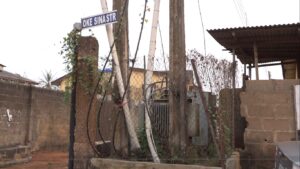
The drive to Oke Sina Street was loud. Meiran is always loud. The area is a fast-developing, densely populated residential and commercial hub in the Alimosho Local Government Area of mainland Lagos. Positioned along the Lagos-Abeokuta Expressway, it serves as a key transit point for commuters and offers affordable housing and lively local markets.
But amid this heavy noise, there was heavy silence as our correspondent entered a tall black gate, introducing a decent compound. It belongs to a pastor and businesswoman, Mrs Bimbo Phillips.
Mrs. Philips welcomes this reporter and returns to sit on a weathered wooden bench. She is light-skinned. When she stands, she moves with a distinct, laboured gait: the quiet signature of a body that has been broken and forced to heal. Months before, she had had a terrible accident that almost claimed her life.
“Standing here is by the grace of God. I thought I would not make it. I was in a coma for a month,” she said, as she showed our correspondent where to set up for her interview.
READ MORE: FG Arrests Two Suspected Illegal Miners, Shuts Site In Osun
Beside her, her elderly mother sits in the shadows. She has a worn-out wrapper on and her left hand underneath her chin.
When she speaks, her voice is barely above a whisper. It is thick with an emotion that time has refused to dull.
Six years ago, her community was in darkness: there was no power supply. Their transformer had packed up. She stepped out to see what she could do to get a new transformer for her neighbourhood.
By Christmas of 2024, she got a different reward. Bimbo was locked inside Kirikiri prison. Her children, her mother, and her nieces were trapped inside a police cell in Meiran.
She takes a breath. She looks at her hands. This is how the darkness found her.
How it all started

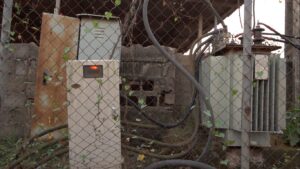
The nightmare began in 2018 when her neighbourhood’s transformer packed up. The community wrote to Ikeja Electric’s head office in Ponle, Alimosho, requesting repairs. When the utility firm declared the unit unfixable, the residents asked for its removal to stop the financial bleeding in the form of estimated billing.
“During those periods, the community chose four men to handle the contributions,” Philips recalls, shifting slightly on the bench. For nine months, the neighbourhood was plunged into total darkness as the committee was fractured over money. When a replacement transformer finally arrived in 2019, it blew up within 24 hours.
The official explanation from the utility officials—then popularly referred to by the legacy acronym NEPA (now Ikeja Electric)—was as bizarre as it was unscientific.
“They came and checked what caused it; we were told the earth wasn’t good,” she says, her voice tinged with lingering disbelief.
“We were told to usually pump water into the transformer. I’ve never seen where they pump water into a transformer. So, we all began to fetch water, and it dried up so quickly after a few hours. I connected a hose from my home straight to the transformer, but it didn’t do much.”
Within three months, the second unit packed up.
Credit: TVC News/Godfrey George
As darkness returned, so did the financial demands. The original four-man committee had dissolved into bitter, unspoken infighting, leaving a local engineer, whom she identified only as Mr Odetunde, as the sole administrator of the pool of funds. He returned to the community with a fresh demand: Ikeja Electric required another ₦500,000.
Sensing deceit, Phillips bypassed the local intermediaries. She tracked the administrative trail from the Abule Tailor service station back to the head office in Ponle.
There, she confronted an official, one Engineer Okoye, demanding to know why a community that had just raised ₦350,000 for “recharge cards” — a euphemism for operational bribes — was still being left in the dark.
The reaction was immediate panic.
“Madam, don’t implicate me oh, nobody give me any money oh,” Okoye blurted out. The community had been fleeced; the money had never left Meiran.
Phillips called an emergency town meeting to expose the fraud, igniting a localised war.
Determined to solve the crisis permanently, she personally marched down to the company’s warehouse in Oke Afa alongside an independent engineer, verified a functional unit, and carted it back to her street.
In June 2021, the new transformer was powered. But her triumph came at a devastating personal cost. The men who had spent years extorting the community now had a target on her back.
Unending police palaver
The dispute quickly escalated to the police at Zone 2, where the Assistant Commissioner of Police, one ACP Adesoye, issued multiple invitations that the defunct committee members ignored. Then came the ambush. Phillips received a call stating that the Divisional Police Officer (DPO) of Meiran wanted to see her. Believing she was walking into a haven of law enforcement officers, she said she entered the DPO’s office.
A phone call was placed to ACP Adesoye, who explicitly instructed the female DPO to detain the defaulting party. But as Philips turned to step outside the office, she said she was surrounded by three plainclothes operatives—one woman and two men—who identified themselves as officers from the Alagbon unit of the Lagos Police Command.
“If you don’t follow us, we will rough-handle you,” they warned her inside the executive office.
Phillips looked to the station’s leadership for protection.
READ MORE: Hunters, Civilian JTF Kill Bandit Commander, Kachalla Yello, In Zamfara
“DPO!” she cried out. The response was a chilling abdication of duty. “Eh, maybe you have to follow them,” the Divisional Police Officer murmured. Even as Mrs Phillips called the ACP back on her mobile phone, the DPO refused to take the call, offering a weak defence: “Alagbon is superior to Zone 2.”
What followed was an exhibition of unbridled state brutality inside a police station.
“Right from the office, this policeman named Gbenga Daniel gave me the beating of my life,” Phillips says, her eyes darkening.
“Inside the office, I was brutalised. I had braids on; he literally pulled them off my head. They dragged me from the office all the way out, right in front of the DPO.”
She was bundled into a commercial minibus (korope). As the vehicle hit the Meiran junction, local youths who recognised her blocked the road at Ahmadiyya Bus Stop along the Lagos-Abeokuta Expressway, attempting to rescue her.
The police responded by pulling out service weapons, threatening to open fire on the crowd and Phillips herself.
“They did not tell me my offence before Almighty God,” she said. When she fell during the assault and tried to claw her way back up, she said the officers twisted her hands, later claiming she had attempted to assault police personnel.
As the bus sped across the bridge toward the Alagbon facility, the operatives threatened to dump her body into the lagoon.
“They told me they would shoot me and dump me into the river and nothing would happen,” she recalled in chilling wonder.
Locked up after brutal beating, bailed for N250,000
At the Anti-Fraud unit, she said an unnamed Commissioner of Police accepted the handlers’ narrative that Phillips was the aggressor and ordered her lockup.
To secure her release, her family and community members had to raise ₦250,000 in cash, an extortion sum she said was paid directly to one Supol Bose Kehinde under the threat of immediate arraignment.
The violence, however, followed her home.
Days later, while Phillips was confined to her bed and on an intravenous drip to recover from the injuries of her detention, a violent pounding shook her front gate.
A man whom she identified as Mr Ayeni, who was an associate of the said Odetunde, had stormed the compound, violently assaulting a guest before turning his rage on Philips’s son, a sickle cell patient, who collapsed into unconsciousness from the beating.
When Phillip’s 70-year-old mother rushed out to defend her grandson, Ayeni reportedly struck the elderly woman with a heavy wooden club, landing both grandmother and grandson in the hospital. Our correspondent saw video evidence of the fight.
When Phillips sent the video evidence of the domestic raid to Supol Kehinde, the officer who had collected the ₦250,000 bail, she invited both parties to the station. When they got there, the institutional response was dismissive.
The police classified the home invasion as an “affray” or “two fighting.”
“How can a 40-year-old man be fighting with a woman of 70 years?” she asked, her voice rising in bitter irony. “How can he be fighting my mother in her own house, and you call it two fighting?” Rather than arresting the assailant, the police locked up the 70-year-old grandmother, releasing her on bail at 9:00 PM. This time, Philips said no money was paid.
Fatal accident and another police arrest
Then, tragedy struck from a different corner. Months later, Mrs Phillips was involved in a near-fatal automobile accident that left her in a month-long coma, causing partial memory loss, temporary blindness, and physical paralysis.
Yet, the machinery of harassment did not pause for her convalescence.
While resting in her wheelchair, another thunderous knock brought her front gate crashing down.
Ten heavily armed police officers from the State Criminal Investigation Department (CID), Panti, had surrounded her home, demanding her arrest over an allegation that she had broken the mirror and windscreen of the said Odetunde.
The absurdity of arresting a paralysed woman in a wheelchair eventually forced the case before the AIG.
Shocked by the documentation of the initial ₦250,000 extortion, the AIG ordered the matter transferred to the S-Squad under the supervision of an IPO identified as Supol Saheed. But Saheed’s intervention came with its own systemic twist. He ordered Bimbo to rewrite her official petition to completely erase the mention of police extortion.
“He stressed that there was no police officer who did not extort and that the N250k was gone,” she reveals. He then extracted an additional ₦50,000 from her, claiming it was needed to “radio” the Panti command to stop invading her residence.
Exhausted by the endless cycle of administrative extortion, her husband demanded that the matter be tested in an open court of law. But the police had no intention of allowing a fair trial.
Before the scheduled court date, Mrs Phillips was lured back to Alagbon under the guise of an official invitation. The moment she crossed the threshold, she was intercepted, forced into a minibus, and driven straight to the Yaba Magistrate Court.
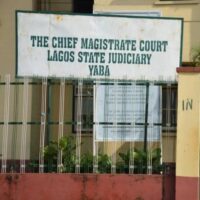
By the time her family could navigate the administrative bureaucracy to perfect her bail conditions, the judicial system had already processed her. On December 18, 2024, Mrs Philips was moved to Kirikiri prison.
From the confines of the correctional facility, she placed a desperate call to her household, only to discover that the vengeance of her persecutors had extended to her entire bloodline.
While she was being processed into Kirikiri, police operatives had swept through her home in Meiran, arresting her elderly mother, her young children, and her sister’s children, who had simply travelled to the house to spend the festive season.
Mrs Phillip’s voice drops to a whisper as she recalls the final, cruel boast of her captors—a phrase that encapsulates the raw, unchecked abuse of power in the fringes of Lagos: “They said I would do Christmas in prison, and my family would do Christmas in a cell.”
Efforts to get the said Odetunde to speak to the matter proved abortive. Our correspondent visited his home twice, knocked on his gate and was met with silence. Several calls were also made, but no response was given. Also, a text message had not been responded to as of press time.
Steve Winners: From birthday party to prison
The descent of then-24-year-old event planner into the violent machinery of the Nigerian penal system began with a casual Internet search.
In late 2017, Stephen Godwin, a rising entertainer known professionally as Steve Winners (Alias Chief Wowo), was staring at the biggest break of his career.
A London-based tea company with operations in Port Harcourt, Rivers State, South-South Nigeria, had reached out to him to execute a massive corporate tea party. Seeking spiritual validation for the milestone project, Godwin decided to mark his upcoming birthday by hosting a charity fiesta for local orphans.
To market the charity drive, he opened a browser to find generic illustrations of vulnerable children. “I went online and searched for ‘hungry orphans in Africa and Nigeria’, and a lot of pictures popped up,” Godwin recalls. “I selected and downloaded about 20 pictures to use on the flier and social media.”

He had no way of knowing that the algorithm had served him a photograph of a real child who had vanished from an Owerri, Imo State church months prior. By saving the file, he had inadvertently woven himself into a frantic, cross-state police hunt.
The architecture of a trap
The trap snapped shut under the guise of religious solidarity. A week before the event, a man identifying himself as a prominent Port Harcourt bishop called Godwin, hinting at a partnership.
The caller inquired specifically about whether the children on the fliers would be present at the venue.
“I told him I got them from the Internet, that the children coming for the event were the orphans in Rivers State,” Godwin recalled.
Days later, a group claiming to be the bishop’s emissaries arrived at St. John’s Catholic Church in Rumuokwurishi, where Godwin was preparing. The delegation arrived in a Sienna, carrying a woman, a cleric, and a five-year-old girl. They asked Godwin to accompany them to local orphanages to verify his logistical arrangements.
“Since they said they were from the bishop, I didn’t feel there was any need to further probe their mission,” Godwin admits.
He spent two days guiding the strangers through various homes, oblivious to the fact that the woman beside him was a grieving mother, the young girl was a surviving twin, and the entire exercise was an unmonitored reconnaissance mission by plainclothes operatives looking for a missing child.
Abducted by armed policemen, driven from Rivers to Imo
The illusion fractured on March 24, 2018, midway through the fiesta at the Obio Akpor Local Government secretariat.
The supposed delegates sat quietly through the event, offering empty promises. When they rose to leave, Godwin politely followed them to the parking lot to express his appreciation. There, the operatives asked one final time about the origin of the flier’s artwork.
When Godwin repeated that the image was an internet download, the badges were finally produced. They were investigators from the Imo State Police Command.
“A clear conscience fears no accusation, so I still thanked them for coming,” Godwin says. But the professionalism ended there.
Before he could alert his staff, the operatives dragged him toward their vehicle.
“I asked them what I had done and why I was being taken to the police station. As I wanted to explain, they told me to come out and do so. As I did, two of them dragged me into a Toyota Hilux and zoomed off. I sensed danger, and I told them to allow me to call my manager, but they refused as they seized my phone.”
By 7:00 PM, Godwin was locked inside a cell at the Owerri North police station in Imo State, completely cut off from his life.
‘We will break your legs’
The subsequent police interrogation was characterised by a total abdication of forensic discipline.
The officers pointed at the photo on his flier, explaining that the child had been stolen on October 1, 2017, at St. John’s Anglican Church in Owerri while the congregation closed their eyes for prayers.
Godwin handed over his phone, begging them to look at the file properties. “I showed them the picture, and my phone showed it was a downloaded document, but they refused to listen to me,” he says.
The state apparatus refused to relent, leading to baffling contradictions within the investigation.
“The mother of the missing child brought food for me to eat, but the Investigative Police Officer rejected her food,” Godwin recalls, still puzzled by the memory.
“Why would a complainant bring food for someone she claimed stole her child?”
Though subsequent field trips back to Port Harcourt verified every detail of Godwin’s timeline, the leadership bypassed the findings.
The Investigative Police Officer, a sergeant he identified only as Victor, formally notified the Imo State Commissioner of Police that they had found nothing against the entertainer.
The Commissioner’s response was brutal. He ordered Godwin transferred directly to the notorious Scorpion Squad.
“The commissioner told me that my legs needed to be broken so I would tell them where I kept the child,” Godwin says.
Inside the squad’s quarters, the physical torture began. “They beat me and told me I used the child for rituals and that that was how I got the money to celebrate my birthday with the orphans. They tagged it ‘ritual murder’.”
The stalled clock of Owerri Prison
To prevent legal intervention, the police manipulated the judicial calendar. Knowing that Godwin’s defence counsel, Catherine Okoro, had formalised a bail application, operatives secretly arraigned him at the Owerri Magistrates’ Court a week ahead of schedule.
“I went to court without a defence, despite having a lawyer,” Godwin says.
“Before all this, my parents reached out to a lot of people who were to help grant me bail, but when they called the police, the police would tell them that I had promised to confess to the crime, so there was no need for them to bother bailing a criminal.”
Remanded to the Owerri Correctional Centre on upgraded charges of abduction and fraud, Godwin watched the machinery of justice grind to a halt. The presiding High Court judge retired from active service, leaving his case file stranded for nearly a year.
Then the COVID-19 pandemic struck, freezing the legal system entirely.
The integrity of a fugitive
In April 2021, a violent jailbreak shattered the walls of the Owerri prison, releasing over a thousand inmates. Godwin initially ran out with the panicked crowd into the streets. But as he stood outside, the gravity of his situation settled in.
“When I thought about the fact that I would be a fugitive for the rest of my life, I returned on my own,” he says. “I was the very first prisoner who came back on my own.”
The following morning, Vice President Yemi Osinbajo arrived to inspect the damage. “He came and promised every prisoner who didn’t run a presidential pardon,” Godwin recalls. “Up until I left the prison, no one heard from him again.” Instead of freedom, Godwin spent the following weeks watching other returned inmates, including a married couple, get marched off to the Condemned Convict Block to await execution by hanging. “I was so afraid I was going to die.”
The stolen years
Godwin’s exit from the penal system was not a triumphal judicial exoneration, but a quiet administrative release. On Friday, August 20, 2021, after three years of unlawful detention, his family managed to perfect his bail conditions.
“Well, it was a miracle. I don’t know how God did it,” Godwin says, stepping past the gates. “It seems so surreal that I was released.”
The youth who walked out into the sun, however, was fundamentally altered. Three critical years of his 20s are gone, his career is stalled, and his reputation remains tied to a digital nightmare, all because the Nigeria Police failed in their duty of care.
The language of extortion
Long before an officer reaches for a driver’s licence or asks where a traveller is headed, there is often a phrase. Sometimes it is spoken with a smile. Sometimes it comes as a command. Other times, it is merely implied through an outstretched palm.
“Owo mi da.”
In Yoruba, the phrase literally translates to “Where is my money?” But on many Nigerian roads, particularly in Lagos and parts of South-West Nigeria, it has acquired a meaning that goes far beyond its literal translation. It has become shorthand for an expectation that money should change hands before a motorist is allowed to continue a journey.
The phrase did not originate within the Nigeria Police Force. It has long been associated with transport touts, popularly known as agberos, who collect illegal levies from commercial buses at motor parks and bus stops.
As buses approach loading points, conductors often hear the familiar refrain, “Owo da” or “Owo mi da”, an unmistakable demand for payment before passengers can be picked up or dropped off. Over time, the expression has escaped the confines of motor parks and entered everyday conversations about roadside extortion, including allegations against security personnel.
A social commentator based in Uyo, Akwa Ibom State, Aniekan Edet, noted that its evolution illustrates something deeper than corruption.
“It reflects the emergence of an informal language understood by both those demanding money and those expected to pay it. Like all enduring systems, extortion has developed its own vocabulary.
As our correspondent investigated Nigerian roads, rarely did an officer simply say, “Give me a bribe.” Instead, the requests are wrapped in euphemisms.
“Anything for the boys. Do weekend for us. Make we drink pure (sachet) water. Do Christmas for us. Settle us.”
Sometimes, the demand is disguised as concern. “You want make we waste your time?“
Other times, it is presented as a problem only money can solve. “Your documents no complete. Settle boys.“
Whether the documents are complete often becomes secondary. The conversation has already shifted from law enforcement to negotiation.
For many motorists, these expressions require no interpretation. They signal that the encounter has entered a familiar ritual.
A driver who plies the Ketu-Berger route, who refused to give his name for fear of retribution, told TVC News that a refusal may lead to prolonged delays, repeated searches, threats of arrest, confiscation of vehicle documents or invitations to “follow us to the station.”
“If you comply, things will be swift, and the officers will not disturb you,” he said during a ride to one of the notorious stops, Berger Bus Stop, Ogun State.
The Berger Bus Stop ‘collection centre’
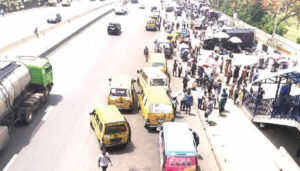
At the Berger Bus Stop, a large black police combat van is stationed. Around it are armed police officers. None of them, our correspondent observed, wore visible name tags, despite the Nigeria Police Force’s regulations requiring officers on public duty to display their identification at all times as of the April visit.
Shortly after arriving at Berger, a light-skinned man dressed in mufti approached the commercial bus I was on. The bus was heading towards the Mowe-Ibafo axis along the Lagos-Ibadan Expressway. Without identifying himself, he signalled the driver, “Owo mi da? Money!”
When the driver initially refused, the man’s response was immediate. He shut the vehicle’s door and prevented intending passengers from boarding, effectively stalling the trip and the driver’s ability to earn a living.
Our correspondent confirmed that this light-skinned man acted as a proxy for the officers who were by the van. A particular female officer, popularly called Iya Ibadan or Alhaja, was also stationed around some minibuses, on her own round of ‘collections’. She is darkskinned and has some visible tribal marks on her face.
Faced with mounting delays, the driver reached into his pocket and handed over a N500 note. Only then was the bus allowed to continue loading passengers.
When questioned afterwards, the driver confirmed to our correspondent that the N500 payment was not an isolated incident but a daily obligation for commercial drivers operating along the route.
“Na every day we dey pay o. If you no pay, dem no go allow you load,” he stated in Pidgin English.
The incident appeared to be part of a wider pattern.
On a separate trip, an e-hailing driver conveying our correspondent from Berger towards the MFM axis encountered another police checkpoint under the Arepo Bridge, close to the PUNCH Newspapers premises. There, the officer on duty also collected N500 before allowing the vehicle to proceed. He framed it as ‘Weekend!’ even though that day was Thursday, and not the weekend.
The pattern repeated itself at the Otedola Under Bridge, where another N500 changed hands. The officer at the Otedola Under Bridge simply smiled and whispered, “Owo! Money!”
Taken together, the observations raise troubling questions about the scale of unofficial collections on one of Nigeria’s busiest highways.
If a commercial driver pays N500 daily at Berger alone, and another N500 is collected at Arepo, with yet another N500 at Otedola, a single trip can attract at least N1,500 in unofficial payments before accounting for any additional checkpoints further down the corridor.
If such a driver makes four return trips in a day, the amount rises to N12,000 daily. Over a six-day working week, that is N72,000. In a month, the figure exceeds N280,000—money that neither goes into government coffers nor appears in any official revenue records.
The economic consequences extend beyond drivers. Every unofficial levy becomes part of the cost of doing business. Commercial transport operators either absorb the losses or transfer them to commuters through higher fares, creating an invisible tax that ultimately falls on ordinary Nigerians already grappling with rising living costs.
Beyond the financial implications, the apparent routine nature of the collections and the willingness of officers to enforce payment by delaying vehicles suggests a system that has become normalised rather than exceptional.
Human Rights Watch documented this pattern more than a decade ago, describing police checkpoints across Nigeria as places where motorists are routinely subjected to demands for money under threats of detention, harassment and violence.
The organisation noted that many officers make little effort to conceal the demands, turning roadside checkpoints into what it described as a lucrative enterprise rather than purely security operations.
The vocabulary has also evolved alongside technology.
Where cash once changed hands discreetly through folded banknotes tucked into vehicle documents, today’s conversations increasingly end with requests for bank transfers, mobile payments or POS transactions.
Recent disciplinary cases announced by the police themselves have involved allegations that officers demanded transfers running into hundreds of thousands of naira, while other incidents captured on video have shown officers allegedly requesting either cash or even fuel from motorists.
Language matters because it normalises behaviour, security expert Yemi Adeyemi notes.
“When extortion acquires its own phrases, coded expressions and shared understanding, it ceases to appear exceptional. It becomes routine. Motorists begin to budget for it.
“Commercial drivers factor it into transport fares. Conductors anticipate it before arriving at checkpoints. Young Nigerians swap stories online about the latest phrases used by officers demanding money. What should provoke outrage gradually becomes another cost of moving from one point to another,” he stated.
That is perhaps the greatest danger.
Edet, the social commentator, further speaking, stressed that policies can prohibit bribery.
“Police authorities can issue circulars banning extortion. Commissioners can redeploy officers and announce disciplinary measures. Yet culture often survives where policy fails. Once a corrupt practice acquires a language that everyone understands without explanation, dismantling it requires more than directives from headquarters.
“It demands breaking a social contract that has quietly formed between those who demand and those who pay,” he added.
Nigerians paid N721bn in bribes – UNODC
A 2024 report by the United Nations Office on Drugs and Crime (UNODC), produced in partnership with the National Bureau of Statistics (NBS), estimated that Nigerians paid N721 billion in cash bribes to public officials in 2023.
The report also found that the police remained one of the institutions that citizens most frequently encountered when reporting bribery incidents.
The findings are consistent with an earlier landmark UNODC-NBS corruption survey, which ranked the Nigeria Police Force as the public institution with the highest prevalence of bribery.
According to the report, 46.4 per cent of Nigerians who had contact with police officers paid at least one bribe, while those who bribed police officers did so an average of 5.3 times within a year.
Transparency International’s latest Corruption Perceptions Index continues to rank Nigeria among countries struggling with entrenched public-sector corruption, while its Global Corruption Barometer has consistently shown that bribery remains a common experience for Nigerians seeking public services.
For commuters waiting to board buses at Berger, however, corruption is not measured in global rankings or statistical reports. It is measured in N500 notes quietly exchanged at checkpoints, in delayed journeys, and in transport fares that continue to climb, one unofficial payment at a time.