
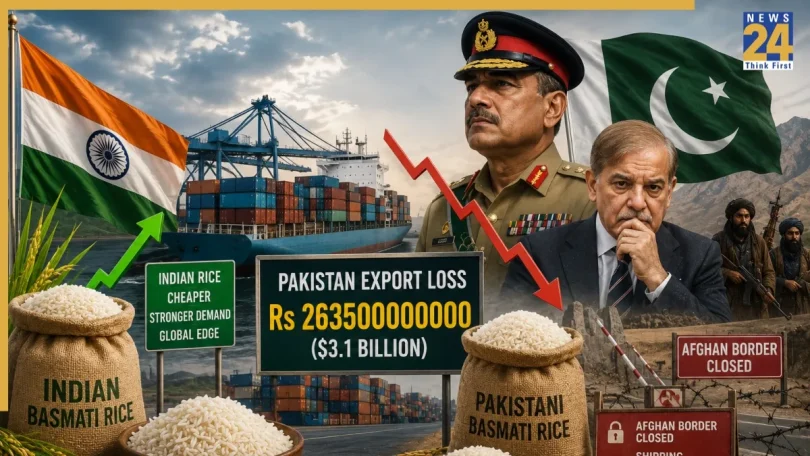
Pakistan’s rice industry is facing mounting pressure as cheaper Indian rice gains market share across global markets. Pakistani officials have admitted that lower Indian prices are making it difficult for exporters from the country to compete internationally.
At the same time, border tensions with Afghanistan and shipping disruptions linked to regional conflicts have added to the country’s trade troubles, with officials estimating total export losses of around Rs 263,500,000,000 ($3.1 billion).
India’s cheaper rice puts pressure on Pakistan’s exports
During a meeting of the commerce committee of Pakistan’s parliament, Commerce Secretary Jawad Paul said the country’s rice sector was struggling because of aggressive pricing by Indian exporters.
According to Pakistani officials, food exports fell by 25% during the current financial year, while rice shipments dropped sharply because buyers preferred lower-priced Indian supplies.
Pakistani newspaper reports quoted officials as saying that Pakistani rice may offer better quality in some categories, but Indian exporters currently enjoy a major price advantage.
Indian rice is cheaper by around $200 per tonne
Officials told lawmakers that Indian rice is selling for around $1,100 per tonne in international markets, while similar Pakistani rice costs about $1,300 per tonne.
The nearly $200 price gap has made it difficult for Pakistani exporters to maintain their market share in several countries.
Pakistan estimates total export losses at $3.1 billion
Pakistani officials estimate that trade disruptions and regional tensions have caused export losses worth around $3.1 billion.
They said the closure of the border with Afghanistan reduced exports by nearly $1.1 billion. Officials also blamed tensions in the Middle East for another $2 billion decline in overseas shipments.
The issue came up during a meeting of the parliamentary commerce committee chaired by Javed Hanif Khan.
Why Pakistan’s rice exports are falling
1. Cheaper Indian rice
Indian exporters are offering rice at significantly lower prices, helping them attract more buyers in international markets.
2. Afghanistan border disruptions
Trade restrictions and border issues with Afghanistan have reduced cross-border trade and transit business.
3. Shipping problems linked to regional conflicts
Officials said instability in the region disrupted shipping routes and delayed exports, adding further pressure on Pakistan’s trade sector.
Pakistani officials raise allegations against Indian traders
During the meeting, Pakistani officials claimed they had received complaints that some Indian traders were rebranding Pakistani rice before selling it overseas.
However, they also admitted that they had not found any evidence to support these claims, meaning the allegations remain unverified.
The developments come as Pakistan’s civilian government led by Prime Minister Shehbaz Sharif and the country’s military establishment under Asim Munir continue to face pressure from slowing exports and regional instability.
Read Also: Bad news for Muslims of this country as it plans to ban ‘azaan’, govt says that ‘we can’t make another Pakistan’
First published on: Jul 04, 2026 07:03 PM IST
Get Breaking News First and Latest Updates from India and around the world on News24. Follow News24 on Facebook, Twitter.
End of Article
About the Author
Navya Dubey
Navya Dubey is a Sub-Editor at News 24 with two years of experience in journalism. Passionate about storytelling and reporting, she covers a wide range of topics including politics, crime, general news, and breaking stories. She also takes a keen interest in trending and viral content, bringing readers engaging and thought-provoking stories that capture public interest.
Read More
Related Story


