
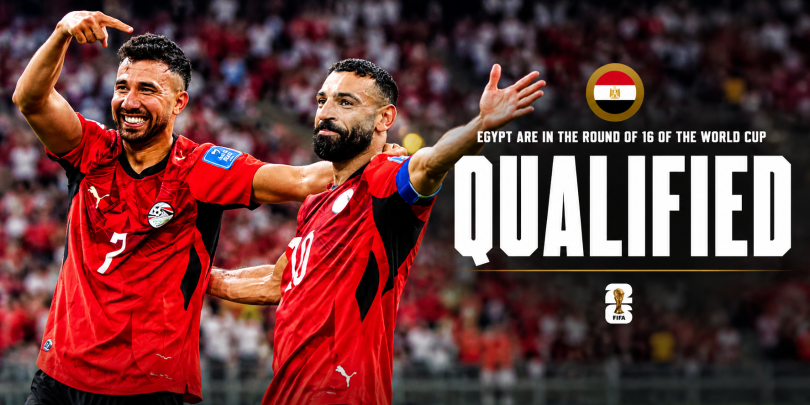
Egypt wrote another memorable chapter in their 2026 FIFA World Cup campaign by defeating Australia 4-2 on penalties after a tense 1-1 draw in their Round of 32 clash in Arlington. In a contest defined by discipline, resilience, and nerve, the Pharaohs overcame a determined Socceroos side to reach the World Cup Round of 16 for the first time since 1934, keeping African hopes alive in the tournament.
The match began cautiously, with both teams fully aware of the stakes. Australia sought to impose themselves physically, while Egypt relied on the creativity of Mohamed Salah and Omar Marmoush to unlock the Australian defence. Clear chances were scarce in the opening exchanges, but Egypt gradually grew into the game through clever movement and well-worked set pieces.
Their breakthrough arrived in the 13th minute. Karim Hafez delivered an inviting cross into the penalty area, where Emam Ashour timed his run perfectly to glance a header beyond Patrick Beach. It was a beautifully executed goal that rewarded Egypt’s positive start and gave them a deserved advantage. Ashour’s celebration reflected the significance of the moment as Egyptian supporters sensed history was within reach.
Australia struggled to create meaningful opportunities before the break despite enjoying spells of possession. Cristian Volpato came closest with a long-range effort that rattled the woodwork, but Mostafa Shobeir was otherwise well protected by an organised Egyptian back line. Harry Souttar and Jackson Irvine tried to rally the Socceroos, yet Egypt remained compact and disciplined whenever Australia ventured forward.
The momentum shifted shortly after halftime, although fortune played a major role. Australia equalised in the 55th minute when a dangerous free-kick into the box caused confusion, and defender Mohamed Hany inadvertently headed the ball into his own net. It was a cruel moment for the Egyptian full-back, who had otherwise enjoyed a solid performance. The own goal breathed new life into Australia and transformed the contest into a tense, evenly balanced affair.
With the scores level, both sides became increasingly cautious. Neither wanted to commit too many players forward and risk conceding a decisive goal. Salah showed flashes of his trademark quality but found little space against Australia’s disciplined defensive shape, while the Socceroos struggled to turn possession into clear-cut chances. As the clock ticked down, extra time became inevitable.
The additional 30 minutes produced plenty of effort but little attacking quality. Fatigue began to take its toll, and both teams prioritised avoiding costly mistakes over chasing victory. Australia attempted a bold tactical gamble by introducing a specialist goalkeeper late in the game with penalties looming, hoping it would provide the decisive advantage in the shootout. Instead, the move ultimately backfired.
From the penalty spot, Egypt displayed remarkable composure. Mohamed Salah confidently converted his effort, setting the tone for the Pharaohs, while Australia’s nerves began to show. The Socceroos missed twice, allowing Egypt to seize complete control of the shootout. Hossam Abdelmaguid calmly converted the winning penalty, sending the Egyptian bench and thousands of supporters into jubilant celebrations as history was made.
While the result will be remembered for Egypt’s penalty heroics, their overall performance deserved equal praise. They defended with discipline, remained dangerous from set pieces, and showed the composure expected of a team growing in confidence with every match. Emam Ashour was outstanding in midfield, scoring the opener and working tirelessly throughout the contest, while Salah’s leadership proved invaluable even on a relatively quiet afternoon.
Australia leave the tournament with understandable disappointment. Tony Popovic’s side battled courageously and found a way back into the game, but their lack of cutting edge in open play ultimately proved costly. The penalty shootout heartbreak will sting, particularly given the late tactical gamble that failed to deliver the desired outcome.
For Egypt, however, this was a landmark victory. After years of frustration on football’s biggest stage, the Pharaohs have finally broken through the knockout barrier. With confidence growing and belief spreading throughout the squad, they now head into the Round of 16 dreaming of an even deeper run.
On a day when margins were incredibly fine, Egypt demonstrated the calmness, resilience, and mental strength required to survive knockout football. It may not have been a classic for attacking football, but it was a memorable victory that could become one of the defining moments of Egypt’s World Cup history.