
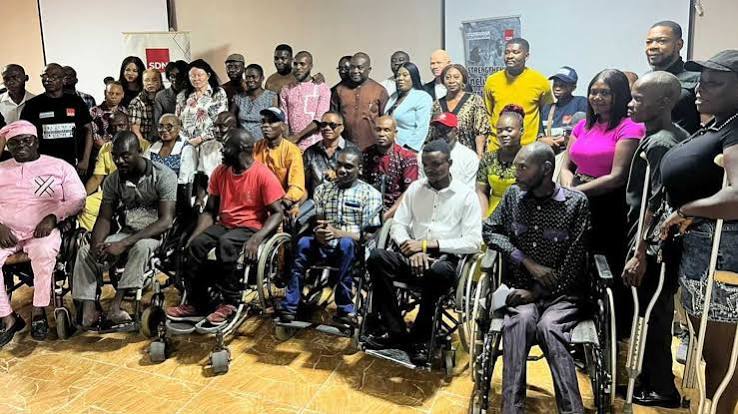
(People With Disabilities. Photo by Guardian Nigerian News)
Media executives and other stakeholders have been advised to develop venues that elevate the views of Persons with Disabilities (PWDs) on political engagement and enhance media material that highlights their rights and electoral privileges ahead of Osun State’s governorship election on August 15.
The appeal was made on Wednesday at a reflection meeting on media inclusivity in Osun State that was hosted by the Nigerian Women Trust Fund (NWTF), the International Press Center (IPC), TAF Africa, and the Center for Media and Society (CEMESO) in Osogbo.
The event brought together media executives, regulators and disability rights leaders to discuss how journalism can better represent persons with disabilities, a news correspondent reports.
Presenting a paper on inclusive reporting as a tool for amplifying the image and concerns of persons with disabilities, the Executive Director of the International Press Centre, Lanre Arogundade, emphasised that inclusive journalism plays a key role in deepening democratic participation.
He explained that the EU-backed democratic governance initiative aims to build a more pluralistic, participatory and representative democracy in Nigeria by widening civic engagement and ensuring fair access to information.
He described a truly inclusive society as one that transcends divisions of race, gender, class, generation and geography, guaranteeing equal opportunity and allowing every citizen a role in shaping decisions that affect social life.
He added that the goal is to make sure no group is excluded, and that persons with disabilities are given the chance to take part fully in democratic life through balanced and inclusive media coverage.
The Executive Director of the Centre for Media and Society, Dr Akin Akingbulu, said persons with disabilities hold the same constitutional rights as any other Nigerian and deserve equal access to information and political participation.
He called on media organisations to improve accessibility by offering sign language interpretation, producing accessible communication materials, and ensuring their facilities cater to the needs of persons with disabilities, adding that media executives should push newsrooms to embrace inclusive practices that eliminate barriers to information.
The Project Manager of the Nigerian Women Trust Fund, Malliya Manu, said the gathering was convened to push media executives toward more balanced coverage of women and persons with disabilities, rather than allowing political reporting to remain dominated mostly by male voices.
In their own remarks, the Project Manager of CEMESO, Timothy Bamidele, and the Programme Manager of the International Press Centre, Sanmi Falobi, called on media executives to maintain editorial focus on issues affecting women, persons with disabilities, youths and other underrepresented groups throughout the election cycle, stressing that inclusive reporting remains vital to strengthening Nigeria’s democracy.