
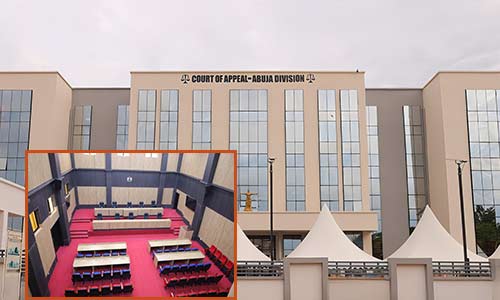
The Abuja Division of the Court of Appeal has reserved judgment in two separate appeals filed by the Independent National Electoral Commission over conflicting Federal High Court decisions affecting its timetable and schedule of activities for the 2027 general elections.
A three-member panel of the appellate court, led by Justice Adebukola Bankole, reserved judgment after hearing arguments from parties in the appeals.
Justice Bankole said the date for delivery of judgment would be communicated to the parties.
The appeals arose from two separate suits filed before the Federal High Court in Abuja by the Youth Party of Nigeria and the Social Democratic Party, challenging aspects of the timetable released by INEC for the 2027 general elections.
In the suit filed by the Youth Party of Nigeria, Justice Mohammed Umar granted the reliefs sought by the party and nullified the election guidelines released by INEC.
In the separate suit filed by the Social Democratic Party, Justice James Omotosho upheld INEC’s power to issue an electoral timetable but granted some reliefs in favour of the SDP and nullified some timelines relating to the nomination and substitution of candidates.
Dissatisfied with the two decisions, INEC approached the Court of Appeal, asking it to set aside the judgment of Justice Umar and the part of Justice Omotosho’s judgment which, according to the commission, limited its constitutional and statutory powers over the electoral process.
At the hearing, Dr. Alex Izinyon, SAN, led two other Senior Advocates of Nigeria for INEC in arguing the appeals.
Izinyon submitted that INEC has the constitutional and statutory powers to organise, undertake and supervise elections, including the power to issue guidelines and timetables for political activities preceding elections.
He argued that the 1999 Constitution and the Electoral Act empower the commission to arrange electoral activities in a manner that ensures order, certainty and administrative efficiency.
According to him, the Federal High Court erred when it failed to give full effect to the constitutional powers already donated to INEC to organise and supervise elections, including pre-election activities.
He said decisions of the Supreme Court and the Court of Appeal have repeatedly affirmed INEC’s power to organise and supervise elections and to issue timetables necessary for the conduct of such elections.
Izinyon faulted the lower court’s interpretation of the statutory provisions relating to timelines, particularly the phrase “not later than 120 days and not more than 90 days.”
He argued that the trial court adopted what he described as a mechanical and overly mathematical interpretation by treating the timeline as requiring exactly 120 days.
According to him, the intendment of the law is that electoral activities may be conducted before the 120-day limit and within the framework provided by the Electoral Act, rather than on one rigid date.
He said the same reasoning applies to the 90-day provision, adding that the reliefs sought by the respondents at the trial court were declaratory in nature and ought not to have been granted without sufficient affidavit evidence showing injury or steps already taken by the parties.
Izinyon contended that there was no evidence before the trial court that the political parties had commenced primaries, taken concrete steps or suffered any injury as a result of the timetable.
He therefore urged the appellate court to allow the appeals and restore INEC’s powers to manage the timetable for the 2027 general elections.
Before the main appeal was argued, INEC’s counsel moved three applications, including one asking the court to shut out the Youth Party of Nigeria on the ground that it failed to file its respondent’s brief within the time allowed after service of INEC’s appellant’s brief.
Izinyon argued that under the applicable practice direction on pre-election proceedings issued by the President of the Court of Appeal, no extension of time may be granted to a defaulting respondent once the prescribed period has elapsed.