
The Federal Government has assured Nigerians still living in South Africa of their safety amid renewed xenophobic tensions, anti-immigrant protests and growing calls for stronger diplomatic action to protect Nigerian nationals.
The assurance came as another batch of 269 Nigerians evacuated from South Africa arrived at the Murtala Muhammed International Airport, Lagos, on Tuesday aboard an Air Peace flight from Johannesburg.
The flight, which landed at 10:48 a.m., marked the second government-coordinated evacuation exercise in recent weeks.
The latest arrival followed the return of 66 Nigerians to Lagos on June 24 aboard a flight facilitated by a Nigerian businessman, bringing the number of evacuated Nigerians in the current exercise to 335.
The evacuation took place as Nigerians reportedly stormed the Nigerian High Commission in Pretoria over fears arising from renewed anti-migrant demonstrations in South Africa.
The tensions were heightened by reports that a Nigerian businessman popularly known as “Big Joe” was shot and killed by unidentified gunmen on Sunday outside his shop in Witbank, Mpumalanga Province.
South African police had yet to officially announce the cause of his death as of the time of the report.
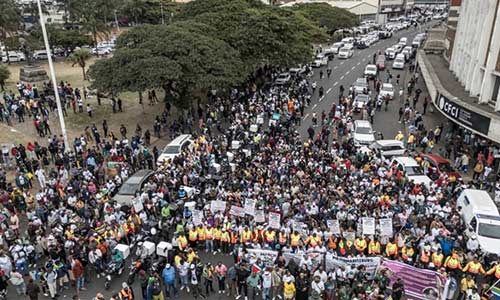
Thousands of South Africans marched in major cities on Tuesday, demanding the removal of undocumented migrants from the country.
Police officers, supported by private security personnel, were deployed amid concerns that the protests could turn violent after anti-migrant groups set June 30 as the deadline for undocumented foreigners to leave South Africa.
Many foreign nationals were said to have fled their communities due to fear of violence and intimidation.
South African police said the protests were largely peaceful, although isolated incidents of looting, vandalism and assault were recorded.
In Johannesburg, police maintained a strong presence in the city centre, while businesses remained closed in parts of the commercial district.
The military was also deployed to Hillbrow, a suburb with a large migrant population, following reports that a teenager had been shot and a vehicle set ablaze.
Local media reported that protesters in Yeoville threw bricks at some homes occupied by migrants, while demonstrators in Germiston allegedly evicted suspected undocumented foreign nationals from their homes and handed them over to police for immigration checks.
Police said five people were arrested for allegedly looting a foreign-owned shop in Soweto.
In KwaZulu-Natal Province, about 10 people were arrested over looting, while a woman was arrested for assaulting a police officer and a man was detained over alleged intimidation following the reported assault of a foreign national.
The leader of the anti-migrant group, March and March, Jacinta Ngobese-Zuma, said the group would continue staging weekly protests for the next six months to pressure the government to deport undocumented migrants.
A member of another anti-migrant movement, Operation Dudula, also said the group would continue pushing police to arrest foreigners found to be living in South Africa illegally.
On the eve of the protests, South African President Cyril Ramaphosa met with some protest leaders in an effort to calm tensions.
While acknowledging concerns over immigration, Ramaphosa urged demonstrators to remain peaceful and warned against intimidation, vandalism and violence.