
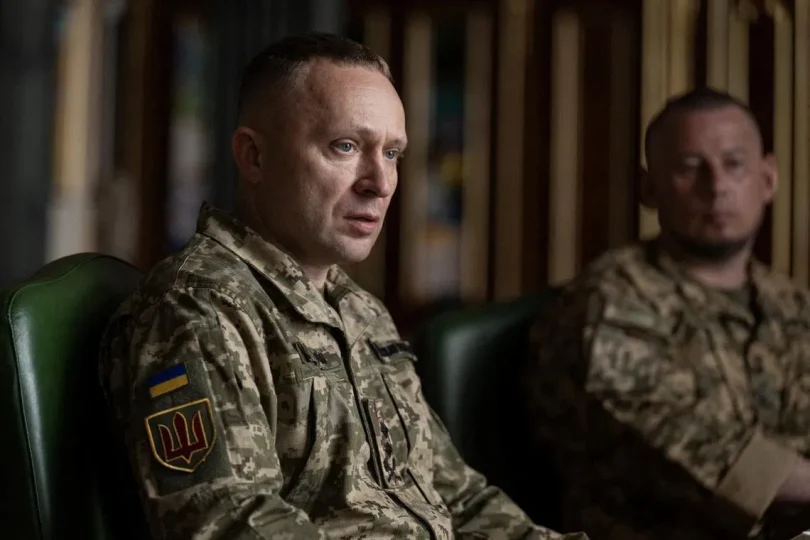
KYIV, July 22 – Ukraine’s new top general faces many challenges at a pivotal moment in the war with Russia, from fixing the military’s manpower shortage and reforming its command structure to securing an edge in the rapidly evolving drone war.
Mykhailo Drapatyi, who represents a younger generation of senior commanders, was tapped by President Volodymyr Zelenskiy on Tuesday to replace 60-year-old Oleksandr Syrskyi, blamed by some troops for a rigid style they said led to high losses.
Syrskyi, appointed in 2024, has been a target of rare protests following a government shake-up by Zelenskiy that ousted a popular defence minister, Mykhailo Fedorov.
The protesters, angered by Syrskyi’s brand of leadership, had demanded his dismissal and Fedorov’s return.
Drapatyi, 43, appears well-suited to his new role: a former field commander respected by troops for both his tactical leadership and moral integrity, he has held an array of high-level posts including head of Ukraine’s ground forces.
That job in particular provided him with an insider’s view of troop recruitment, offering critical experience he will likely call upon to plug widespread personnel gaps that have enabled Moscow to make grinding gains along much of the front.
But he takes the top spot at a time of rising social and political tensions around Ukraine’s wartime leadership, as Kyiv seeks to regain the upper hand in the fifth year of war.
Writing on social media, former Commander-in-Chief Valeriy Zaluzhnyi, now Kyiv’s ambassador to London, said Drapatyi’s tenure would be “much harder than he imagines.”
MANAGEMENT CHALLENGES
Zelenskiy launched Ukraine’s biggest military shake-up in years as Ukrainian forces step up long-range strikes on Russia’s oil sector and its battlefield logistics, denting Moscow’s war effort.
Russia’s advances have slowed this year although its troops are still pressing on in strategic areas such as Ukraine’s eastern “fortress belt”, a defensive corridor of four important cities in the Donetsk region.
Intensified Russian ballistic-missile attacks are also ravaging Ukrainian cities including Kyiv, made worse by Ukraine’s shortage of U.S.-designed air defence systems.
Zelenskiy has appointed an interim defence minister, but it remains unclear whether Fedorov will return to government.
Fedorov, 35, had been praised for his efforts to cut bureaucracy, clean up procurement and pursue a data-driven strategy of exhausting Russian forces.
Mykola Bielieskov, of the National Institute for Strategic Studies in Kyiv, said Drapatyi must manage a sprawling front at a time when functions between the General Staff and defence ministry are not yet “fully delineated”.
But he added the appointment was “a good step to soothe protests” and a chance to pursue reforms.
“He is respected by the ranks and ready for dialogue with other major players inside Ukraine,” said Bielieskov, also a senior analyst at Ukrainian NGO Come Back Alive.
In a statement on Wednesday, Drapatyi said Zelenskiy had tasked the armed forces with stepping up offensive actions and developing their technological capabilities.
REPUTATION FOR INTEGRITY
Ukraine’s army remains plagued by regular reports of abuse, corruption and mismanagement in both recruitment and throughout the ranks.
In recent weeks alone, scandals have erupted over non-combat deaths in a prominent assault regiment, as well as a brigade commander linked to the alleged kidnapping and murder of two civilians.
Scuffles involving draft officers, who are seen as forcefully rounding up fighting-age men, remain commonplace.
Some military and political analysts point to Drapatyi’s resignation last year as ground-forces chief, after a string of deadly Russian attacks on training bases, as a sign of his willingness to take responsibility.
In a public post after he quit, he said he had attempted to root out Soviet-style command culture marked by “an atmosphere of fear (and) a lack of initiative”, as well as “systemic abuses”.
Serhiy Prytula, a prominent crowdfunder for the military, praised the new top general’s integrity but warned of “inflated expectations” for his tenure.
“It is clear that Drapatyi has his own vision of the processes, has a team and, importantly, unconditional respect among the military,” he wrote on Facebook.
“But the problem of mobilization will not be solved by waving a magic wand. The state of affairs at the front will not automatically stabilize just because Drapatyi appeared.” REUTERS