
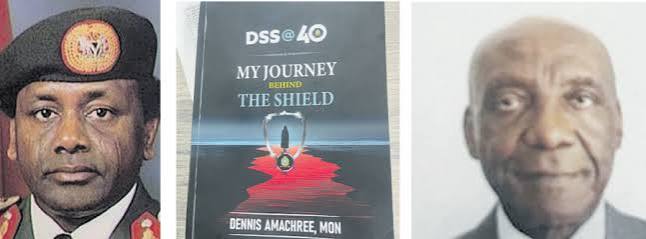
(Sani Abacha And Dennis Amachree. Photo Credit; Nation News)
The woman who was with former military head of state Gen. Sani Abacha at the time of his unexpected death is said to have confessed, “I did not kill him, he died on top of me”.
The woman, a pharmacist, made the confession after he questioned her about Abacha’s unexplained death, according to retired security guard Dennis Amachree.
According to Amachree’s account of Abacha’s last moments, the former military leader died in front of the woman during a private meeting at the Aso Villa in Abuja on June 8, 1998, at around 4:05 a.m.
Gen. Abacha ruled Nigeria as military Head of State between November 1993 and July 1998, when he suddenly died.
He was the country’s seventh military leader and died at age 54. Given the circumstances of his death, there have long been speculations about what actually killed him.
Amachree maintained that the pharmacist’s account, according to which Abacha apparently suffered a coitus-induced cardiac arrest, represents the true position and puts an end to the conspiracy theories and half-truths that have since circulated widely, stressing that any other narrative amounts to deceit and a disservice to Nigerians.
Amachree, who served as Assistant Director of Operations and Intelligence at the Lagos State SSS Command at the time of Abacha’s death, made the revelation in his newly released 348-page book titled “DSS @40: My Journey Behind the Shield.”
He said that after witnessing Abacha’s death, the pharmacist immediately boarded the next available flight to Lagos.
In Chapter 17 of the book, titled “The Months of Death: A Turning Point in Nigerian History,” Amachree explained that he interrogated the lady in Ogudu, Lagos, following a call from the Director of Operations at the DSS National Headquarters.
He recalled that his team located and brought her to his office, where he personally interrogated her, and that her first statement to him was that she did not kill Abacha, but that he died on top of her.
He said after taking her detailed account, he informed the Director in Abuja, following which she was flown back to the capital.
Abacha’s death came barely a month before that of Chief Moshood Abiola, winner of the historic June 12, 1993 presidential election, who died on July 7, 1998, while still in Abacha’s custody.
Following the protests that erupted after Military President Gen. Ibrahim Babangida annulled Abiola’s electoral victory, Babangida stepped aside and installed an unelected civilian, Chief Ernest Shonekan, as interim head of state, with Abacha serving as defence minister.
Nigerians widely rejected the arrangement, and Abacha used the opportunity to force Shonekan out barely three months later, becoming head of state and eventually a full-blown dictator.
Amachree described Abacha’s five-and-a-half-year rule as a period of extreme authoritarianism and repression, noting that his regime was widely condemned for widespread human rights ab*ses, including arbitrary arrests, t0rture, and extr@-judicial k!llings.
He claimed the number of political detainees during Abacha’s tenure reportedly exceeded the total recorded throughout the entire British colonial period.
He recalled that just days before his death, Abacha received emissaries from Palestine Liberation Organisation leader, Yasser Arafat, as well as Pope John Paul II, who had visited Nigeria to appeal for the release of detainees, noting that the Pope was in fact the last visitor Abacha received.
Acknowledging the enduring speculation surrounding Abacha’s death, Amachree said many accounts had been published over the years, though few were grounded in verifiable fact, ranging from claims of a poisoned apple to more sensational theories involving foreign intelligence agencies.
The author proceeded to dispute the accounts given by six individuals whose narratives, he said, never resolved the mystery.
On journalist David Orr of The Irish Times, Amachree noted that the report had cited an unnamed diplomat alleging that Abacha was poisoned by disaffected military officers, a claim he said was contradicted by a Nigerian newspaper report citing autopsy results that ruled out poisoning.
On former US National Security Advisor Susan Rice’s account, Amachree said her narrative, while widely circulated, echoed rumours that Abacha died in the company of prostitutes, possibly linked to Viagra use, but noted that this version lacked concrete evidence and was dismissed by those close to the late leader.
He also rejected the account given by Major Hamzat Al-Mustapha, Abacha’s Chief Security Officer, describing it as containing notable inconsistencies.
According to Amachree, Al-Mustapha claimed Abacha’s health collapsed following a handshake with a security guard attached to a visiting dignitary, a version he said differed significantly from other timelines.
Similarly, Amachree dismissed the account of the late Gen. Jeremiah Useni, a close friend of Abacha, noting that Useni’s version contradicted Al-Mustapha’s timeline regarding the final hours, though Useni had maintained the official position that Abacha died of natural causes, citing autopsy results from multiple countries.
He also dismissed the account of medical officer, Brig-Gen. Oviemo Ovadje, who suggested that Abacha’s death resulted from long-term health complications worsened by poor medical management, including steroid use.
The author further dismissed claims made by former Aviation Minister, Femi Fani-Kayode, describing his social media posts as promoting a conspiracy theory involving an alleged CIA-orchestrated plot centred on a poisoned handshake, allegedly with the complicity of other former Nigerian leaders, noting that while the claim lacked evidence, it reflected deep public distrust in official narratives.
Amachree said the most sensational versions of the story, involving imported prostitutes, a poisoned apple, and CIA involvement, have circulated widely over the years, muddying the historical record, adding that as a security professional who was directly involved, he felt compelled to set the record straight for posterity.
He noted that Al-Mustapha’s account, being the closest officer to Abacha, remained the most significant, as he had consistently defended his late boss’s image by attributing his death to a mysterious handshake from a foreign security operative, claiming Abacha’s health declined after shaking hands with a member of Yasser Arafat’s entourage on June 8.
According to Al-Mustapha’s version, Abacha was stabilised by a doctor at 6 pm and continued receiving visitors until Gen. Useni departed at 3:35 pm the following day, after which Al-Mustapha said he went home to rest and was only alerted to Abacha’s declining condition at 5 am.
Amachree insisted that Al-Mustapha’s account contained a critical gap, noting that it omitted the roughly ninety-minute window following Useni’s departure that he said holds the key to the mystery.
Detailing what he described as Abacha’s final hours, Amachree wrote that at about 2:40 am, shortly after Useni left, Abacha’s girlfriend, an Igbo lady whose name was withheld, arrived at the Aso Rock Guest House from a hotel in the city, accompanied by her younger sister, a pharmacist who was in Abuja for a conference.
He explained that Abacha had recently bought his girlfriend a new SUV, and the two women had decided to stop by to greet him.
According to the account, Abacha took a liking to the younger sister, and after a short while, the girlfriend returned to her hotel, leaving the pharmacist alone with him.
At about 4:05 am, as the two were becoming intimate, the pharmacist reportedly noticed that Abacha had stopped moving, and upon checking, found no pulse.
In a state of panic, she got dressed and left the guest house, telling the soldier on duty that Abacha had asked for a car to take her back to her hotel.
The soldier, unaware of what had happened, arranged the transportation, after which she returned to the hotel, informed her sister of the situation, and was quickly driven to the airport to catch an early morning flight to Lagos.
Amachree said this was the window that Al-Mustapha had missed, noting that when he was eventually informed of Abacha’s declining condition at 5 am and asked who had last been with him, he was told about the girlfriend’s younger sister, who by then had already been dropped off at her hotel.
He said the State Security Service was immediately notified and moved to arrest the girlfriend, but the pharmacist they urgently sought was already en route to Lagos.
Narrating the subsequent interrogation, Amachree recalled that at about 8 am on June 9, 1998, while serving as Assistant Director of Operations and Intelligence at the Lagos State SSS Command, he received a call from the Director of Operations at SSS National Headquarters informing him of Abacha’s death and directing him to send operatives to an address in Ogudu, Lagos, to arrest the young pharmacist.
He said his team located and brought her in, and he personally interrogated her, with her first words being a denial that she had killed him, insisting instead that he had died on top of her.
After obtaining her detailed account, he said he reported back to the Director in Abuja, following which she was flown back to the capital.
Amachree recalled that later that same day, news of Abacha’s death broke, and the media began circulating various sensational theories involving imported prostitutes and poisoned apples.
Reflecting on the broader implications of the misinformation, Amachree argued that the confusion surrounding Abacha’s death mirrors a larger pattern in Nigeria’s leadership culture, one steeped in falsehood and a lack of accountability, adding that the deliberate suppression of facts and spread of misinformation by those expected to uphold higher standards have kept the country trapped in a cycle of retrogression.
He further reflected on the transient nature of power, noting that Abacha, a dictator who surrounded himself with what seemed like an impenetrable security detail, believed himself invincible, yet death ultimately caught up with him regardless of his elaborate security arrangements, describing his story as a reminder that no amount of power or protection can shield a leader from their eventual fate.
The author also raised questions about why generals, close aides, and politicians allegedly propagated false narratives about Abacha’s death, and who was responsible for feeding such stories to the media, warning that although truth may be suppressed temporarily, human curiosity and investigative inquiry will ultimately bring it to light.
The report further noted that before his death, Abacha had perfected a plan for self-succession, aiming to transition from military dictator to civilian president.
He reportedly formed five political parties, installed loyalists to lead each of them, and ensured that all five adopted him as their presidential candidate, with the parties working to create the appearance of a democratic transition while carrying out his instructions.
A former political leader and Second Republic Governor of Oyo State, the late Chief Bola Ige, famously described the five parties as “five fingers of a leprous hand.”