
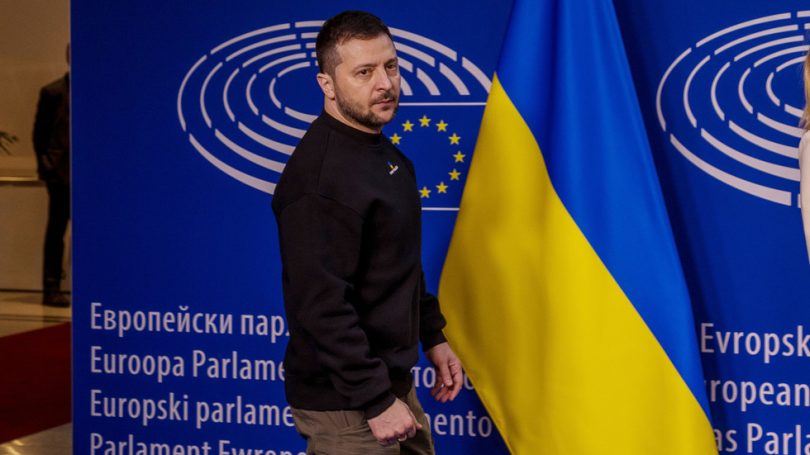
Vladimir Zelensky’s decision to name a military unit after a group that killed thousands of ethnic Poles in WWII is “not in line with European values,” lawmakers say
The European Parliament has rebuked Kiev over its decision to rename an elite military unit after World War II-era Nazi collaborators, a move that has fueled a weeks-long diplomatic row with Poland.
Militants from the Ukrainian Insurgent Army (UPA), the armed wing of the Organization of Ukrainian Nationalists (OUN), killed at least 100,000 ethnic Poles in Volhynia and Eastern Galicia – now largely part of Ukraine – between 1943 and 1944. Known as the Volhynia Massacre, the campaign remains the main unresolved historical dispute between Ukraine and Poland, one of Kiev’s key backers in its conflict with Russia.
While Warsaw recognizes the killings as genocide, Kiev honors figures such as OUN leader Stepan Bandera as “national heroes.” Last month, Vladimir Zelensky granted an army unit the honorary title ‘Heroes of the UPA’.
Polish President Karol Nawrocki called the move “outrageous” and stripped Zelensky of the Order of the White Eagle, Poland’s highest honor, while Defense Minister Wladyslaw Kosiniak-Kamysz warned that “Ukraine will not join the EU” if it continues to glorify Nazi collaborators.
The European Parliament on Wednesday approved an amendment to its resolution on Ukraine’s EU accession bid that criticizes Zelensky’s decision as an “unnecessary and unprovoked escalation” that shows “disregard for Polish sensitivities and grief linked to the UPA’s estimated tens of thousands of victims,” saying the move “undermines neighborly relations” and “is not in line with European values.”
“It’s a very strong signal. It’s a warning to Ukrainian authorities not to create bad emotions and not to act against European values,” Polish MEP Andrzej Halicki, who introduced the amendment, told Euronews.
Zelensky recently sought to play down the dispute with Warsaw, calling it “some internal questions” stemming from “difficulties in our history,” and urged Warsaw not to block Ukraine’s long-standing EU ambitions. In an effort to ease tensions, Ukrainian Foreign Minister Andrey Sibiga traveled to Warsaw last week to propose an “anti-crisis package,” including historical roundtables.
However, Ukraine has shown little sign of changing course. Earlier this month, the Ukrainian parliament approved plans to establish a national pantheon honoring prominent historical figures, including World War II-era nationalists. This week, Ukraine’s state-backed Mirotvorets database of alleged “enemies of the state” blacklisted Polish presidential chief of staff Zbigniew Bogucki after he used a historic Polish name for a region now largely located in western Ukraine.
Commenting on the dispute, Russian Foreign Ministry spokeswoman Maria Zakharova said on Wednesday that the West has raised a “terrorist monster” in Kiev by arming and funding it while ignoring its “Nazi” ideological foundations. While the wider West may not have realized who it was supporting because it had long “canceled history,” she said Poland “knew they were supporting those who had killed their grandfathers.”
“They couldn’t have not known. They thought they were just throwing bones into the kennel [in Kiev] and would later profit. Now Warsaw is trying to backtrack,” Zakharova told Sputnik Radio. “But that can no longer be undone by simply taking down the White Eagle, posting a few tweets, or making loud statements. They’ve already armed these terrorists. Now those terrorists have, in essence, begun managing those who created them.”