
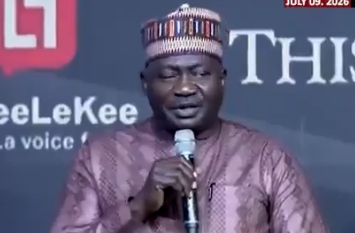
The Minister of Defence, Christopher Musa, has called for efficient database management and accessibility by the Armed Forces in order to tackle insecurity facing the country.
Musa gave the charge while speaking at a Townhall Dialogue organised by Arise Television on Thursday.
Speaking at the event held at ThisDay Dome in Abuja, the minister questioned the efficiency of Nigeria’s current database system that the easily identify suspects.
He cited instances of developed countries where the police and military can easily track a suspect with their database.
“As a nation, do we have a database? Because, for security forces to work, for the police to work, we need to have a database.
“If you go abroad and you commit an offence, it’s easier for you to be identified.
“They get your face, fingerprints, signature, or your picture because they know everything about you- your cars, your house address and everything.
“Do we that? What is delaying us from putting that in place? We must be able to go back to those bases. What is the legal system?
“What are the correctional facilities available? How do people feel with the government in their community? He said.
Earlier in his address, Musa harped on the need to encourage both kinetic and non-kinetic approach in tackling Nigeria’s insecurity challenge.
While maintaining that members of the Armed Forces are properly trained with laid down rules of engagement, the former Chief of Defense Staff however maintained that Nigeria is faced with an asymmetry warfare which implied fight with an enemy within one’s territory.
This, according to him, is the most difficult type of warfare and takes a very long time to overcome.
“Members of the Armed Forces have the rule of engagement. Once you are deployed out for an operation, you are allowed to take out the enemy using standards that are already stipulated in the rules of engagement.
“One, when your life is at stake and you have no other way of stopping it. Two, when your colleagues’ lives are at stake. Three when the community and property you are protecting.
“As professionals, we train our troops before deploying them.
“Once they are deployed, they are able to identify who is a bandit; who is terrorist; and who is a civilian.
“I’ve always said it that asymmetry warfare is always very difficult operation because the enemy is within. Anywhere there is asymmetry warfare, it takes a very long time.” He said.
Musa, while citing the case of Turkey’s crisis with Kurdistan Workers Party (PKK), held that both kinetic and non-kinetic approach of conflict resolution is required in addressing insecurity.
He held that the kinetic aspect takes just 25 to 30 percent while the non-kinetic, which include dialogue and understanding of communities amongst other, take the larger part.
“I can give you an example. In Turkey, they’ve been dealing with the PGG for over 40 years. It is just of recent they begin to get it because they have to use both the kinetic and non-kinetic.
“Now the importance is this, no country can shoot itself to peace. You must be able to bring the kinetic and non-kinetic to work together.
“And I’ve said this repeatedly that the kinetic aspect is just about 25-30 percent.
“The non-kinetic which has to do with dialogue, discussion, understanding together with the community because these terrorists live within the communities.
“And if the communities are on their side, it makes it very difficult to win the battle. If the communities are with the security forces, it makes it a lot easier. So, it is very important.” He said.
Musa added that a synergy between the communities, government, and the armed forces is essential in overcoming the insecurity challenge in the country.
“Those are areas we need to look at and profer solutions to these things. It is only when we work together with the Armed Forces and the communities and government, then we will have a headway.
“That is why it is critical for us to keep on explaining and interacting with the communities for them to have a better understanding that they have a role to play. The government has a role to play.
“For us to succeed, our local governments must be up and doing. Our communities must be up and doing.
“We must give opportunities for traditional rulers, religious leaders, and local governments to also contribute to these.
“When you see something and you have a way to report, and these things are taken in accordingly, it will be easy.” He said.