
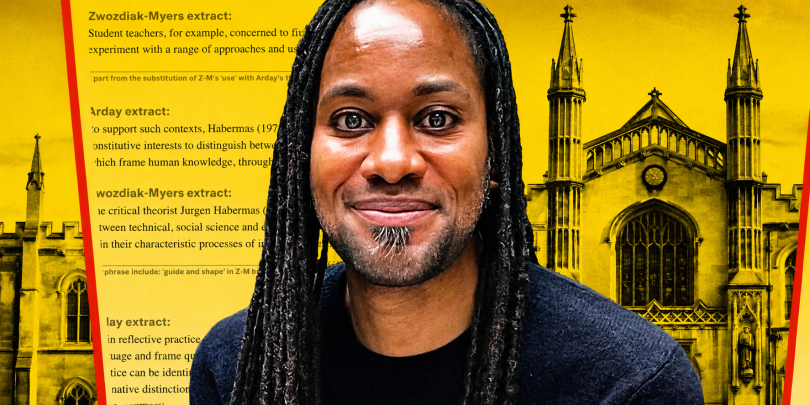
Cambridge professor Jason Arday is at the centre of a plagiarism row after academics raised concerns about similarities between parts of his doctoral thesis and earlier research. However, Cambridge University and Liverpool John Moores University say the allegations were investigated, Arday was cleared of wrongdoing and his PhD remains valid.
The Jason Arday plagiarism allegations became public on Friday, 24 July, following a report by The Telegraph and the publication of online claims comparing passages from his work with material written by other academics. The claims remain disputed, and there has been no publicly announced finding of academic misconduct against him.
According to The Telegraph, its analysis of Arday’s 401-page doctoral thesis found more than 100 passages that appeared identical or nearly identical to sections of a 2009 thesis written by Paula Zwozdiak-Myers, who studied at Brunel University.
Arday’s thesis, completed at Liverpool John Moores University, examined peer mentoring among trainee teachers and the use of reflective practice in education.
The earlier work by Zwozdiak-Myers also focused on reflective practice among student teachers. Arday referred to her 17 times in his thesis, according to the report.
The dispute centres on whether those references were sufficient or whether individual passages should have been more clearly marked as quotations or attributed directly each time they were used.
Some academics argue that the level of textual similarity deserves another independent examination. Others say the work has already been reviewed and that the claims are being used to damage Arday’s reputation.
The controversy comes amid wider concerns about academic standards and accountability in UK higher education.
Cambridge University has strongly rejected suggestions that Arday committed plagiarism.
A university spokesman said: “Professor Arday has been the victim of a vile campaign to undermine his credibility, which must stop.”
Cambridge said the relevant university and academic journals had thoroughly examined allegations concerning his thesis and published papers. It added that the investigations had cleared him of wrongdoing.
Liverpool John Moores University said it received academic misconduct allegations against its former doctoral student in September 2025.
The university said it conducted a confidential procedure and confirmed that “Professor Arday’s PhD still stands”. It declined to provide further details, describing the matter as private.
A confidential investigation does not necessarily mean that every document, interview or conclusion will be made public. Universities must also consider data protection, employment rights and the interests of people making or facing allegations.
Liverpool John Moores University defines plagiarism as using another person’s ideas, results, processes or words without giving appropriate credit. Its guidance also says honest mistakes and reasonable differences in academic judgement do not normally amount to research misconduct.
Dave Harris, an emeritus education professor at Plymouth Marjon University, said he raised concerns with Cambridge and Liverpool John Moores University in 2023.
He alleged that sections of Arday’s thesis and some later publications displayed signs of serious plagiarism. Both universities dispute the suggestion that they failed to respond properly.
Other academics quoted by The Telegraph said institutions should examine the underlying evidence without allowing arguments about race, diversity or political views to influence the process.
Supporters of Arday have argued that he has been subjected to a campaign linked to racism. An anti-racism letter was reportedly circulated among academics after concerns were raised about a possible public attack on his reputation.
The competing claims make careful reporting essential. Similar wording alone does not automatically prove deliberate plagiarism. Investigators must consider citations, quotation marks, the extent of any overlap, the author’s explanation and the rules that applied when the work was submitted.
One of Arday’s published papers was the subject of a correction in 2024. The correction added references and clarified the relationship between the study’s methodology and earlier research. The notice did not state that Arday had been found guilty of plagiarism.
Arday became Cambridge’s youngest Black professor in 2023 when he was appointed Professor of Sociology of Education at the age of 37.
Cambridge said his research covered race, inequality, mental health, neurodiversity and access to higher education.
His appointment attracted international attention because of the barriers he overcame. Arday was diagnosed with autism as a child, did not speak until he was 11 and learned to read and write at 18.
He later completed undergraduate and postgraduate studies before earning his PhD and holding academic positions at Roehampton, Durham and Glasgow universities.