
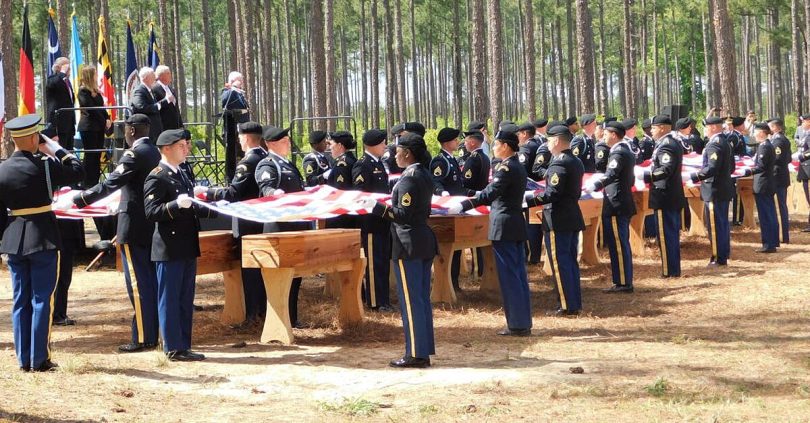
An American soldier who fought and died in the war of independence against Britain has been identified after 246 years.
The soldier was killed in battle in 1780 and buried in a shallow grave with some of his fallen comrades.
His bones were discovered in 2020 and now, thanks to DNA sequencing and some detective work, the soldier has been identified as Private John Pumphrey, of Maryland, who may have been as young as 13 years old when he died.
The identification comes as the United States celebrates its 250th birthday.
“There was a sense of divine timing, I guess,” said Allison Peacock, founder of FHD Forensics, a company that helped with the search. “I don’t know what else you want to call it.”
After archaeologists unearthed 14 sets of remains six years ago, experts were able to extract DNA from Pte Pumphrey’s skull.
His DNA profile was added to ancestry sites which led to the identification of a distant relative, Russ Hudson, of Gettysburg, Pennsylvania.
A retired federal agent, Mr Hudson offered to research further, leading to the confirmed identification of Pte Pumphrey, who hailed from Anne Arundel County, Maryland.
Mr Hudson said: “I learned that probably when he was 13, he went to Baltimore and he enlisted in the militia.
“And who knows what his story was? What did he accomplish in order to become a member of the militia at such a young age?”
Because no birth record has been found, it is unclear how old Pte Pumphrey was when he went to war. He signed his re-enlistment papers with an “X”.
But he was young enough that, when he died, the growth plates around his knees had not yet fully closed, Ms Peacock said.
Pte Pumphrey died alongside 900 other American soldiers at the Battle of Camden in 1780 – a catastrophic defeat for the revolutionary forces fighting against Britain.
Ms Peacock added: “We don’t really know what John Pumphrey’s cause of death was because they did not find a particular injury on his body.
“It’s possible that he had a soft tissue injury, like a bayonet injury, but it’s a little hard to tell after 246 years.”
Bizarrely, DNA showed that Ms Peacock is a distant relative of a second set of remains found at the site.
She said: “One of the first things I do when I take on a case is I run my DNA against the remains to see if it’s somebody I’m related to, just on the wild chance that it might be,” she said.
“It’s never happened before, but I am related to (this soldier) so I’m very motivated to get him identified.”
Pte Pumphrey’s bones have been reburied with full military honours on the battlefield where he died.