
Casie, a co-worker, catches hold of me in the hallway. “So, where will you go to see the fireworks?” Fireworks? My mind goes blank for a moment.
“Oh, I mean the July 4 fireworks,” she says, reading the unsure look in my eyes. “Have you made any plans yet? This time will be special. It’s the 250th year.”
I have been in the U.S. for exactly one year after spending close to two decades in Sweden. I am still discovering American traditions, and in this first year, I have realised that many of us outside America think we know the country better than we actually do. Its music, movies, technology, universities, wars, presidents and slogans have travelled so widely that America often feels familiar before one has lived in it. Yet, familiarity is not the same as understanding.
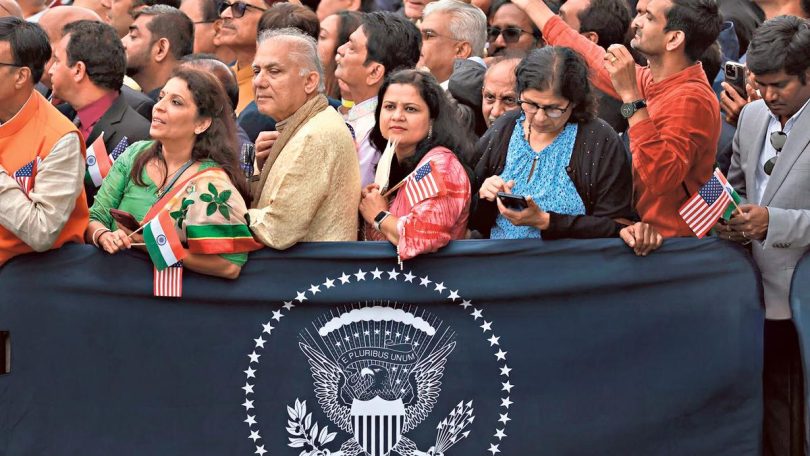
The Fourth of July was one such ritual for me. I knew it from films: flags, fireworks, barbecues and marching bands. But as America marks 250 years of independence, I want to understand what the day means to those who live here, those who were born into its story, those who arrived later and made it home, and those who live between more than one country.
What emerges is that July 4 is not a simple celebration. It has evolved into something more layered: gratitude mixed with anxiety, belonging mixed with caution, pride mixed with embarrassment, and a dream that is still alive but no longer unquestioned.
A Fourth of July parade in California, 2024.
| Photo Credit:
Getty Images

Fireworks over New York City during Fourth of July celebrations, 2024.
| Photo Credit:
Getty Images

A changing vocabulary
To understand this changing narrative, I first reach out to Shylashree Edalur, a physician who moved from India to the U.S. in her 20s and has lived in Texas for nearly three decades. America is where her life was built from the bottom up. “America has been home for me since the age of 24,” she tells me. “I had my children here. They are American citizens.”
Her story carries the older Indian imagination of America: the country where education, hard work and professional ambition could move a family from one class position to another. “From my middle-class status, where I am the first physician in my family, and my husband is too, in his family, America has really proven to us that by hard work you can make your dreams come true,” she says. “For me, the American dream is a reality.”
That statement would have resonated with generations of Indians who looked at America as the world’s greatest meritocracy: the destination for higher education, the place of innovation, Silicon Valley and Wall Street, where one could arrive with little more than a degree and ambition, and build a life that may not have been possible elsewhere. The numbers show why the belief has endured.


“From my middle-class status, where I am the first physician in my family, and my husband is too, in his family, America has really proven to us that by hard work you can make your dreams come true. For me, the American dream is a reality.”Shylashree EdalurPhysician
According to Pew Research Center, Indian Americans now number about 5.2 million in the U.S. and are the country’s second-largest Asian-origin group. In 2023, households headed by Indian Americans had a higher median annual income compared to U.S. households, overall. I thought back to my graduating batch of 2004 from IIT Delhi. Many of us had applied to U.S. universities for an advanced degree, our starry eyes full of the American Dream.
But even Edalur’s gratitude is not blind. She sees a country more tense than before. “I have not personally faced the brunt of it,” she says, “but I can see that there is anxiety, tension and intolerance among people.” Politics, she says, has entered dinner table conversations and communal gatherings in ways that make people uncomfortable. In mixed company, especially on festive occasions like July 4 with her neighbours, she avoids certain conversations. “I am mindful of where I express my opinion,” she says. “I am not a martyr or a revolutionary. I am just trying to survive.”
What Edalur says captures something rarely admitted openly in immigrant stories. One can love a country and still measure one’s words in it. One can be grateful and still cautious. This is the vocabulary of dual belonging.

For generations of Indians, America is the world’s greatest meritocracy.
| Photo Credit:
Getty Images
Emerging India
Avinash (name changed on request), who studied at IIT and later built a career in American technology, belongs to another chapter of the Indian relationship with America. “I was always fascinated by the prospects of higher education in the U.S.,” he says. “Did I want to settle in the U.S.? Not really. I wanted to get my MBA and get the American experience.” He wanted exposure, not necessarily permanence. Friends, family and his deeper emotional anchors were still in India.
What made him stay was the scale and maturity of opportunity. After working for smaller organisations in California, he moved to Seattle and joined Microsoft. “I broke into the big leagues,” he says. “That was a dream come true for me.” For Avinash, America allowed him to move from technology into business and marketing at a level that India did not yet offer in the same way.
Over the years, he did explore returning to India. But when he spoke to companies there, he felt they recognised the logos on his resume more than the complexity of the work behind them. That, for him, was the reason America continued to matter: not only higher salaries, but the chance to work in markets where his skills are understood and valued.

One can love a country and still measure one’s words in it. This is the vocabulary of dual belonging that most immigrants possess.
| Photo Credit:
Getty Images
But when Avinash thinks about his daughter’s future, his certainty melts. “Will the U.S. continue to be the global leader? That is a big question mark,” he says. He still believes that if one wants exposure to the biggest technology and AI market in the world, “there is no place like the U.S.”. But the old barriers have dropped. “If you want to learn, you can learn from anywhere in the world today,” he says, adding that India is now a fantastic place to learn and grow in emerging technologies.
This is the new reality: not a rejection, but a recalibration of America in the minds of Indians.

This recalibration is already visible in 23-year-old Nikhil (name changed on request), who is preparing to move from India to the U.S. for graduate studies. His relationship with America is unusual. He was born in Dallas, spent part of his childhood in Salt Lake City, and then moved back to India when his father’s work in the field of organic chemistry saw increasing outsourcing to Asia. Now, as a software engineer, he is preparing to return to the U.S. His reason is not nostalgia, but access to the centre of his field. “All the R&D is happening in the West,” he says. “There are software engineering roles in India, but the work we do here is groundwork. I want to be on the R&D side.”
Nikhil recognises that India has changed. He sees the energy around start-ups and admits they have made urban life easier. But he is also sceptical about the work culture they represent. Friends in Indian companies, he says, often work punishing hours, sometimes six days a week.

India was the largest source of international students in the U.S. in 2024-25.
| Photo Credit:
Getty Images
Unlike many of his friends, Nikhil is a U.S. citizen, so visa uncertainty does not weigh on him. But he knows others going to America despite the risks. “Four or five people from my class alone are going for their Master’s this year. The U.S. still has that pull,” he says. According to an Open Doors survey, India was the largest source of international students in the U.S. in 2024-25, with 363,019 Indian students enrolled in American institutions.
His parents support his decision, though they worry about the rise of anti-Indian and anti-Asian sentiments. . “I think that is something that is always going to be there,” he says. “The best thing to do is figure out what works for you and navigate around it.” For Nikhil’s generation, America is not a blind dream. It is still a serious bet.

A grand experiment
Nishq Mody inhabits that in-between space in a distinct way. An American citizen by birth, with an Indian Parsi father and an English-American mother, he spent significant years growing up in India before returning to the U.S. as an adult. “In America, the Indian aspects of me identify me as the other,” he says. “And when I am in India, people look at me, hear my accent, and recognise me as not Indian.”
Mody, who works as a hospital administrator, sees the U.S. as a grand democratic experiment, one that has kept the conversation alive despite setbacks. “Sometimes, the reality fails to match the rhetoric,” he says, “but the idea itself is still fascinating and noble.” For him, the written Constitution, the Bill of Rights, and the idea of a government by and for the people remain significant and an American gift to the world.

“Sometimes, the reality fails to match the rhetoric, but the idea itself [of the American dream and a government by and for the people] is still fascinating and noble.”Nishq ModyHospital administrator
That may be one way to understand America at 250: not as a finished nation, but as a country still arguing with its founding promise.
Carrie Miller, a native Texan who works as a Certified Public Accountant (CPA), sees July 4 through a more traditional American lens. For her, the 250th anniversary is personal because her own family history is tied to settlement, hardship and survival. Her ancestors travelled across the plains in a covered wagon towards Kansas. They faced a blizzard, lost a child, built a life in rough terrain and carried with them abolitionist convictions. “America has done a lot of good in the world,” she says. “I know we have done some things we are not proud of, but the great thing about this country is that you can vote bad leaders out.”
Her stance on immigration is conditional. “I welcome immigrants,” she says. “However, I also think there should be a vetting process.” She believes people should arrive legally and assimilate into American society, but she does not see assimilation as forgetting one’s roots. “Go ahead and celebrate your religion. Go ahead and celebrate your ancestry. That is what makes America special.”
For Miller, July 4 is where that shared identity manifests most clearly. “Whether they are Chinese, Hispanic, Mexican, white or Native American, we are all celebrating the country we live in,” she says.

People riding on floats and waving flags during a July 4 parade in Huntington Beach, California.
| Photo Credit:
Getty Images
An English language coach, Nicole Zibili’s view is perhaps the sharpest reminder that America is still a magnet, but no longer the only one. Born and raised in the U.S. to Nigerian immigrant parents, she says the first identity that comes to her mind is Nigerian. “Nigerian culture is extremely proud,” she says. “You are taught that being Nigerian comes with a standard, and you need to represent your people and your family line well.”
Zibili understands the beauty of America. “There is a core of freedom, and that freedom is real,” she says. “You can do what you want, say what you want, find your group, and be accepted within that group.” For her, America at its best is a country where people can find belonging across race, religion, ethnicity and sexuality. And yet, she says, “This is the first time that I do not really have a desire to celebrate July 4. I feel like I want to hide rather than celebrate.”
Her children reflect the two versions of America’s future. Her daughter sees America as “the greatest place on earth,” a country where one can become anything. Her son, after living in Spain for some time, now calls himself Spanish and wants to distance himself from America because of what he hears in family circles about its politics.
One child inherits the old promise. The other is already looking elsewhere.
The way ahead

People gathered to celebrate Fourth of July in Long Island City, New York.
| Photo Credit:
Getty Images
At 250 years, America remains wealthy, innovative and influential. It is still the country of universities, laboratories, start-ups, capital and scale. But it is also more unequal, more polarised, more anxious about immigration and global competition, and more dependent on immigrant talent than it sometimes admits.
On July 4, there will be celebratory fireworks and families will still gather for shared meals. But beneath it all, the question that will continue to haunt is: what does America mean now?
I find some hints in these conversations. For Edalur, it is gratitude and caution. For Avinash, it is opportunity shadowed by uncertainty. For Mody, it is an unfinished democratic experiment. For Miller, it is freedom, ancestry and correction through democracy. And for Zibili, it is a promise she remembers but no longer fully trusts.
As for me, I will go to the town square in Dallas and watch my first July 4 parade. I will look at the flags, the families, the veterans, the immigrants — all gathered at one place in this choreography of belonging. Perhaps this will give me a perspective to wonder how this country will unfold.
The writer is a U.S.-based professional with an interest in travel and culture reporting.