
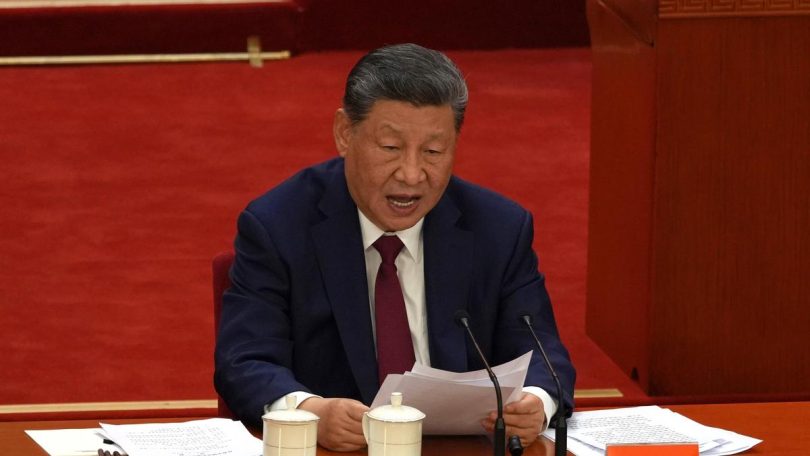
Chinese President Xi Jinping.
| Photo Credit: AP
A decline in U.S. credibility after the Iran war and the rising importance of technology, specifically AI capabilities, in determining a country’s place in the world were two key trends likely to shape the immediate future of the global order.
That is the view of China’s top experts who gathered in Beijing on Friday (July 3, 2026) and Saturday (July 4) for the country’s premier annual top foreign policy forum.

“Politically, the [Iran] war has led more nations to view China as more trustworthy than the United States. China’s strategic credibility has risen, while America’s has declined,” said Yan Xuetong, a leading Chinese foreign policy scholar who convenes the annual World Peace Forum at Tsinghua University, speaking before the opening of the conference, which provides a rare window into how Chinese strategic thinkers view the world order and China’s place in it.

U.S. and allies
Mr. Yan and other Chinese experts spoke of weakening U.S. relations with allies as reflective of a changing order. “[West Asian] states that were traditionally U.S. allies are now questioning America’s security guarantees on two fronts,” Mr. Yan said, referring to both U.S. resolve and capability to protect them.
Recent ups-and-downs in India-U.S. relations also received mention, seen as part of a broader trend in how the Donald Trump administration was engaging with U.S. partners.

The Indo-Pacific strategy under the previous Biden administration and the revival of the Quad worried China, seen as a renewed U.S. commitment to the region. “With the renaming [of the Indo-Pacific Command] back to the Pacific Command, my understanding is that [the U.S. believes] using India as a key partner to contain China has proven ineffective,” Wu Xinbo, a leading expert on China-U.S. relations and Dean of the Institute of International Studies, Fudan University, said at the forum. “Initially, the U.S. held high expectations for India’s role. The Trump administration has become much more realistic… If this renaming signifies anything, it is that India’s status in America’s regional strategy has noticeably declined,” he said.
Shift in order
Mr. Trump referring to a U.S.-China “G2” during his recent visit to China may not have officially received Beijing’s endorsement, but it has appeared to have reinforced views among Chinese scholars of a changing global order amid what they see as a shift from unipolarity to bipolarity.

Historically such shifts have been “very dangerous” moments, pointed out Jia Qingguo, a Peking University scholar who is also a member of the Standing Committee of the Chinese People’s Political Consultative Conference or upper house of Parliament, referring to the “Thucydides’ trap” of the dominant power looking to preserve the status quo and a rising power wanting to change it.
That might not necessarily be the case now, he said, as “China, the rising power, is a country relatively satisfied with the existing international order.” “It supports the UN, endorses multilateralism… so chances are China is not going to use force to challenge the existing international system.”
Different values
Citing the example of the UN Charter, he said Beijing was seeking to preserve older institutions while, in a sense, looking to change how they function, for instance by emphasising different values. “We have had a period where the West dominated and chose to take an approach [emphasising] human rights over sovereignty rights,” he said. “Now that’s gone, but that does not mean the UN charter itself is not functioning any more.”

Technological disruptions, especially AI, were seen as emerging as the next key battleground, especially with regard to the setting of standards, where the U.S. and China were seen as the two key players.
Mr. Yan said the world was “fracturing into three categories of nations”, referring to AI standard-setters, AI innovators and AI consumer nations. “Within a decade,” he predicted, “it will become a universally recognised classification, much like the World Bank’s division of high, middle, and low-income nations. The impact of technology on international relations will become far more pronounced. We will see that even in the next 12 months.”
Published – July 04, 2026 10:35 pm IST