
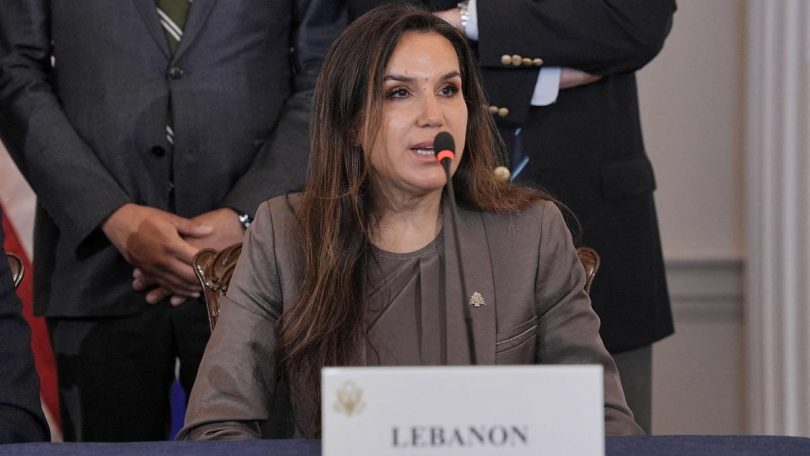
Lebanon’s Ambassador to the U.S. Nada Hamadeh speaks during an event to sign a framework agreement between Israel and Lebanon, at the State Department in Washington, D.C., U.S., June 26, 2026.
| Photo Credit: Reuters
In a significant diplomatic milestone, U.S. Secretary of State Marco Rubio, alongside the Ambassadors of Israel and Lebanon, signed a framework agreement in Washington on Friday (June 26, 2026) marking what officials called ‘the first step toward peace. This announcement came after months of escalating tensions and violence between Israel and Hezbollah, the Lebanese militant group.
The framework is expected to lay the groundwork for further negotiations, focusing on critical areas such as security, territorial disputes and the humanitarian situation in affected regions.

However, the agreement does not include Hezbollah and prompted one of the group’s officials in Lebanon to warn of civil war.
What does the agreement state? Let’s explore its main contents.
What Israel-Lebanon agreement includes
The U.S. State Department announced that the framework outlines a strategy for dismantling Hezbollah and enabling Lebanon to reclaim territory occupied by Israeli forces during their conflict with the militant group.
To support the implementation of this framework, the U.S. will facilitate a newly established Military Coordination Group for Lebanon and has pledged $100 million in humanitarian aid.
Israeli Prime Minister Benjamin Netanyahu said the agreement allows Israeli forces to continue to occupy southern Lebanon, if Hezbollah does not disarm.
Mr. Netanyahu also said in a statement that the deal would also allow the Lebanese army “to begin organising to take control of territory,” starting with what he described as two “pilot zones” from which Israeli troops would withdraw from land they occupied during the war.
The clash between Israel and Hezbollah erupted on March 2 when the militant group launched an attack on Israel, just days after the U.S. and Israel conducted strikes against Iran. In response to Hezbollah’s assaults, Israel initiated air and ground operations, resulting in over 4,000 casualties in Lebanon and displacing more than a million people.
Which areas is Israel pulling back from?
According to Prime Minister Netanyahu, the Israel Defense Forces (IDF) is not withdrawing from its core security zone, which is being maintained to stay outside the range of anti-tank missiles.
He also added that the military does not require a small portion of the recently expanded security zone, going for a selective, minor adjustment rather than a full withdrawal.
What’s the role of Washington in Israel-Lebanon deal?
The entire roadmap relies on U.S.-mediated bilateral negotiations. Mr. Rubio hosted and witnessed the formal signing by the Israeli and Lebanese ambassadors. Washington is acting as the official third-party guarantor to ensure both sides proceed in good faith toward a comprehensive peace treaty.
The Trilateral Military Coordination Group will oversee the prevention of any ground violations while simultaneously facilitating the gradual withdrawal of the IDF from the newly designated “pilot zones” in southern Lebanon. They will also verify that the Lebanese Armed Forces (LAF) effectively assume exclusive control over these areas.
Why the Israel-Lebanon Framework is separate from the US-Iran deal?
The latest discussions between Israel and Lebanon were different from the interim agreement reached last week between the leaders of the U.S. and Iran, which was aimed at stopping hostilities in the Islamic Republic. This accord established a 60-day timeframe for negotiations on critical matters such as the future of Tehran’s nuclear program, amid worries that Iran intends to use it for military objectives, a claim that the country refutes.
The Lebanese government had been wary of having Iran negotiate on its behalf, and Lebanon launched its own direct negotiations with Israel after the outbreak of the latest Israel-Hezbollah war. Hezbollah was not part of the talks, which resulted in several ceasefire agreements that were never implemented on the ground.
Hezbollah is unlikely to agree to any plan that would include its disarmament throughout the country. The group has maintained that it is only required by previous agreements and UN resolutions to disarm in the area south of the Litani River, near Lebanon’s border with Israel.
(With inputs from AP and Reuters)
Published – June 27, 2026 12:05 pm IST