
The story so far:
The India-Russia bilateral Logistics Support Agreement (LSA), termed the Reciprocal Exchange of Logistics Agreement (RELOS), which had been dragging on for several years, was operationalised in January this year. There was a flutter on social media recently with claims that it allows the stationing of 3,000 Russian troops on Indian soil or vice versa, painting it as a military alliance. However, it is like any LSA, the likes of which India has signed with other countries.
What are Logistics Support Agreements?
A logistics agreement is a foundational military cooperation agreement between countries for administrative purposes that enables the reciprocal use of each other’s bases and ports for supplies, repair, and fuel. The agreement also stipulates the occasions on which this can be utilised, generally for exercises, joint training, port calls, and Humanitarian Assistance and Disaster Relief situations. As defence cooperation and military-to-military engagement become vital in international relations, the agreement simplifies essential administrative procedures and reduces bureaucracy.
For instance, the agreement with the U.S., Logistics Exchange Memorandum of Agreement (LEMOA) signed in 2016, the first such, provides a framework for reciprocal provision of logistic support, supplies and services for activities such as joint exercises, training, or humanitarian assistance and disaster relief. “It does not provide for the establishment of any bases or basing arrangements,” Minister of State for Defence Subhash Bhamre said in a written reply in the Parliament in February 2017.
Logistic Support, Supplies, and Services include food, water, billeting, transportation, petroleum, oils, lubricants, clothing, communication services, medical services, storage services, training services, spare parts and components, repair and maintenance services, calibration services, and port services as stated by the Ministry of Defence with respect to the LEMOA.
If the hyperbole is to be believed, India and Russia can station troops on each other’s territory, then by convention, it also means that India and the U.S. can do the same under the LEMOA. But that is grossly incorrect, as clarified by the Minister, and is so for any LSA.
What are the existing agreements?
India has signed a series of logistics support agreements since the LEMOA in 2016. Currently, India has similar agreements with nine countries — the U.S., the U.K., France, Vietnam, Japan, Australia, Singapore, and Russia — concluded on similar lines, which provide logistics support and technical aid. The basic template and purpose for all these remain the same. There is also one with Oman covered under the overarching defence cooperation agreement.
The agreement essentially enables militaries to utilise essential services and settle accounts through a streamlined process. It enables faster turnaround times and thereby increases on-station times for ships and aircraft. For instance, during anti-piracy deployments in the Gulf of Aden, Indian Naval ships and also P-8I long-range maritime patrol aircraft have utilized these agreements for quick operational turnaround without having to return home, extending their reach and endurance.
In 2020, India invoked the logistics pact to procure high altitude clothing from the U.S. as the standoff between India and China in Eastern Ladakh was at its peak with over 50,000 troops sitting through the winters.
The U.K. has also leveraged the LSA, with Royal Navy ships receiving spare parts manufactured by Indian shipyards during visits and ships also undergoing essential maintenance at Indian yards.
What is the agreement with Russia?
Like other agreements, RELOS defines procedures for supporting military formations, port calls of warships, and the use of airspace and airfield facilities by military aircraft of both countries and the organisation of logistics and technical support of military formations of warships, military aircraft, and other equipment.
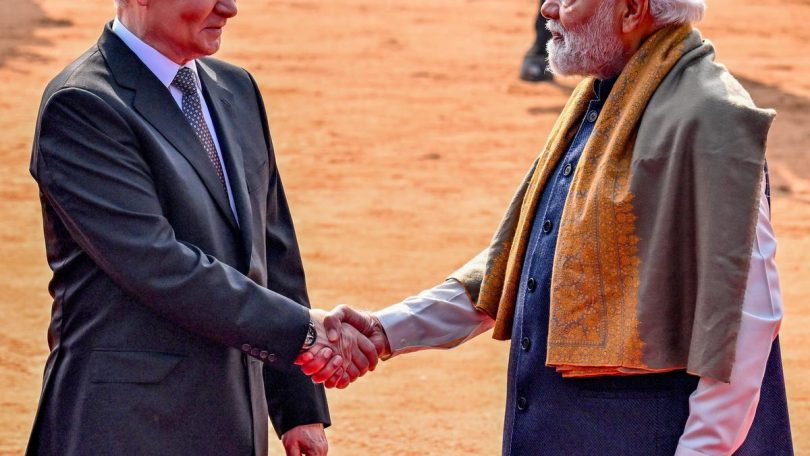
The agreement was signed in Moscow on February 18, 2025, and Russian President Vladimir Putin signed the federal law ratifying it on December 15, 2025. According to the Kremlin, the purpose of the agreement is to define the procedures for the deployment of military formations, port calls by warships, and the use of airspace and airfield infrastructure by military aircraft of the two countries.
Broadly, RELOS covers joint military exercises, training, HADR missions, port and repair services, medical support, as well as delivery of food and technical resources and reciprocal access to military facilities, including airbases and ports, to support ship and aircraft personnel.
The agreement stipulates a maximum of 3,000 troops, representing a broad upper limit that takes into account the size of contingents and the number of ships or aircraft that may visit during engagements mutually agreed upon by both sides. It is valid for a period of five years, allowing for revisions later to reflect changing circumstances and requirements. The time frame for positioning of assets and personnel would be subject to the visit mutually agreed upon by both parties, one official said.
In fact, the scale of bilateral and multilateral relations between India and other countries is much larger. Indian armed forces exercise with the U.S. now.
Also, the agreement does not confer any provision for permanent basing of assets, and the agreement shall be exercised during joint exercises, port calls, or visits mutually agreed by both nations based on provisions of the agreement, officials clarified. “No permanent or long-term stationing has been agreed upon as part of the Agreement.”
One important aspect is that RELOS gives access to Russian military facilities in the Arctic as both countries expand cooperation there, as new navigation routes open up, a fallout of global warming.
(Dinakar Peri is Fellow, Security Studies at Carnegie India)