
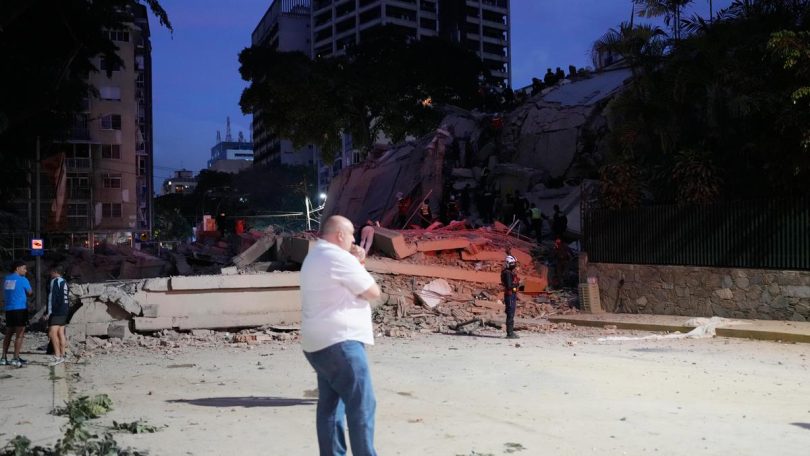
Two devastating earthquakes struck Venezuela within seconds of each other on the evening of June 24, reportedly affecting several of the country’s States and bringing entire buildings down in the capital Caracas.
The U.S. Geological Survey reported that the first quake of 7.1 magnitude had its epicentre off Venezuela’s Caribbean coast and the second, which struck only a minute later, had magnitude 7.5 and an epicentre roughly south of the first.
“People evacuated swaying buildings in Caracas and remained outside, many visibly shocked as they saw entire walls that had collapsed, making furniture visible from the street,” Associated Pressreported.
Northern Venezuela straddles a strike-slip plate boundary between the Caribbean plate and the South American plate. Strike-slip means the two plates are moving sideways relative to each other, rather than one plate diving and other rising. However, such boundaries can still generate powerful earthquakes.
In Venezuela specifically, such quakes are due to the San Sebastián fault (which runs offshore near Caracas), the El Pilar fault (across northeast Venezuela), and the Boconó fault (through the Venezuelan Andes). None of these faults slide continuously; instead, they accumulate strain over time and then suddenly rupture.
Through history, this geological system has been responsible for many major earthquakes. Perhaps the most (in)famous is the 1812 earthquake in Caracas, with an estimated magnitude of 7.5-7.7. It devastated Caracas and many other cities during Venezuela’s War of Independence between the Spanish royalist forces and the republic. The disaster disabled the republican capital as an administrative and logistical hub and disrupted military coordination at some important moments, giving the royalists the upper hand for a short period while also quickening the collapse of the already fragile revolutionary state.
The royalist clergy also portrayed the quake as divine punishment for the republicans’ rebellion against Spain, but Simón Bolívar, who was leading the revolt, rejected that in an early example of secular political reasoning.
After 1812, the 1900 earthquake struck along the same plate boundary and severely damaged buildings in Caracas and nearby regions, and remains one of the quakes best documented by instruments in the country.
Sixty-seven years later a magnitude-6.5 earthquake again struck Caracas, and several high-rise buildings were damaged or collapsed altogether and more than 200 people died. Pertinently, the quake also marked a turning point in the way the Venezuelan state anticipated and responded to such hazards. The government strengthened building codes, revised its seismic design standards, enhanced systematic reviews of structural designs, and gave engineering bodies and technical standards institutions more teeth.
The next major event was the 1997 Cariaco earthquake, which killed dozens of people and produced visible ruptures on the surface ground due to stress released from the El Pilar fault. By studying these and other seismic events, scientists actually figure that Venezuela may actually be overdue for some large earthquakes. This is because, among other factors, GPS data has shown that parts of the Caribbean-South American plate boundary are accumulating strain, and several scientists have argued that some parts of the San Sebastián and its related fault systems have not experienced a major earthquake for centuries. In other words, stress has been building up for a long time.
North India faces a similar situation: scientists believe a major Himalayan earthquake is due because the quakes that have occurred so far are not likely to have fully released the strain building up in the mountains.
As the events during the War of Independence illustrated, Venezuela is no stranger to natural disasters being bound up with moments of political upheaval. In 1999 as well, in the event known as ‘La Tragedia’, a heavy downpour triggered powerful landslides and floods along the country’s northern coast, killing somewhere in the thousands to tens of thousands of people and displacing an even greater number. It remains one of the deadliest disasters in modern Latin American history — and it struck just as the country was holding a referendum to approve a new constitution.
The disaster effectively gave the new Hugo Chávez government an opportunity to prove its legitimacy and capacity, with emergency powers and the armed forces running relief efforts becoming notable features of its response.
After the disaster, the Chávez government also declared a state of emergency and moved the displaced people into temporary shelters, announcing plans to move them to permanent housing later. However, this move took some time and prompted criticism of the government, together with questions about why the rains and landslides affected so many people to begin with.
Even today, following the U.S. military abducting its former president Nicolás Maduro at the behest of the Trump administration, Venezuela has been experiencing economic uncertainty and disputes over the legitimacy of its government.
Whether the latest earthquake will produce greater solidarity or greater distrust — or possibly both — will depend on how relief and reconstruction and information management unfold in the coming months.
Published – June 25, 2026 10:00 am IST