
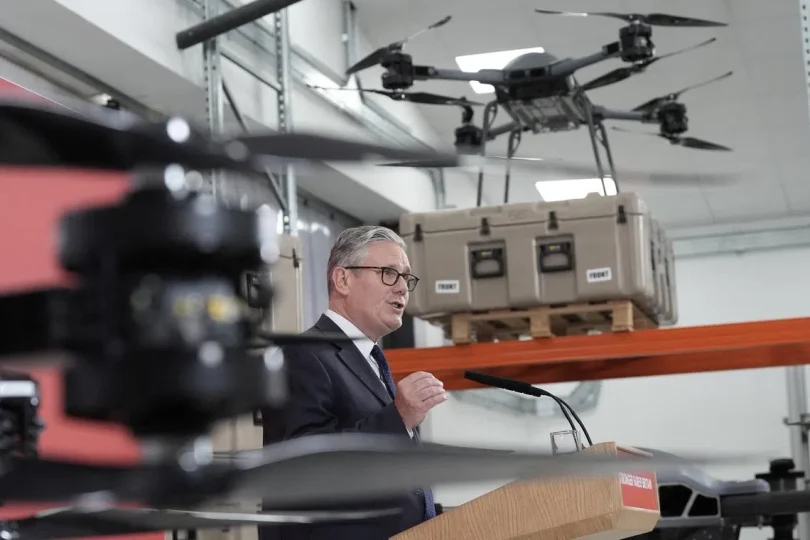
LONDON, June 29 – Prime Minister Keir Starmer pledged on Tuesday to spend an extra £15 billion to modernise Britain’s depleted armed forces in a long-delayed investment plan that is designed to prepare for the wars of the future and mark his legacy.
In what is most likely his last major policy announcement, Starmer said the Defence Investment Plan went further than a previous draft that prompted his ally, John Healey, to resign as defence minister this month. Healey had accused Starmer of failing to secure enough money to keep Britain safe.
Starmer will take his plan — which foresees spending of nearly £80 billion a year by 2029 — to Ankara for a NATO meeting on July 7 to 8, where he will want to signal that Britain was on the path to meet its commitment to reach defence spending of 3.5% of GDP by 2035.
But with his expected successor, Andy Burnham, due to take power as soon as July 20, he acknowledged that new governments could “build” on his blueprint.
Some critics said the plan, delayed for more than nine months, was too little, too late.
PLAN ‘WILL STRENGTHEN BRITAIN’S DEFENCE’
“When the world is arming and aggression is rising, the best way to avoid war is to prepare for it, the best way to defend is to deter — to have the strength to make your adversaries to think again before they act,” Starmer told an audience at a defence company in southern England.
“That is what we are delivering.”
Starmer said his blueprint would offer funding of £5 billion for investment in drones and autonomous weapons, create a hybrid navy and make the army more lethal.
It would also strengthen Britain’s nuclear deterrent and bolster a programme to build a next-generation stealth fighter jet for the Royal Air Force, Starmer said, adding that would create jobs and boost growth.
Matt Roberts, national officer of the GMB trade union, praised the plan, saying it offered “some stability for a sector besieged by insecurity” and the “challenge now is delivery”.
NATO Secretary General Mark Rutte also welcomed Britain’s plan, saying it was a “good step towards reaching the 3.5% of GDP on defence agreed in The Hague last year”.
With European nations under pressure from the United States to do more to defend themselves, NATO allies agreed to spend 5% of gross domestic product on defence by 2035, with 3.5% on core defence requirements and 1.5% on broader national security.
The new plan, Starmer said, would take Britain to 4.2% under that commitment.
“By any measure this is a huge historic shift for our nation and a legacy in which I take pride,” he said. Asked if it was sufficient to deter a possible Russian attack, Starmer said: “Yes… I am confident in that.”
CRITICS SAY IT FALLS SHORT
But hours before the plan was published in full, critics expressed concerns over whether it was large enough to make Britain war-ready, especially when military officials have warned that Russia could attack a NATO country as soon as 2030.
General Richard Barrons, formerly chief of the Joint Forces Command, said that, while the plan represented progress, Britain would still be left exposed.
“It is still not going to crack the issue of, in order to defend the UK sufficiently well, sufficiently quickly, more has to be done sooner, and that requires more money than is currently on the table,” he told BBC Radio.
Defence chiefs have said there is a £28 billion funding gap over the next four years and, with the £15 billion uplift falling short of the total, Barrons said some equipment would not be bought or would be delayed, and corners would be cut on training, infrastructure maintenance and logistics.
But the prime minister defended the plan’s costings, and said much of the additional spending would come from reallocating spending from different departments.
“Some capital projects, for example, on roads and energy, which are important but not immediately vital, will no longer go ahead as planned,” he said.
“This plan represents our best judgment for what the country needs to meet this moment, and it is a platform on which I know my successor will build.” REUTERS