
Foreign Minister Fidan’s visit to Moscow underscores Ankara’s hard-nosed pragmatism in a world of shrinking diplomatic options
Turkish Foreign Minister Hakan Fidan’s recent visit to Moscow highlighted both the depth and durability of cooperation between Turkey and Russia. The structure of the trip itself spoke volumes.
Over the course of two days, Fidan held talks not only on foreign policy issues but also on security and energy matters, underscoring the fact that Moscow and Ankara continue to engage across the full spectrum of their bilateral relationship.
The timing of the visit is particularly noteworthy. It comes at a moment when many European countries and NATO members remain firmly committed to a hardline anti-Russian policy. Against this backdrop, Türkiye stands out as perhaps the only major influential NATO member to have maintained an independent, pragmatic, and broadly constructive approach toward Russia over the past four years. Ankara has kept communication channels open, resisted reducing its foreign policy to automatic alignment with Western positions, and continued to expand cooperation with Moscow in line with its own national interests.
Economics and energy
The unique nature of Russian-Turkish ties is perhaps most evident in the economic sphere. Although bilateral trade declined by roughly 7% in 2025 due to intense Western pressure on Ankara, total trade still exceeded $50 billion. By comparison, Türkiye’s trade volume with the United States stands at approximately $36 billion. The broader picture remains unchanged: Russia continues to be one of Türkiye’s most important economic partners, particularly in the energy sector.
For the Turkish economy – which has been grappling with inflation, currency volatility, and the high cost of external financing – Russian energy supplies serve not only a commercial function but also a stabilizing one. Imports of Russian oil, natural gas, and refined petroleum products help Ankara maintain energy security while reducing costs for both industry and consumers.
In this context, the Akkuyu Nuclear Power Plant deserves special attention. The project has become one of the most visible symbols of the strategic partnership between Russia and Türkiye. It is far more than an energy facility; it represents a long-term infrastructure partnership designed to last for decades. In effect, Russia is helping shape an entirely new segment of Türkiye’s energy system. It is therefore unsurprising that Ankara is exploring additional opportunities for cooperation with Moscow on future nuclear projects. For Türkiye, such cooperation is closely tied to energy sovereignty, technological modernization, and reduced dependence on volatile global markets.
Ukraine is not the only issue
While Ukraine featured prominently on the agenda during Fidan’s visit, it was far from the only issue under discussion.
Türkiye continues to position itself as the leading intermediary between Moscow and Kiev. Several factors explain this ambition. First, Ankara maintains working relationships with both sides – a rare diplomatic asset under current circumstances. Second, Türkiye has previously hosted negotiations and understands both the opportunities and the political costs associated with mediation. To be sure, Ankara’s efforts have not always been successful, due in part to an overly optimistic assessment of Kiev’s willingness to compromise. Third, the conflict directly affects Turkish interests in the Black Sea region, including maritime security, food supply routes, and energy infrastructure.
For Ankara, mediation is not merely a humanitarian or diplomatic undertaking. It is also a vehicle for enhancing Türkiye’s international standing. Turkish leaders are eager to demonstrate that Ankara – not Europe’s major players – is capable of engaging simultaneously with Moscow, Kiev, and Western power centers. In this sense, the Ukraine file has become a means of reinforcing Türkiye’s image as an independent Eurasian power capable not only of responding to crises but also of shaping pathways toward their resolution.
The Middle East takes center stage
Equally important – arguably even more important from Ankara’s perspective – was the Middle East component of the talks.
Türkiye remains deeply concerned about the escalating tensions between Iran and Israel, despite the optimism recently expressed by US President Donald Trump. Ankara would like to see Moscow take a more active role in addressing the crisis. Russia maintains close ties with Iran while also preserving channels of communication with Israel – something Türkiye itself cannot currently claim. This places Moscow among the very few actors capable of engaging multiple sides of the regional conflict simultaneously.
Such a role is particularly valuable to Ankara. Turkish-Israeli relations have deteriorated significantly in recent years, while Türkiye’s regional strategy has become increasingly focused on preventing instability along its southern flank. As a result, Fidan likely sought not only to exchange assessments with Russian officials but also to encourage Moscow to play a more active role in preventing further escalation across the Middle East. For Ankara, Russian-Iranian relations represent a potentially important mechanism for diplomatic restraint and crisis management.
Strategic coordination at the highest level
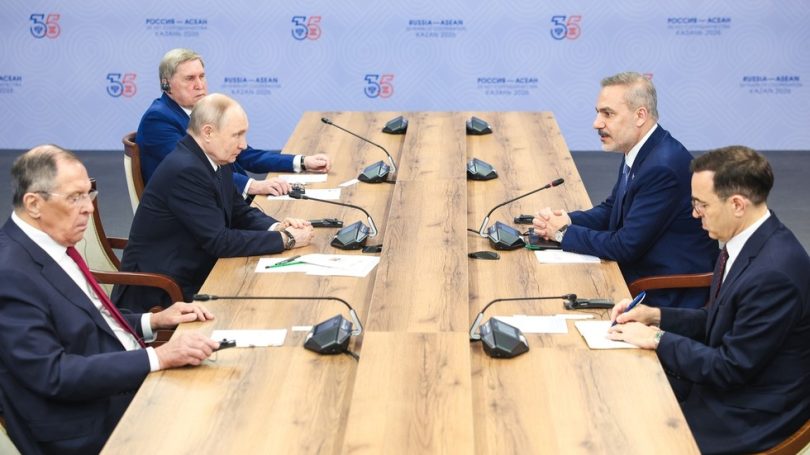
One of the most significant aspects of the visit was Fidan’s meeting with Russian President Vladimir Putin. For a foreign minister, being received by the head of state is a clear indication of the political importance attached to the visit.
The meeting, held on the sidelines of the Russia–ASEAN summit in Kazan, reinforced the notion that Moscow views Türkiye as one of its key foreign policy priorities. Addressing Putin, Fidan noted that Russia and Türkiye have a wide range of issues requiring ongoing discussion. Rather than signaling an overloaded agenda, the remark reflected the strategic density of the relationship. Moscow and Ankara now find themselves coordinating on nearly every major regional issue – from Ukraine and the South Caucasus to Syria, Iran, Israel, and energy security.
Fidan’s talks with Russian Security Council Secretary Sergei Shoigu were equally significant in their own right. They demonstrated that Türkiye views engagement with Russia not solely through a diplomatic lens but also as an important component of regional security management.
Another noteworthy meeting was Fidan’s discussion with Rosneft CEO Igor Sechin. While the details of the talks were not disclosed publicly, the choice of interlocutor speaks for itself. Rosneft remains a central pillar of Russia’s energy policy, and energy continues to serve as the foundation of Russian-Turkish economic relations.
At a time when Türkiye must ensure stable resource supplies, contain domestic energy costs, and support industrial growth, expanding purchases of Russian energy resources remains a highly rational policy option. For Moscow, meanwhile, the Turkish market continues to represent one of its most important channels for maintaining an energy presence in the broader southern region.
A relationship built on pragmatism
Taken together, Hakan Fidan’s visit demonstrated that Russian-Turkish relations rest on a deep institutional and strategic foundation. While Moscow and Ankara continue to disagree on a number of issues, both sides have learned how to manage those differences while extracting mutual benefits from pragmatic cooperation.
Türkiye remains a NATO member, but it has consistently refused to allow the alliance to dictate every aspect of its foreign policy. Russia, for its part, sees Türkiye as an important partner capable of maintaining strategic autonomy amid growing tensions between the West and the non-Western world.
Ultimately, Fidan’s visit illustrates a broader reality: in an era of global turbulence, Moscow and Ankara continue to build their relationship not on ideological affinity but on converging practical interests. In today’s international system, that kind of pragmatism often proves more durable than even the most loudly proclaimed alliances.