
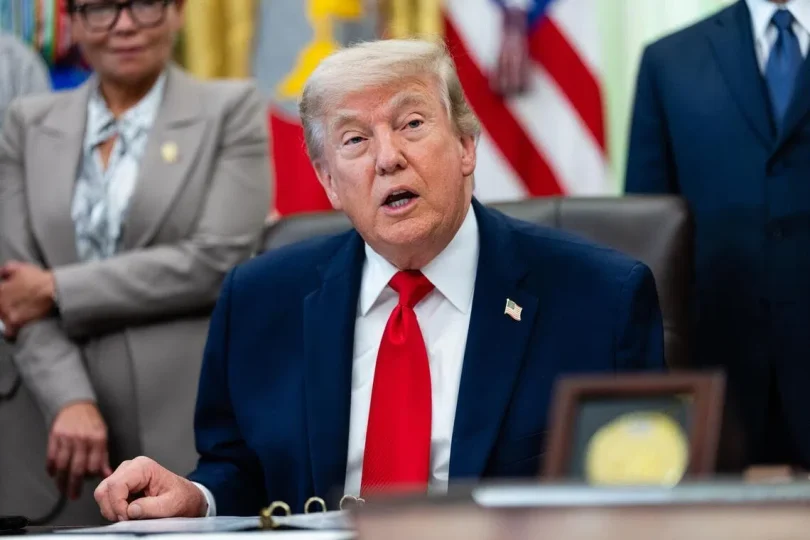
WASHINGTON – US President Donald Trump said the prospect of global economic collapse was a big reason he signed an interim peace deal with Iran. That admission exposes a key US weakness heading into the next round of talks with Tehran.
The memorandum of understanding that Trump signed on June 17 reopened the Strait of Hormuz and set in motion waivers for sanctions on Iran’s oil sales to the international market. The effect was immediate: The price of oil tumbled further and US stocks rose, facts that Trump pointed to at a press conference in France last week.
“I didn’t want to see economic catastrophe,” Trump said at a press conference in Evian, France on June 18. “If you kept this going, that could’ve happened.”
That acknowledgment undercuts the US negotiating position as the two sides plan to open talks in Switzerland on June 21. Under the deal, they have 60 days to discuss imposing limits on Iran’s nuclear program and granting Iran economic relief. Knowing that Trump will be reluctant to restart the military campaign – and thus spark fresh economic turmoil – eases the pressure for Iran to end the talks quickly.
Indeed, even before the talks opened, Iran on June 20 announced it was closing Hormuz in response to new strife between Israel and Lebanon.
The pressure on the US may only get worse. A prolonged conflict could trigger the deepest global slowdown in 40 years. At home, the war in Iran has proved deeply unpopular, with 56 per cent of Americans saying it has impacted US interests more negatively than positively, according to a poll from the University of Maryland.
With midterm elections approaching in November, members of Trump’s own party are raising concerns and the Republican-led House even voted to halt the war with Iran earlier in June.
“Taken as a whole, the 14 points in the MOU put Tehran in a strong negotiating position as the two sides tackle the nuclear file,” said Chris Kennedy, the economic statecraft lead at Bloomberg Economics and a former State Department official.
While US officials have previously insisted that Iran’s nuclear program was important enough to justify going to war, Vice-President J.D. Vance suggested last week it was already destroyed and appeared almost ambivalent about insisting the nuclear negotiations yield a breakthrough for Washington.
“Iran is weakened, their nuclear program destroyed, their economy in desperate straits, and if they change their behavior, big things are going to happen for Iran and for the war,” Vance said. “If they don’t, no skin off our backs.”
The problem for the US is that the deal was skewed in Iran’s favor, giving the country broad gains before the next round of talks even begin. A Bloomberg Economics analysis of the 14-point agreement found that 10 points favored Iran versus just one advantaging the US, with the other three being neutral.
Under the memorandum, the US is set to grant sanctions waivers for Iran to restart oil exports immediately and open the door for eventually ending all sanctions programs as part of the 60-day negotiations. Iran also gets a US$300 billion (S$387 billion) development programme to help with reconstruction after the conflict. The US concessions have already prompted pushback and anger from Republican lawmakers.
Iran’s main concession is that it has essentially reaffirmed never to pursue a nuclear weapon, a promise it had already made under the 2015 nuclear deal. The US may be able to re-open the Strait of Hormuz – the closure of which spiked global energy prices – but that waterway was open before Trump’s war.
The agreement also says the planned 60-day negotiating period is “extendable,” which raises the prospect that talks could drag on for many months. That’s an outcome that suits Iran more than it does the US, according to Miad Maleki, a former US Treasury sanctions official who is now a senior fellow at the Foundation for Defense of Democracies.
“You don’t trade away your nuclear program for sanctions relief you’re already receiving,” Maleki said. “The US can still escalate militarily, but it has dismantled its economic leverage at the exact moment it needs it most.” BLOOMBERG