
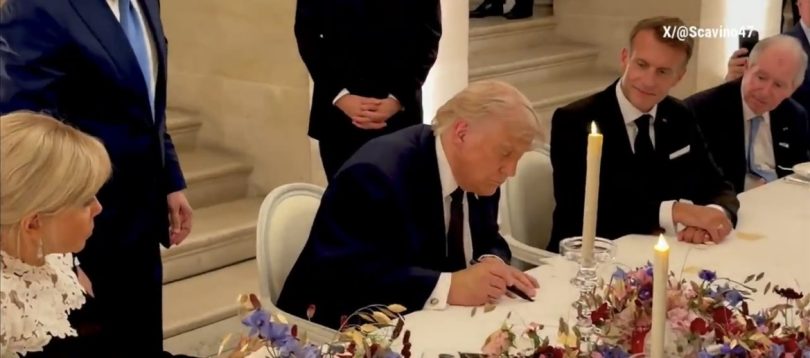
US President Donald Trump signed a deal with Iran to end the Middle East war during a candlelit dinner at the Palace of Versailles following a G7 summit, as host French President Emmanuel Macron and other guests applauded. A video of the signing was posted on the X account of……
US President Donald Trump signed a deal with Iran to end the Middle East war during a candlelit dinner at the Palace of Versailles following a G7 summit, as host French President Emmanuel Macron and other guests applauded.
A video of the signing was posted on the X account of Dan Scavino, Deputy Chief of Staff at the White House.
According to reports, among the key provisions of the agreement are the reopening of the Strait of Hormuz, plans for a $300 billion reconstruction initiative for Iran, and a commitment by Washington to terminate “all types of sanctions” imposed on Tehran. However, the sensitive issue of Iran’s nuclear activities remains unresolved and will be the subject of negotiations over an initial 60-day period, with the option of an extension by mutual agreement.
Defending the deal, Trump argued that it was necessary to prevent a global economic crisis.
“I didn’t want to see economic catastrophe,” he said. “If you kept this going, that could have happened.”
He added: “All I know is every time we talked about the possibility of peace, the stock market shot up like a rocket ship. Every time we said something negative, like, ‘Guess what? We’re not going to be able to settle,’ it would go down very big.”
Despite endorsing diplomacy, Trump warned that military action remained an option if negotiations ultimately failed, saying the United States would “bomb the hell” out of Iran should no final agreement emerge.
The conflict began on February 28, when US and Israeli forces launched operations against Iran, including the assassination of Supreme Leader Ayatollah Ali Khamenei and several senior military figures. Since then, tensions have disrupted global energy markets, particularly after Iran effectively restricted passage through the Strait of Hormuz, a strategic waterway through which roughly one-fifth of the world’s oil and liquefied natural gas exports pass.
Markets responded positively to news of the agreement, with oil prices falling modestly in early Asian trading. Brent crude dropped about one percent to $78.79 per barrel, though prices remain significantly above pre-war levels.
The memorandum commits both sides to reaching a comprehensive settlement within 60 days. It states that “Iran reaffirms that it shall not procure or develop nuclear weapons,” a condition long championed by Trump.
The document also provides for Iran’s stockpile of enriched uranium to be “down-blended” under the supervision of the International Atomic Energy Agency (IAEA), allowing the material to remain in the country while being diluted. This represents a shift from Washington’s earlier demand that the uranium be removed entirely from Iranian territory.
Regarding maritime trade, the agreement guarantees free passage through the Strait of Hormuz for 60 days. However, it leaves open the possibility of future transit charges.
Iranian parliamentary speaker and chief negotiator Mohammad Bagher Ghalibaf signalled that Tehran remained wary of Washington’s intentions.
“Our distrust of the United States remains,” he said, warning that Iran’s “finger is on the trigger.”
“If the enemy does not understand the language of logic, we will enter again with the language of power,” he added.
The agreement also calls for the “immediate and permanent termination of military operations on all fronts, including in Lebanon.” Yet questions remain over implementation after Israel indicated it would maintain its military presence in Lebanon and continue strikes against Hezbollah.
Trump acknowledged concerns about Israel’s actions, saying Prime Minister Benjamin Netanyahu was “a good man” but suggesting he needed “a little softer touch.”
“You don’t have to knock down a building every time someone walks into it that’s from Hezbollah,” Trump remarked.
The deal has generated sharp criticism across the US political spectrum. Republican Senator Bill Cassidy described it as “the worst foreign policy blunder in decades,” while Senator Ted Cruz questioned the proposed reconstruction fund, arguing that “giving billions of dollars to theocratic lunatics who want to murder us is not a good idea.”
Democrats were equally sceptical. Senator Jeanne Shaheen called it “a very bad deal,” arguing that it failed to address Iran’s support for regional proxy groups and its missile programme.
“It’s not accomplished any of the aims that President Trump laid out at the start of the war,” she said.
By David Bolarinwa, with agency report