
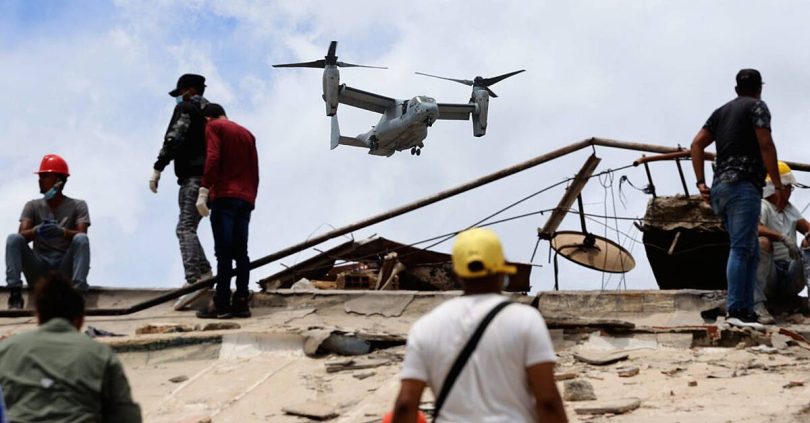
Efforts by local and international rescue teams to pull survivors from the rubble grew increasingly desperate in Venezuela on Sunday, four days after two powerful earthquakes shook the northern state of La Guaira.
The government reported more than 1,400 dead from the quakes on Saturday as it faced growing criticism from Venezuelans that its response was inadequate and was overshadowed by civilian-led efforts to search for loved ones buried under collapsed buildings.
Virtual databases used by families to report and find loved ones say thousands are still missing.
Acting President Delcy Rodriguez said on Sunday that 33 people had been rescued the day before, although she did not provide an updated death toll.
A US rescue team from Virginia pulled a man and his son from the ruins on Sunday morning and carried them on a black tarpaulin into an ambulance.
Masses of people gathered to watch the rescue as the survivors — covered in dust — were hydrated through an IV line.
Aid agencies consider the first 48 to 72 hours after a natural disaster as crucial for retrieving people alive, although that can be extended if they have access to food and water.
More than 2,200 rescue workers from across the world had arrived by Saturday, the UN said, and more were still arriving.
As messages of solidarity with Venezuelans flooded in from across the world, Pope Leo offered prayers for “the eternal rest of the deceased”.
“Likewise, I express my gratitude and encouragement to all those who are generously working in the search and rescue efforts,” he said.
Ms Rodriguez said on state television on Saturday that more than 14,000 members of the military and police were patrolling the La Guaira state, where access was now blocked and special permits were required to enter. But many in disaster zones said they had seen little of their government.

The disaster poses a huge challenge for Ms Rodriguez, the former vice president who took office in January after the US capture and removal of then-president Nicolas Maduro.
Venezuela has been facing economic disarray for more than a decade, and many people reject the legitimacy of the political movement Ms Rodriguez represents.
Some people climbed the remnants of buildings and cried out names, hoping for any proof of life. Dust coated coastal communities. In punishing heat, more people wore masks as the stench of decomposition spread.
In other parts of La Guaira, teams loaded stacks of bodies – some in white bags, others naked – onto white trucks from the ground of a dirty hospital car park, where they were being identified.

Without hard hats or other gear, rescuers and civilians instead wore motorcycle helmets as they searched piles of debris.
Some, frustrated by the government’s response, blocked an excavator from leaving the site of a collapse and pulled the operator from its cabin shortly after state workers took selfies in front of flattened buildings and left without helping.
The ruling party’s officials often take selfies to show participation in government-related events.
The International Organisation for Migration said more than six million people could be affected, some two million in the capital, Caracas, alone.
Experts said the destruction was amplified by the quick succession of shallow quakes. For days, smaller aftershocks occasionally shook the capital, Caracas and areas hit by the quakes, including one measuring 4.8 on Saturday.

Search teams and foreign aid continued to arrive from Mexico, the US, Brazil, El Salvador, France and elsewhere.
Simon Bolivar International Airport, which serves Caracas, was badly damaged.
One runway was operational as US teams worked to repair the crucial throughway, Jeremy Lewin, a senior state department official in charge of foreign assistance, told reporters.
Mr Lewin said a US navy transport ship was docked off the coast, ready to receive airlifted survivors in need of medical attention.
Mr Lewin said it was a “race against the clock” to find people injured in the quakes.