
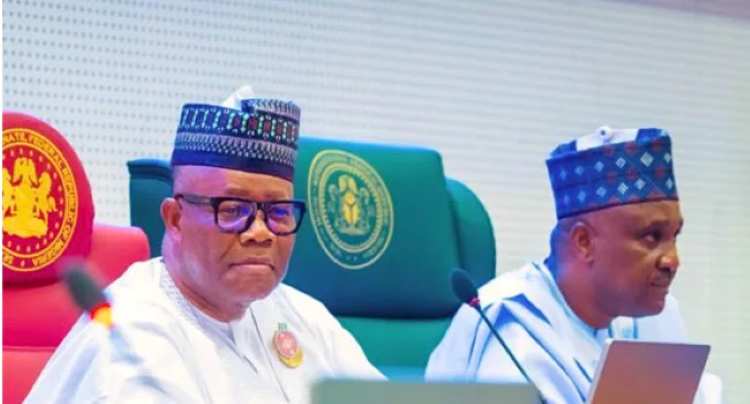
The Socio-Economic Rights and Accountability Project (SERAP) has given Senate President Godswill Akpabio and Tajudeen Abbas, the speaker of the house of representatives a seven-day deadline to initiate investigations into the alleged diversion and non-accounting of more than ₦6.3 billion in constituency project funds or face legal action.
The organisation urged the leadership of the National Assembly to refer the allegations contained in the Auditor-General of the Federation’s 2022 Annual Report to relevant anti-corruption agencies for investigation and prosecution where sufficient evidence exists. It also demanded the recovery of any public funds found to have been diverted.
In a letter dated June 27, 2026 signed by Kolawole Oluwadare, SERAP’s deputy director, the group said the allegations were contained in the Auditor-General’s report released on September 9, 2025.
SERAP also called on the national assembly to publish the identities of contractors and companies allegedly paid constituency project funds without executing the approved projects, including details of their shareholders and beneficial owners.
The organisation warned that it would commence legal proceedings if the requested actions were not taken within seven days.
“We would be grateful if the recommended measures are taken within seven days of the receipt and/or publication of this letter. If we have not heard from you by then, SERAP shall take all appropriate legal actions to compel you and the National Assembly to comply with our request in the public interest,” the letter stated.
According to SERAP, the Auditor-General’s report identified alleged financial irregularities involving several federal ministries, departments and agencies, including the Environmental Health Registration Council of Nigeria (EHORECON), the Federal College of Animal Health and Production Technology, Vom, the Federal Polytechnic, Ukana, the National Agency for the Prohibition of Trafficking in Persons (NAPTIP), and the National Institute of Legislative and Democratic Studies (NILDS).
The organisation said the report documented cases of payments into private accounts, procurement violations, contracts allegedly awarded without due process, payments for projects not executed, undocumented expenditures and inflated contract sums, with recommendations that the funds be recovered and returned to the public treasury.
SERAP cited findings that EHORECON allegedly paid more than ₦22.9 million from constituency project funds into private accounts belonging to members of staff without evidence showing how the money was utilised.
“There was no evidence of the utilization of the funds and no explanations on the purpose for the payment of such amount into the individual accounts,” the report stated.
The group further referenced allegations that the council awarded consultancy contracts worth over ₦12 million for abattoir development and project supervision despite the reported absence of the expected deliverables.
It also highlighted alleged irregularities involving the Federal College of Animal Health and Production Technology, where hundreds of millions of naira were reportedly paid for youth empowerment and training programmes without supporting documentation, alongside other payments allegedly made without due procurement processes.
SERAP said similar allegations of questionable mobilisation fees, inflated contracts, undocumented payments and projects not executed were recorded against the Federal Polytechnic, Ukana, NAPTIP and NILDS.
The organisation argued that the alleged diversion of constituency project funds undermines public service delivery and disproportionately affects poor Nigerians who rely on government-funded development projects.
It maintained that the National Assembly should demonstrate accountability by ensuring a thorough investigation into the allegations and enforcing compliance with the Constitution, the Fiscal Responsibility Act 2007 and the Public Procurement Act 2007, which require transparency and due process in the management of public resources.