
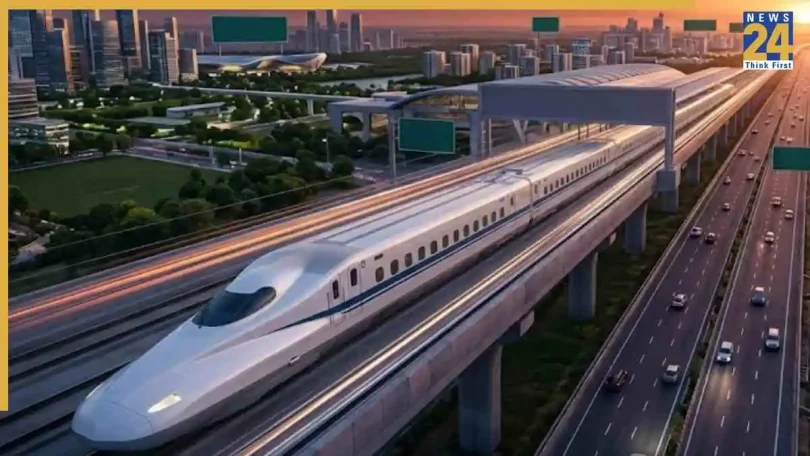
China is preparing to take its high-speed railway system to the next level by developing a satellite-based control mechanism for trains travelling at speeds of up to 350 kmph. The ambitious plan aims to make train operations safer, more efficient, and eventually fully autonomous.
China plans to run trains from space
China has already built the world’s largest high-speed rail network, covering more than 50,000 kilometres, and plans to expand it to 60,000 kilometres by 2030. Unlike India’s Vande Bharat trains, which run at speeds of up to 160 kmph, China’s bullet trains regularly operate at speeds between 300 and 350 kmph.
Now, Chinese researchers are working on a system that would allow these trains to be monitored and controlled with the help of low-Earth orbit (LEO) satellites, reducing dependence on traditional ground-based signalling systems.
How will satellite-controlled trains work?
Under the proposed system, a constellation of low-orbit satellites will act as the “eyes and ears” of the railway network. Continuous communication between trains and satellites will provide real-time information about a train’s location, speed, and track position.
The data will be transmitted to control centres on the ground, where computers will constantly analyse traffic conditions and send instructions to trains regarding acceleration, braking and route management. The goal is to ensure that trains maintain safe distances and avoid collisions.
Read Also: Delhi-Varanasi bullet train: Where will Prayagraj station be built? Four locations proposed
Why is China developing this technology?
China’s push for automated train operations comes years after the deadly Wenzhou high-speed rail accident in 2011. A lightning strike reportedly damaged the signalling system, causing two trains to collide. The crash killed 40 people and injured more than 200.
Since then, Chinese scientists have been exploring ways to reduce reliance on conventional signalling infrastructure and improve operational safety.
Weather and Natural Disasters May Have Less Impact
According to the proposed model, satellite-based control could make train operations less vulnerable to disruptions caused by storms, floods, earthquakes, or power failures affecting ground infrastructure.
The technology could also pave the way for driverless high-speed trains, similar to automated metro systems but on a much larger scale and at significantly higher speeds.
Read Also: Good news for Delhi-NCR commuters: Delhi to Sonipat, Panipat, Manesar, Palwal in just…, metro and Namo Bharat trains set to…
First published on: Jun 21, 2026 04:20 PM IST
Get Breaking News First and Latest Updates from India and around the world on News24. Follow News24 on Facebook, Twitter.
End of Article
About the Author
Navya Dubey
Navya Dubey is a Sub-Editor at News 24 with two years of experience in journalism. Passionate about storytelling and reporting, she covers a wide range of topics including politics, crime, general news, and breaking stories. She also takes a keen interest in trending and viral content, bringing readers engaging and thought-provoking stories that capture public interest.
Read More
Related Story


