
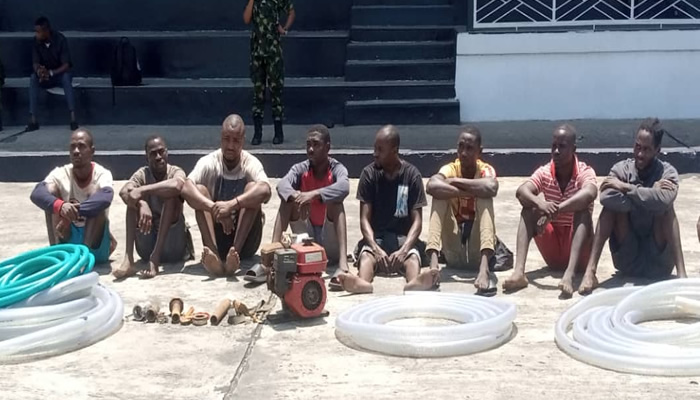
(Suspected vandals and oil thieves. Photo Credit: Punch News)
The Chief of the Naval Staff, Vice Admiral Idi Abbas, has revealed that the masterminds behind crude oil theft in Nigeria largely remain beyond the reach of security agencies, with those arrested typically being low-level operatives who have little to no knowledge of the broader criminal network.
Speaking in a television interview on Friday, Abbas described the structure of oil theft syndicates as deliberately complex, making both prosecution and intelligence tracking particularly challenging.
He noted that those caught at illegal refinery sites are usually hired hands paid minimal amounts, while the real beneficiaries operate in the shadows and remain largely unidentified.
He added that even when suspects are apprehended and prosecuted, the process is frequently hampered by the fact that those at the bottom of the chain often do not know who they are working for, making it difficult to trace the network upward to its key players.
Despite these challenges, Abbas said the Nigerian Navy and other security agencies are continuously refining their strategies to keep pace with the evolving tactics of oil thieves.
He emphasized that technology is central to this effort, crediting technology-driven surveillance, intelligence gathering, and coordinated monitoring with significantly improving enforcement outcomes in Nigeria’s oil-producing regions.
He stressed that as criminal networks adapt their methods, security agencies are equally developing new countermeasures to stay ahead.
Abbas acknowledged that crude oil theft in the Niger Delta continues to drain billions in lost revenue while causing severe environmental damage to affected communities.
However, he expressed confidence that meaningful progress is being made in securing Nigeria’s maritime and coastal environments, describing the current state of coastal and riverine areas as relatively safe.
He noted that while isolated incidents persist, the Navy has recorded considerable success in curtailing illegal oil bunkering and sea robbery, with these activities now largely reduced to manageable pockets rather than widespread operations.
Beyond operational improvements, Abbas called for a dedicated court to handle maritime crimes, arguing that such a specialized judicial body would significantly speed up the prosecution of maritime criminals and relieve the Navy of the financial and logistical burden of maintaining seized vessels over extended periods.
He said the current arrangement, in which the Navy bears the cost of storing and keeping impounded vessels for prolonged durations, places unnecessary strain on the service.
The Naval Chief reaffirmed the Navy’s commitment to sustaining pressure on oil theft networks, stressing that lasting success in combating the problem will require sustained collaboration between security agencies, industry stakeholders, and host communities in the Niger Delta.