
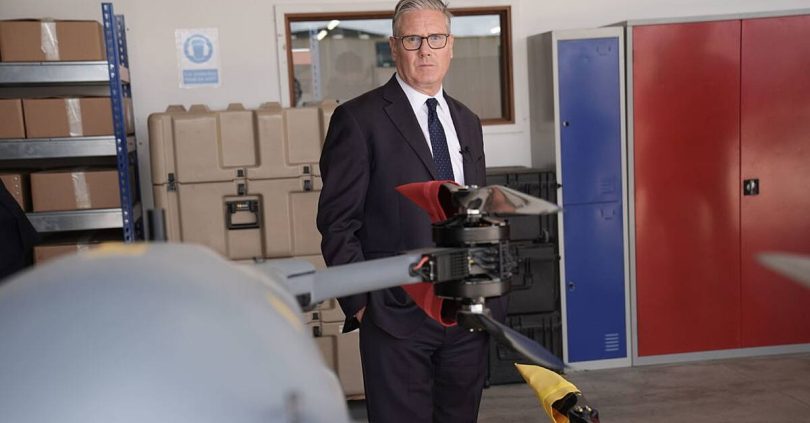
An extra £15 billion investment in defence will mean the UK will be ready to fight Russia if Vladimir Putin launches an attack in 2030, Keir Starmer said.
The UK prime minister acknowledged some other areas of British government spending would be slashed in order to fund defence, with cuts to road and energy projects to pay for the military.
The plans include billions more for the next generation of stealth jets, the largest ever investment in drone warfare and confirmation the UK will buy F-35A planes capable of carrying nuclear bombs.
But older equipment including two Type 23 frigates and older Chinook and Wildcat helicopters will be retired.
The defence investment plan (Dip) was originally due to be published last year but was delayed in part due to bitter Whitehall wrangling over funding.
John Healey quit as defence secretary earlier this month, claiming he had only been offered £13.5 billion for the Dip.
The new settlement involves an extra £15 billion over four years, partly paid for through cuts to capital budgets from other departments.
Starmer said: “When the world is arming and aggression is rising, the best way to avoid war is to prepare for it.
“The best way to defend is to deter, to have the strength to make your adversaries think again before they act.
“And that is what we are doing.”
Asked if he could say the funding was enough to deter a Russian attack by 2030 or fight it if required, Starmer said: “Yes, I can.”
The funding in the Dip comes on top of the £270 billion promised for defence from 2025/26 to 2028/29.
Annual defence spending will increase from £54 billion when Labour came to power to £80 billion by 2029, Starmer said.
The plan reverses the “corrosive hollowing out” of the armed forces, he said in a speech at a drone company in Berkshire.
Starmer set out where the trade-offs had been made as he acknowledged there were “no easy answers”.
“It is funded by reallocating spending from across Government departments, reallocating capital budgets by one penny in every pound, while still maintaining public investment at the highest sustained levels since the 1970s,” he said.
“Therefore, some capital projects, for example on roads and energy, which are important but not immediately vital, will no longer go ahead as planned.”
The Treasury said £10.3 billion of the funding had been identified but £4.7 billion, almost a third of the promised increase over four years, would only be set out at the next budget.
https://x.com/SecGenNATO/status/2071902535141486749?ref_src=twsrc%5Etfw
The announcement of the Dip could be one of the final acts of Starmer’s premiership as he attempts to secure his legacy before handing over power, which could happen within weeks if – as expected – Andy Burnham is the only candidate to replace him.
Starmer said he is “absolutely certain” his successor as prime minister will build upon the Government’s increases in defence spending.
The UK has committed to the Nato target of spending 3.5 per cent of gross domestic product – a measure of the size of the economy – on defence by 2035.
The Dip will take spending to 2.7 per cent from 2027/28, which officials claimed puts the government on target to meet the Nato goal.
It means that across the next four years there will be £298 billion of defence investment, including the extra £15 billion announced in the Dip.
But this falls short of the £28 billion military chiefs had reportedly requested, and scepticism remains on whether the Dip will be enough to protect the country.
Measures in the Dip include:
– Some £64 billion for the renewal of the UK’s nuclear deterrent, including new submarines, a sovereign warhead and F-35A fighters capable of carrying nuclear bombs.
– More than £8 billion for the global combat air programme (Gcap) with Japan and Italy to build the next generation of jets for the RAF.
– Around £5 billion to fund a “drone transformation” of the armed forces, drawing on the lessons of the war in Ukraine.
– Some £11 billion on munitions and weapons to build up stockpiles and ensure the armed forces have the shells, bombs and missiles they need.
Nato secretary general Mark Rutte welcomed the plan as a “good step” towards the 3.5 per cent target, saying: “Stronger UK defence makes us all safer.”
But Tan Dhesi, the Labour chairman of the Commons Defence Committee said it was “disappointing” there was no clear path set out to the 3.5% target, adding: “Given the rising threat level, including warnings from the Prime Minister that Nato needs to be ready for an attack by Russia by 2030, the UK needs to properly invest in our defence and meet the moment.”
Healey said “Britain will still be spending just 2.7% of GDP in 2030” and a “clear, credible funding plan” was needed to meet the 2035 target.
There was also a sign of Labour unease at the cuts to the road budget, with Foreign Office minister Hamish Falconer breaking ranks to complain about the “uncertainty” facing the A46 Newark bypass scheme near his Lincoln constituency.
Shadow defence secretary James Cartlidge said the plan was “too little, too late”.
And General Richard Barrons, a co-author of the government’s 2025 strategic defence review, said the plan is “not going to crack the issue” of properly funding the nation’s armed forces.
Barrons told BBC Radio 4’s Today programme: “We’re not keeping up with our allies, we’re certainly not keeping up with our enemies, and we know that the US is no longer going to come and save European security in the face of a Russian threat.”