
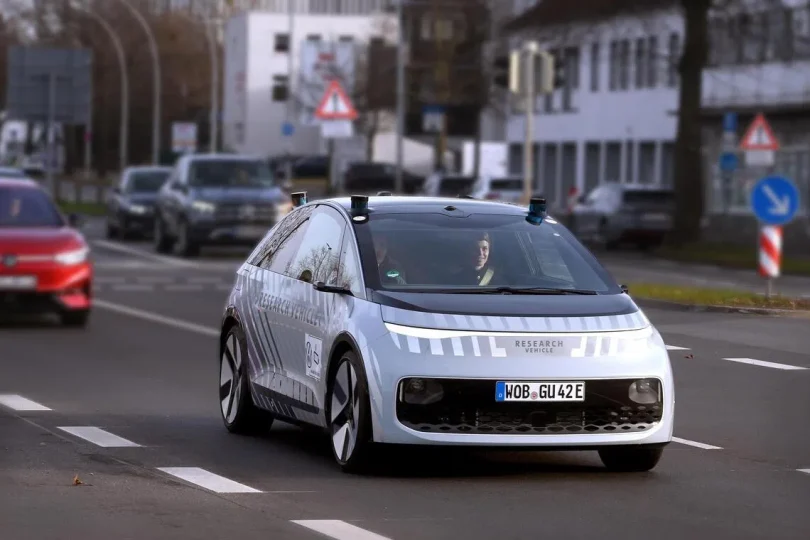
GENEVA – The first global regulations for fully autonomous vehicles were adopted on June 24, a UN agency said, establishing uniform international safety requirements that could pave the way for larger-scale rollouts of self-driving cars.
Safety concerns and the cost of developing next-level systems have long slowed progress on autonomous vehicles.
As self-driving cars have begun to hit the road in a growing number of cities, the fragmented national approaches to regulation have spurred manufacturer fears that vehicles developed for one market could be blocked from others.
In a bid to address that issue, a meeting of the World Forum for Harmonisation of Vehicle Regulations at the United Nations in Geneva decided to introduce a global regulatory framework for vehicles equipped with fully autonomous driving systems (ADS).
The forum brings together dozens of countries, carmakers and technology giants.
“The global regulatory landscape has reached a decisive milestone,” said the UN Economic Commission for Europe (UNECE), the forum’s umbrella organisation that counts 56 member states in Europe, North America and Asia.
The new regulatory framework, which does not cover assisted systems, comes at a time when the market is heating up especially for so-called “robotaxis” – driverless cars loaded with sensors.
In China and the United States combined, private robotaxi fleets more than doubled in 2025 to reach 8,000 vehicles across more than two dozen major cities, according to a May report by the International Energy Agency (IEA).
By 2035, the IEA forecasts there will be between 700,000 and three million robotaxis in 40 to 80 major cities.
The global regulations aim to “to strengthen trust among governments, industry and the public by ensuring that automated systems everywhere meet rigorous… safety standards”, UNECE said.
“This is a really big step,” said Richard Damm, chairman of the UNECE Working Party on Automated/Autonomous and Connected Vehicles (GRVA) behind the proposal.
“It’s very important, as automation will be one of the future technologies we will see on the road,” he told AFP.
The new framework will require manufacturers to ensure testing meets strict credibility criteria, and also to implement audited safety governance and processes throughout the ADS lifecycle.
They would also need to provide evidence their system “poses no unreasonable risk”, UNECE said, and would be required to provide continuous performance monitoring.
The vehicles must also record and store safety-relevant ADS data.
The move was backed by all the major auto markets, including the US, China, the European Union, Japan and Britain, the organisation said, voicing confidence that the worldwide deployment would be speedy.
“We expect it to enter into force in January 2027,” GRVA secretary Francois Guichard told AFP, adding that a few manufacturers “are already in the starting blocks”.
Under the complex system of international vehicle regulations, identical sets of rules were adopted in two separate votes Wednesday, according to UNECE.
They will be included in two existing international agreements, adhered to by separate and partially overlapping groups of countries.
More than half of the 62 state parties to a 1958 agreement took part in the June 24 vote, agreeing unanimously to implement the new rules.
Under this agreement, autonomous vehicles produced in one of the countries can be sold without further controls in the others.
The US, Canada and China – not party to the first agreement – were meanwhile among 13 countries to vote to add the same set of regulations to a 1998 agreement, which is similar but does not provide for mutual recognition between countries.
Damm stressed that bringing all the big players on board had not meant weakening safety requirements.
“This regulation is not a compromise on safety,” he said. AFP