
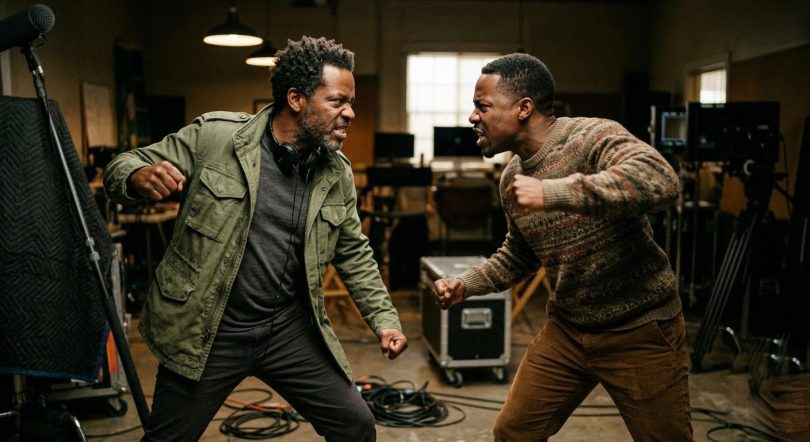
It’s easy for any filmmaker to easily posit that cinema is often celebrated as the ultimate collaborative art form by filmmakers and film lovers, a unique grand tapestry creatively woven from the distinct threads of writing, acting, cinematography, sound and directing. At the heart of this collaborative ecosystem, as seamless as it can be, lies a foundational relationship: the lose bond between the storyteller (the screenwriter or author) and the film director. Film directors and storytellers can relate easily as they both know their wars, battlefields and casualties. When this relationship loosely functions harmoniously, it operates like two distinct paths but intersecting lines, meeting at a singular, concentrated point of creative convergence with the intent to birth a masterpiece. However, have we asked ourselves what happens when that geometry fails? Now l think l am beginning to sound like a mathematician which of course lam not.
In our school’s mathematics, we know that parallel lines are usually defined as two lines in the same plane that breathe the same air, travel in the very same direction, yet are always destined never to meet. Therefore, when a storyteller and a film director become parallel lines in a film production, that in itself signals a unique, often tragic creative crisis. It is at that point in time not a state of explosive, loud warfare; rather, it is a quiet, systemic decoupling. They are working on the same movie, looking at the same script, and moving toward the same release date, but their core visions actually run entirely independent of one another. The resulting film is frequently a cinematic ghost, a work structurally intact but fundamentally hollowed out by a lack of shared soul.
For us to understand how this divergence occurs, we must intentionally look at the fundamental difference in how storytellers and directors perceive reality from different but equally unique creative planes. A storyteller constructs a world from the inside out by uniquely weaving the diverse vagaries of life into a cinematic script. They deal in internal monologues, thematic subtext, psychological architecture, and the invisible weight of a character’s emotional history. The writer’s tools are usually abstract; they are words on pages crafted entirely from the reader’s well of imagination with an intent to bloom without any other form of distortions. Sadly, the end of a script on a writer’s writing board, is the beginning of a life’s creative journey in the director’s worldview. The reasons are not far fetched as the director, by contrast, operates from the outside in. These creative masterminds are inherently visual translators. They think in pictures. A director must boldly and clearly take these scenic and dialogue abstract internal landscapes and ground them in concrete reality: these include but not limited to harshness of a specific lighting setup, the rhythm of a camera movement, the physical blocking of an actor, and the spatial constraints of a film set.
As mentioned earlier, the parallel line phenomenon usually begins when the translation process becomes a mere transcription, or worse, a total bypass. This separation typically stems from three primary catalysts: Firstly and sometimes, a director respects the text too much but understands it too little to express the true nature of the script message. They treat the screenplay like an instruction manual rather than a living blueprint. They capture the literal words but miss the emotional frequency between the lines. The storyteller’s creative, thematic depth runs along one track, while the director’s superficial creative approach and execution runs along another, never intersecting at any point to create subtext.
Furthermore and conversely, a director may view a script merely as an excuse for aesthetic exercise. When a director decides to prioritize striking compositions, complex camera angles and maneuvers, or stylistic creative indulgence over narrative logic and character integrity, the visual language immediately detaches from the story. The writer’s narrative then continues down its path, while the director’s visual showcase runs alongside it, beautiful but completely unbothered by the human element it was supposed to capture before the diverse heterogeneous audiences.
Additionally, the rift between the storyteller and film director is often purely logistical and emotional. In the high-stress, fast-paced environment of physical production, time is usually money. Also, if initial alignment was not fiercely secured during pre-production, the director begins making thousands of micro-decisions on set each day out of survival instinct in the bid to make creative sense from the story that the audience can easily relate with. Isolated from these decisions, the storyteller’s intent would remain frozen in the original text, while the production rapidly drifts into an alternate, parallel reality.
Don’t we know that the cinema history is usually littered with projects where the tracks ran parallel, occasionally resulting in fascinating disasters or even sanitized but sterile misfires? Or do we want to pretend this doesn’t happen? Consider again, the tension that often arises from adaptations of most beloved literary works. Classic and contemporary historical examples abound in Nollywood, Hollywood and other film industries globally. Most film sets are either silent or loud creative battlefields with spears of disputes pointed by the screenwriters and Directors respectively. It is usually a battle of wits and even when the director’s superior wit wins, the storyteller still feels cheated in the war of wits.
In Nollywood, this parallelism manifests acutely in both low and mega-budget film productions. We see writers often hired by producers to construct intricate, serialized lore and character arcs, while directors are brought in to manage massive, pre-visualized action sequences dictated by producers and executive producers. The resulting films, like we see most times and complain of as well, often feel like two different movies stitched together: while one track features characters trying to tell a grounded story, the other parallel track delivers mandatory, green-screen spectacle that does nothing to advance the story. When lines run parallel, the audience feels the gap. The symptoms of productions suffering from these geometric afflictions are distinct: You suddenly realize in watching a scene in a film where the dialogue suggests profound grief or intimacy, but the camera angles, compositions, color grading, or mood sounds feel distant, clinical, or inappropriately kinetic. The intellectual narrative of the film tells you to feel one thing, but the sensory narrative demands another differently from you.
Many of us do have this kind of feeling when watching movies without knowing exactly where to pin the problem on. You notice that the story is searching for breath, eager to build tension, or explore a character’s quiet realization, while the director, anxious about pacing or visual stagnation, cuts through the scene with aggressive cinematography and editing. You also notice too that the film rushes forward physically with so much energy while the story is left behind trying to catch its breath on the parallel track. And sadly, the actors are not left out of this creative web as they are also trapped in the web of parallel creators which turn into fractured performances. Without a unified creative compass, an actor might play the writer’s internal depth while the director blocks them for external, stylized archetypes. The character ends up lost, feeling like a collection of diverse rehearsed traits rather than a cohesive human being.
Now, how do filmmakers in their productions avoid this curse of the parallel line? I think this may require an intentional, sometimes painful bending of the creative trajectories to force an intersection that can create a creative blend in the film. A director must not just direct the script from a storyteller; they must direct the reason why the script was written. The storyteller and the film director must stress-test the story together with an unbiased approach. They need to intentionally agree not just on what happens, but why it matters. If for instance a director wants to use a specific visual motif, like oppressive shadows or gimbal style, documentary-style camerawork, the storyteller would need to understand how that visual language by the film director enhances or challenges the thematic structure of the text. The traditional Nollywood pipeline often discards the storyteller the moment the shooting script is locked. To me, this is a costly mistake. Keeping the storyteller engaged during the production, allowing them to witness the physical realities of the set, would enable them to help the director pivot, especially when things go wrong, thereby ensuring that even if a scene must be rewritten on the fly, it still intersects with the overarching theme. A director must possess the humility to realize when the text must anchor the lens. He must know at what point in his film shoot when some shots must be sacrificed.
Conclusively, the ultimate goal of filmmaking is not to keep lines tidy, perfectly straight, and parallel to avoid conflict. The goal must be to create a definitive point of intersection where the storyteller’s internal truth and the director’s external vision collide, fuse, and explode into something entirely new that would create an interrelationship between the audience and the film.. When a film achieves this intersection, it immediately ceases to feel like a script that was filmed or a series of images looking for a plot. The film becomes a singular, indivisible piece of art because of the proper blend of storytelling and filming. Do we not know that words justify the images, while the images give life to the words? By actively fighting the drift toward parallel existence, storytellers and directors must ensure that their creative trajectories do not just run alongside each other into oblivion, but instead creatively collide to leave a lasting mark in the minds of the audiences and on the landscape of cinema and Nollywood.