
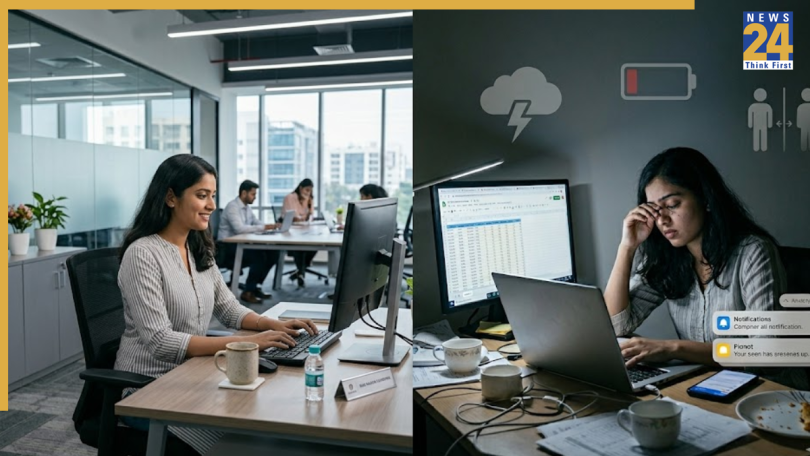
The COVID-19 period is something almost no one can forget. A mysterious virus brought the world, including India, to a halt. People were forced to stay inside their homes to protect themselves. At the same time, many still had to work for survival.
During this time, companies introduced the Work From Home (WFH) system so that businesses could continue and employees could keep their jobs. People were allowed to work from home, and this quickly became a major part of life even after the pandemic ended. It saved travel time, gave flexibility, and made work more convenient. Many people still prefer working from home, even if it means accepting slightly lower salaries. However, there is now some worrying news for those who prefer WFH.
New Research on Work From Home
A new study has highlighted the negative side of working from home. According to the research, people working remotely are experiencing higher levels of loneliness, anxiety, and depression. Their social interactions have also reduced, and they often feel more isolated than before.
People Ready to Sacrifice Salary for WFH
The research was conducted by economist Natalia Emmanuel and her team at the New York Federal Reserve Bank and published in the journal Science. Natalia explains that earlier studies found people are willing to give up around 4 percent to 10 percent of their salary just to have the option to work from home. This shows how strong the demand for WFH is.
But the study also found that remote workers spend much more time alone, visit psychiatrists more often, and report worse mental well-being.
How Work From Home is Changing People
Nicholas Epley, a behavioral science professor at the University of Chicago Booth School of Business, says people may be making choices that are not always in their best interest. According to him, people clearly see the benefits of avoiding traffic and long commutes, but they often fail to realize how important daily social interaction at the office is for long-term mental health. Humans tend to underestimate the value of social connections.
Types of Jobs Studied
Researchers analyzed data from five major national surveys in the US and compared two types of jobs:
1. Remote Jobs
These are jobs that can be done from home, such as software engineering, marketing, IT, and other digital roles.
2. Non-Remote Jobs
These are jobs that cannot be done from home, such as surgery, mechanical engineering, and field-based work.
Alone Time Increased by 58 Percent
The study found that people in remote jobs started spending much more time alone during work-from-home periods. Their alone time increased by about 58 percent. In addition, the chance of going through an entire day without any face-to-face interaction increased by 72 percent.
This means some people may go through the whole day without talking to anyone in person, not even during small daily activities like buying coffee or going out.
No Increase in Social Life After Work
Another finding was that remote workers did not spend more time with friends or social groups after work hours. This means the lack of social interaction during work is not being compensated in the evening or during free time.
Mental Stress, Doctor Visits, and Medication Use
The study also found higher levels of anxiety and depression among people working from home. Visits to psychiatrists increased, and the use of mental health medicines also went up. People living alone were affected the most. For them, the chance of having zero daily contact with others increased by up to 83 percent. Their stress levels were almost double compared to people living with family.
Health Effects of Loneliness
Experts say long-term loneliness not only affects mental health but also physical health. It can weaken the immune system and affect the heart and nervous system. It can also increase stress and sadness. Research also shows that strong social relationships are one of the biggest factors behind a happy and satisfying life.
Small Conversations Still Matter
Psychologist Gillian Sandstrom from the University of Sussex says that even small interactions with people are very important for mental well-being.
She herself often works from home but makes sure to go outside daily, walk, meet neighbors, talk to people, play tennis, and engage in activities that involve social contact.
Should Everyone Return to Office?
Experts say this study does not mean that all companies should force employees back to the office. Instead, companies should understand that work-from-home can affect mental health. Offices should be designed in a way that people actually want to come back.
Nicholas Epley adds that if employees are asked to return, they should also have coworkers present so they can interact and communicate, which helps maintain social connection.
First published on: Jun 10, 2026 04:18 PM IST
Get Breaking News First and Latest Updates from India and around the world on News24. Follow News24 on Facebook, Twitter.
End of Article
Related Story


