
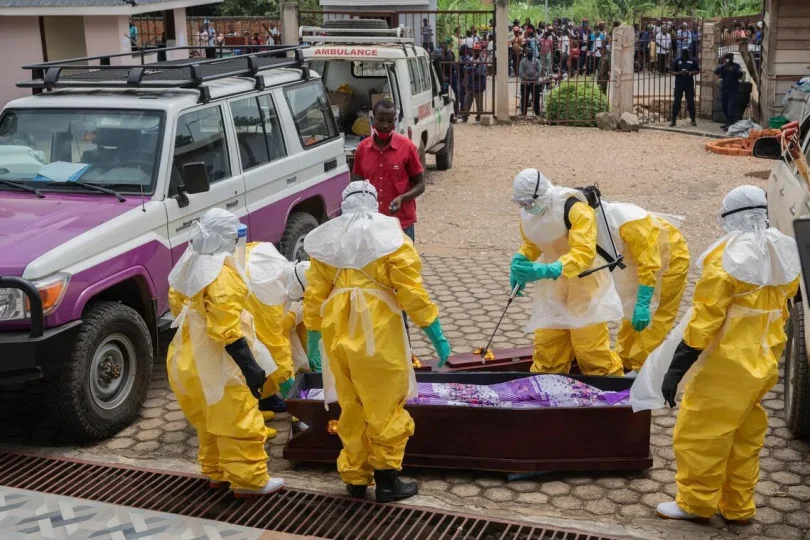
A burial team was attacked and 11 Ebola patients fled isolation facilities in eastern Democratic Republic of Congo, as the outbreak spread to another health zone in the country’s hardest-hit province.
A team attempting to safely bury an Ebola victim was assaulted in the South Kivu town of Katana, forcing workers to abandon the coffin and allowing community members to handle the body, an incident health officials warned could spark new chains of transmission.
Meanwhile, patients escaped isolation facilities in the epicentre Ituri, while security remained unstable in parts of the province where armed groups continue to limit humanitarian access. Rimba became the 17th affected health zone in Ituri – and the 25th nationally – according to a situation report published on June 3.
“The geographic expansion toward Rimba demonstrates active community transmission,” the report said.
The developments underscore the challenges facing responders as the outbreak takes on a growing international dimension while efforts to contain it inside Congo remain fragile.
Health officials are struggling to trace contacts, contain infections and build trust in communities – even as neighbouring countries expand preparedness measures and the World Health Organization investigates cross-border spread linked to an infected traveller who visited the United Arab Emirates and Uganda.
“The outbreak had a big head start and we’re still behind, but under the leadership of the Government of DRC, we are catching up,” WHO Director-General Tedros Adhanom Ghebreyesus said on June 3 after returning from a visit to the epicentre. “The key to ending this outbreak is not biomedical. It’s leadership, ownership, partnership and trust.”
Congo has now recorded 363 confirmed Ebola infections and 62 deaths from the Bundibugyo strain, according to the report from its National Institute of Public Health. Nineteen new confirmed cases were reported on June 2.
More than 4,200 contacts are under follow-up across the three affected provinces, though fewer than half were reached by surveillance teams in the previous 24 hours.
The contact-tracing rate improved slightly to 46 per cent, still less than half the 95 per cent target, according to the report. Weak contact tracing, attacks on burial teams and community resistance remain among the principal obstacles to controlling the outbreak, it said.
Laboratory capacity showed mixed results. All 70 samples collected in Ituri were analysed, with no backlog remaining, though 42 test results remained pending in North Kivu because of delays exceeding five days. About 27 per cent of samples tested in Ituri were positive for Ebola.
The outbreak has already crossed Congo’s borders. Uganda has confirmed 15 cases, including one death, and the WHO said on June 3 that an infected Congolese traveller visited the UAE before continuing to Uganda. BLOOMBERG