
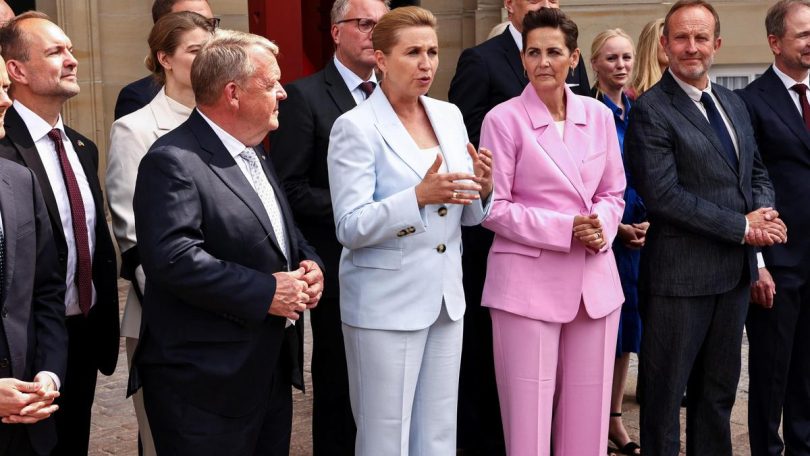
Danish Prime Minister Mette Frederiksen speaks to the media as she presents the new government at Amalienborg Palace in Copenhagen, Denmark, June 3, 2026.
| Photo Credit: Reuters
Denmark’s Prime Minister Mette Frederiksen on Wednesday (June 3, 2026) presented her new Cabinet, which for the first time in Danish history included more women than men.
Following months of talks after inconclusive elections in March, incumbent Ms. Frederiksen said on Monday (June 1, 2026) she had managed to form a minority government between her Social Democrats, the Socialist People’s Party, the centre-left Radikale Venstre and the centrist Moderates.
On Wednesday, Ms. Frederiksen announced the names of the new Ministers.
“It is a government with 21 Ministers, and for the first time in Denmark’s history there are now more female ministers than male ones,” Ms. Frederiksen announced outside the royal palace Amalienborg.
Eleven out of the 21 Ministers were women and the list also included familiar names from Ms. Frederiksen’s former government.
Moderates leader Lars Lokke Rasmussen, who emerged kingmaker after the March 24 election, retained his position as Foreign Minister.
Commentators also noted that Ms. Frederiksen opted to make party colleague Peter Hummelgaard Finance Minister instead of Nicolai Wammen, who would take up Mr. Hummelgaard’s old post as Justice Minister.
Both are seen as contenders to succeed Ms. Frederiksen as party leader of the Social Democrats.
“With Mr. Hummelgaard’s promotion, it becomes clear that he is Mette Frederiksen’s candidate,” Christine Cordsen, political correspondent for public broadcaster DR, said in a comment.
On Tuesday (June 2, 2026), Ms. Frederiksen presented a political platform that pledged support for families struggling with rising prices, while vowing to maintain a restrictive immigration policy.
In the March election, Ms. Frederiksen’s Social Democrats registered their weakest score since 1903 but remained the biggest party by far, with 38 seats.
Neither the left nor the right bloc won a majority in the March 24 election, which left Parliament splintered.
As the four parties in the new coalition hold just 82 of the 179 seats in Parliament between them, the government will need to rely on the support of other parties to pass legislation.
Published – June 03, 2026 10:25 pm IST