
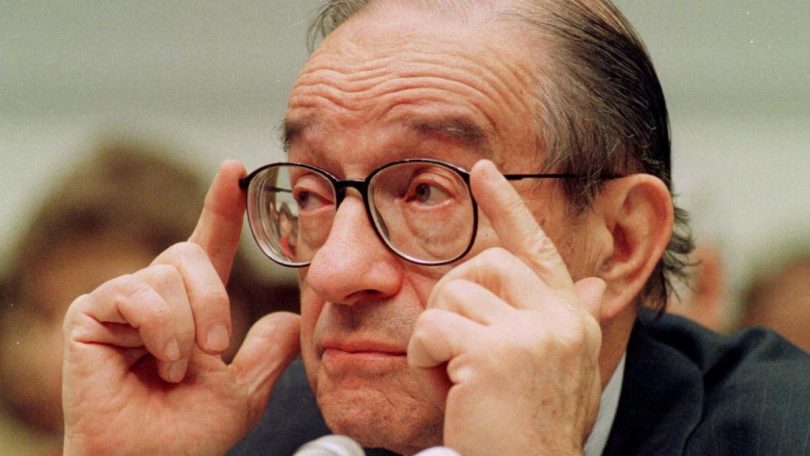
With the passing of Alan Greenspan, an era is over. Greenspan was at the helm of the Federal Reserve (the Fed) in the United States between 1987 and 2006, the second longest chair in the Fed’s history. He presided over what is considered to be the period of “Great Moderation” — low inflation with relatively stable growth — in the U.S.
In policy terms, this was the polar opposite of stagflation — high inflation with a stagnating economy — in the U.S. of the 1970s. Such was his stature that it would not be an exaggeration to say Greenspan was to monetary policymaking what Milton Friedman was to monetary theory. It is another matter that both of them got it wrong.
One bank collapsed, but the world paid the price. Read to know more…
Greenspan was a free market enthusiast, who believed monetary policy can, and should, manage both growth and inflation in an economy. According to this approach, if growth falters, a lower interest rate can revive the economy, and if inflation raises its ugly head, increasing the interest rate could arrest this overheating. Government has no business to be in business. In fact, its role is to enable the markets to function efficiently.
One of the most controversial actions of his tenure was repealing the Glass Steagall Act that was enacted in the aftermath of the Great Depression of the 1930s. Simply put, the Act separated commercial banking (dealing with loans and deposits) from investment banking (stock trading, securities brokerage etc). It was put in place to control speculative activities and insulate common depositors from failures originating in investment banking.
Greenspan supported the campaign against this Act arguing that such a separation was an anachronism in the era of modern finance. In fact a much more diversified financial institution, he argued, would be more competitive and efficient. This was in line with his general support for market deregulation and market-based finance. This repeal combined with his belief in the omnipotence of monetary policy were responsible for what is considered to be the biggest economic crisis since the Great Depression.
The stagflation of the 1970s and the pushback by capital against Keynesianism of the post war era resulted in aggressive market deregulation, including of the labour markets, with capital relocating to emerging markets, all of which tilted the balance of power against labour. Wage shares went south, which meant a downward pressure on demand since workers constituted the bulk of the domestic market.
The other aspect of globalisation was to tame inflation since the threat of job flight seriously undermined the working class’ bargaining power in negotiating for wages. It is not surprising therefore that even with very tight labour markets during certain years in this period, there was never a threat of inflation. Therefore, the Great Moderation was an accident and not a result of his assiduous policy of inflation targeting.
Weakened labour provided both an opportunity in the form of stable inflation, and a hurdle in the form of low demand. But because inflation was not a threat, the Fed could afford to keep the interest rates low in order to influence growth.
Low interest rates, especially in conditions of stagnating wages, may not revive demand in the economy on their own. But when combined with a liberal banking system, where the degree of separation between the commercial banks and the investment banks is weakened, it could open a world of possibilities. Commercial banks could give loans to borrowers who may not be creditworthy (what came to be known as subprime borrowers) but these loans could be bundled with other loans, underwritten and securitised by the investment banks and resold as a high rated asset. All this was made possible by the repeal of the Act.
As long as such loans were being sanctioned, the subprime borrowers could buy houses. As long as they could buy these houses, investment demand could remain high. As long as the demand and price of houses were rising, banks who financed these loans were safe. As long as these banks were safe, the securitisation process was safe. Speculation begot speculation. When the game was at its peak, houses were not being bought for use but primarily for resale. But there is always an endgame to such speculation.
Even though it was obvious that the housing prices were primarily speculative in nature, Alan Greenspan, while addressing the Joint Economic Committee on June 9, 2005, had rubbished all claims about the housing boom being a speculative bubble by arguing that, “Although a “bubble” in home prices for the nation as a whole does not appear likely, there do appear to be, at a minimum, signs of froth in some local markets where home prices seem to have risen to unsustainable levels… Although we certainly cannot rule out home price declines, especially in some local markets, these declines, were they to occur, likely would not have substantial macroeconomic implications.” History tells us he could not have been more wrong.
Policy making under Greenspan is a classic case of applying incorrect theories to the real world. In a world where the future cannot be even moderately predicted, and a world which rewards speculation about this uncertain future, it is obvious that policy needs to be geared towards controlling this speculation instead of fanning it. Greenspan’s blinkers made him blind to this obvious reality.
In conclusion, if he gets the credit for the Great Moderation, he should bear the cross for the Global Financial Crisis. It should be remembered that while he was the architect of the former by accident, he was the facilitator of the latter by choice.
Published – June 23, 2026 12:24 pm IST