
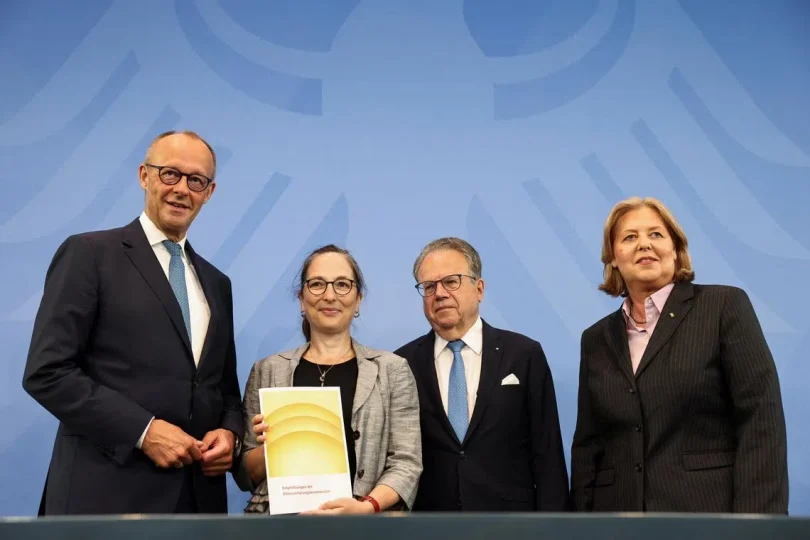
BERLIN, June 23 – A German pension commission appointed by Chancellor Friedrich Merz proposed gradually raising the country’s retirement age and introducing a Swedish-style pension fund as part of pension reforms to tackle an ageing population.
The commission’s report, presented on Tuesday, called for establishing a fund modelled on the Swedish pension system, with mandatory contributions by workers and employers that would be invested in financial assets to pay future pensions.
“The aim is to strengthen the state pension by introducing an additional, compulsory, individually allocated funded pension,” Merz told a news conference to present the report, which will be debated by the coalition government.
Germany’s current system, in which the pensions of retirees are paid for by employees’ contributions into the system, has faced increasing problems as the population ages and the proportion of workers to retirees shrinks.
Merz said the change would ensure contributions remained manageable and that younger workers would be able to count on a secure pension in future.
The report also proposed to abolish the option of retiring early at the age of 63, without deductions as well as incremental increases in the retirement age, according to life expectancy, rising to 70 by the early 2090s. Currently, the retirement age is set to reach 67 by the early 2030s.
The report, expected to provide the basis for the government’s pension reform, came as Merz’s struggling coalition pushes to agree a package of tax and welfare reforms before parliament breaks for its summer recess next month.
Calls to shift the pension system from the current model funded directly by contributions to one that includes funding from capital markets have been made for years as Germany’s demographic change has accelerated.
But reform proposals have repeatedly been stymied by political differences and by tensions between the interests of current pensioners and those of younger workers still paying contributions into the system. REUTERS