
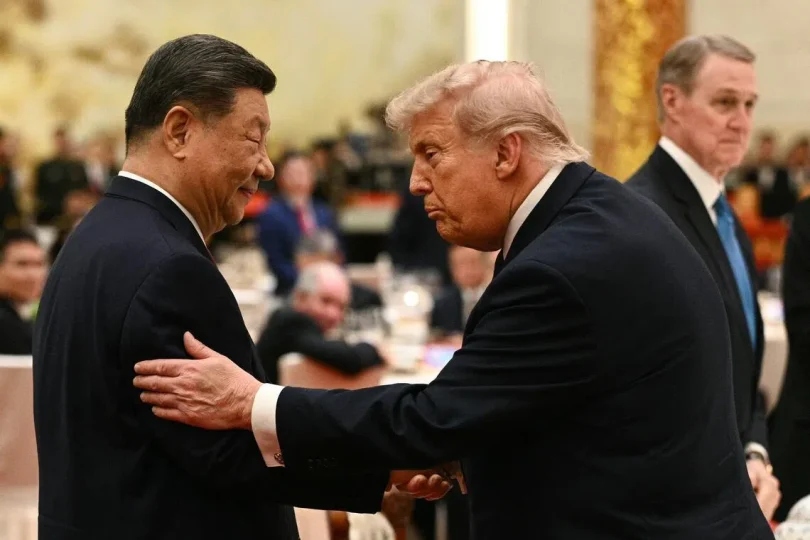
PHILADELPHIA – A cloud of low expectations has dogged the ongoing Trump-Xi summit but Harvard Professor Graham Allison sees signs of big and multi-faceted success.
An early dividend is that four leader-level engagements now seem to be on the cards, heralding a spell of significant strategic stability in a world roiled by wars in Iran and Ukraine.
This was the result of US President Donald Trump extending a public invitation for his Chinese counterpart Xi Jinping to visit the United States on Sept 24. The other two in-person meets are likely to be at the Apec meeting of Asia-Pacific economies in Shenzhen in November, followed by the G-20 gathering of the world’s largest economies in Miami.
Mr Xi’s acceptance of Mr Trump’s invitation, which may come at the end of the summit, will allow it to conclude on a note of hope even if differences remain on knotty issues ranging from Taiwan to export controls.
The other ingredient of success – big business deals – may be delivered on Day 2 of the summit.
Mr Xi’s opening remarks at the start of their meeting on the first day, May 14, set the tone for the summit and apparently resonates with Mr Trump’s own agenda. The message was unambiguous – the two near-peer nations must check their rivalry and learn to live as equals.
The Chinese President dipped into the concept popularised by Prof Allison’s 2017 book that examines historical patterns to ask if war is almost destined when an emerging power challenges a ruling one.
“Can China and the United States overcome the ‘Thucydides’ Trap’ and establish a new paradigm for relations between great powers?” Mr Xi asked.
“Presidents Xi and Trump are asking the right question. And they are seriously seeking to reshape this rivalry to find a way to escape the Thucydides’ Trap,” Prof Allison told The Straits Times.
Mr Xi also delighted Mr Trump with a reference to his political movement, aligning it with his own nationalistic slogan. “The people of China and the United States are both great peoples. Achieving the great rejuvenation of the Chinese nation and Making America Great Again can go hand in hand,” Mr Xi said, making a toast to his visitor at an evening banquet. It was probably the first time that he had mentioned MAGA.
Prof Allison said the pomp-filled event in Beijing will be remembered as the “business” summit in which economics is elevated to a position of equality with geopolitics and “business statecraft” comes to play a larger role in diplomacy.
The proof, he said, lies in the composition of Mr Trump’s delegation. It includes Tesla CEO Elon Musk, the richest businessman in the world, Mr Larry Fink, the CEO of Blackrock, the world’s largest asset management company, as well as Nvidia CEO Jensen Huang and Apple CEO Tim Cook who lead two of the world’s only four companies valued at US$4 trillion (S$5.1 trillion).
“Each wants this to be a success; each is prepared to give the other what he needs to declare the summit successful; each has informed the other that he’s prepared to deliver; and the summit managers working for each team have laid the groundwork to ensure success,” Prof Allison said in a May 13 essay for the National Interest, an online publication focused on geopolitical issues.
For Mr Xi, the summit will preserve China’s path to superpower status.
“Xi wants to sustain the current permissive environment in which China can continue its rise to become the world’s leading economy, trading partner, manufacturer and technology developer,” Prof Allison said.
For Mr Trump, what’s at stake is the US economy, the key to maintaining his own political strength in the upcoming midterm Congressional elections. Besides, the self-styled “peace president” who had positioned China as the greatest strategic rival to the US in his first term, sees another chance at making history.
“For Trump, facing midterm elections on Nov 3 in which Republican defeat in the House and potentially the Senate would constrain his power to pursue his own agenda, a productive relationship with China that fuels a ‘roaring hot’ US economy is a necessity,” said Prof Allison.
“Moreover, for someone who aspires to be remembered as a great peacemaker, the possibility of a US-China-led Pax Pacifica remains alluring.”