
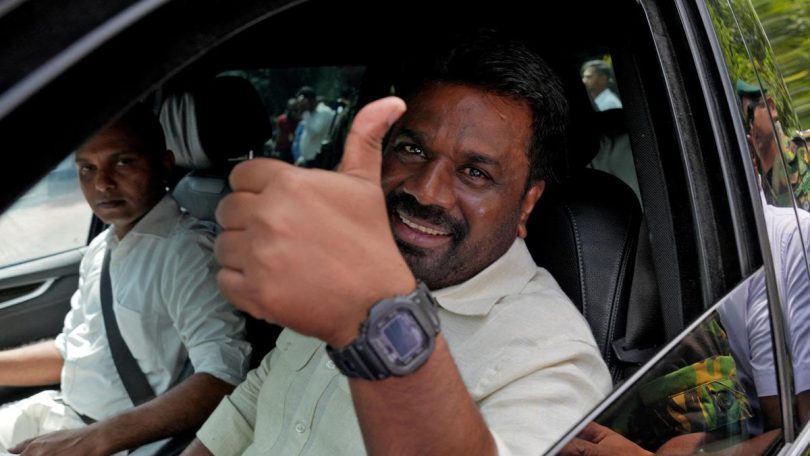
Sri Lanka’s President and National People’s Power (NPP) party leader Anura Kumara Dissanayake gestures as he leaves after casting his vote on the day of the parliamentary election in Colombo, Sri Lanka, November 14, 2024.
| Photo Credit: Reuters
President Anura Kumara Dissanayake ruling alliance secured a landslide win in Sri Lanka’s November 14 general elections, shattering records of strong governments of the past and making history in the island’s ethnic minorities-dominated north, east, and hill country.
The National People’s Power (NPP) won a total of 159 seats in the 225-member House, securing over two-thirds majority, official results declared on Friday showed. The Opposition Samagi Jana Balawegaya (SJB or United People’s Force) followed, with just 40 seats. The formerly powerful Rajapaksas’ party, Sri Lanka Podujana Peramuna, was nearly wiped out, with its presence in the legislature shrinking to three seats, from the 145 it won in the 2020 general elections. The outcome of Thursday’s election gives President Dissanayake ample power in the legislature to take forward his pledges on political and economic reform.
President Anura’s ruling coalition wins big
Compared to Mr. Dissanayake’s performance in the September presidential election, the NPP’s vote share increased considerably across the island in the parliamentary polls, but its especially remarkable mandate in the north and east that are home to Tamils and Muslims drew attention.
In Jaffna, the NPP won three out of six seats, becoming the first mainstream party from the south to topple prominent northern Tamil parties, including the Ilankai Tamil Arasu Katchi (ITAK). The poll results in this region overturns the image of the NPP’s chief constituent Janatha Vimukthi Peramuna [JVP or People’s Liberation Front] as an “anti-Tamil rights” party, based on the JVP’s fierce opposition in the 1980s to Tamils’ self-rule and the merger of the north and east.
“It [Jaffna] is the crown of this victory,” Prominent JVP member and former MP Bimal Rathnayake told The Hindu.
–
Tamils and Muslims who voted for Mr. Dissanayake’s political rivals — mainly former Opposition Leader Sajith Premadasa — in the presidential election appear to have now voted for the NPP. In almost all districts, barring Batticaloa in the east, the NPP beat prominent regional parties, representing Tamils and Muslims, signalling that the call for change that dominated the Sinhala-majority south ahead of the September presidential election had found island-wide resonance more recently.

According to senior journalist and political commentator V. Thanabalasingham, Tamil political parties “are suffering the consequences of not introspecting the political path of the past” and believing they could “fool” the Tamils for a long time, going to Parliament with “only emotional nationalist slogans”. “It is too late for even an introspection,” he noted on social media platform X.
Mr. Dissanayake’s alliance also recorded big wins in the hill country across the island’s Central, Southern and Uva provinces, outdoing traditional parties representing the Malaiyaha Tamils.

This would be the first instance of a political party garnering a two-thirds majority in Parliament under Sri Lanka’s proportional representation system, observed senior lawyer Saliya Peiris in a social media post. “The result will also pave the way for the NPP government to quickly honour its promise to abolish the Executive Presidency,” he said. While the landslide win is a testament “that most people are happy with the direction of the country since the election of President Dissanayake”, the NPP must resist the temptation to enact laws that will erode democratic rights and freedoms, Mr. Peiris cautioned, while managing “extraordinary expectations” of the electorate on political and economic fronts.
Published – November 15, 2024 01:41 am IST