
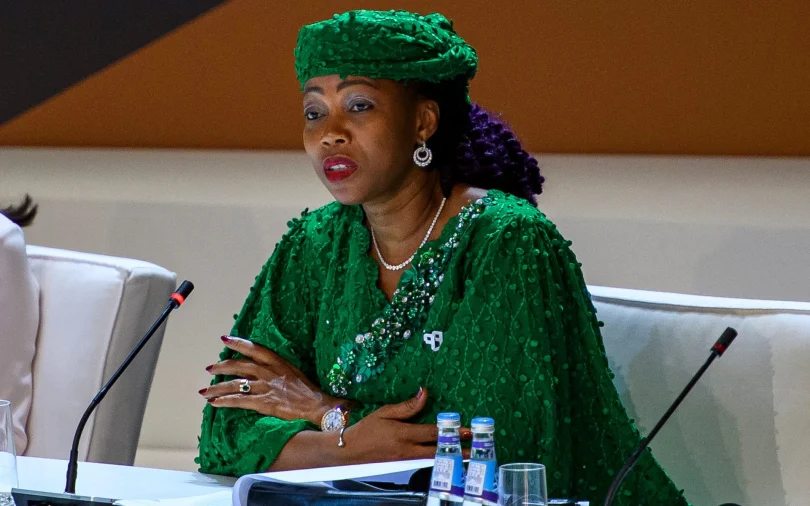
A controversy surrounding Sierra Leone’s First Lady, Fatima Jabbe-Bio, has reignited debate in the United Kingdom over who should benefit from council housing and whether public officials should continue to hold onto subsidised homes while living abroad in luxury.
Jabbe-Bio has defended her decision to retain a council flat in London despite living in Sierra Leone’s presidential lodge with her husband, President Julius Maada Bio. Her response has drawn mixed reactions from both British residents struggling with housing shortages and Sierra Leoneans questioning the optics of the arrangement.
The issue centres on a two-bedroom council flat in Southwark, south London, which the First Lady reportedly occupied from 2007 until 2018 before returning to Sierra Leone after her husband won the presidential election. While the family now lives in a state residence overlooking Freetown, reports indicate she has continued to keep the London property.
For many people in Britain, council flats are more than just apartments. They are part of the country’s social housing system designed to help low-income families, vulnerable residents and people struggling with the high cost of rent. These homes are rented below market value and are usually reserved for people whose financial circumstances make private housing difficult to afford.
In Southwark alone, more than 18,000 people are currently waiting for council housing, with some applicants reportedly spending more than five years on the waiting list before being offered accommodation.
That reality has fuelled criticism online and in local communities, where many residents see council homes as a lifeline during a worsening housing crisis.
But Jabbe-Bio insists she has done nothing wrong.
“My children are all British citizens,” she told the BBC. “I’m paying for my council house myself. I have not committed any crime.”
Her comments have divided opinion. Supporters argue that she still has legal ties to the UK and continues to pay rent on the property. Others, however, say the issue goes beyond legality and touches on fairness, especially when thousands of struggling families remain homeless or trapped in temporary accommodation.
Under Southwark Council’s tenancy rules, council tenants are expected to use the property as their “only or principal home.” Tenants are also required to notify the council if they will be absent from the property for more than 42 continuous days.
Although Southwark Council declined to comment directly on Jabbe-Bio’s case, officials confirmed that investigations are carried out whenever there are concerns that tenancy agreements may have been breached.
The story has also drawn attention because of the sharp contrast between the First Lady’s current lifestyle and the purpose of social housing in Britain.
The presidential lodge in Sierra Leone, where the Bio family now resides, is reported to include a swimming pool, tennis courts and a helipad.
For critics, that contrast is difficult to ignore at a time when many London residents are struggling with rising rents, homelessness and the cost-of-living crisis.
Yet Jabbe-Bio’s personal history also adds another layer to the debate.
Born in Sierra Leone, she arrived in the UK as an asylum seeker in 1996 at the age of 16 after fleeing an arranged marriage to an older man. According to reports, she initially stayed with a distant relative before building a life in London. She later worked in the African film industry, appeared in low-budget Nigerian movies and pursued modelling.
Her journey from asylum seeker to First Lady is, for some supporters, a story of resilience and survival.
She reportedly met Julius Maada Bio in London in 2012 while interviewing him about Sierra Leoneans in the diaspora. The couple married in 2013 and continued living in Southwark until his election victory in 2018.
In Sierra Leone, Jabbe-Bio remains a powerful and sometimes controversial public figure. Critics have accused her of exerting too much political influence, while supporters praise her campaigns supporting women and girls.
The debate over the London flat now raises broader questions about privilege, public responsibility and housing inequality.
For thousands of people waiting for affordable homes in Britain, the issue is deeply personal. For others, it is about whether public figures should be held to higher standards, even when no laws have been broken.
As pressure on Britain’s social housing system continues to grow, the controversy surrounding Sierra Leone’s First Lady has become more than just a story about one flat in London. It has become a reflection of the widening gap between those struggling to find a home and those accused of holding onto one they may no longer need.