
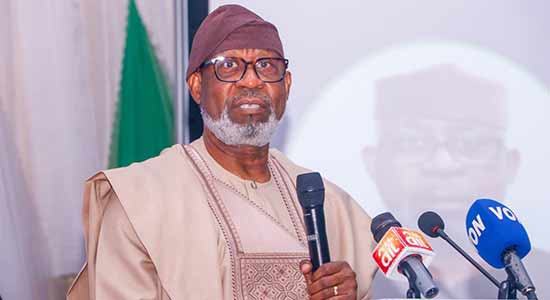
The Minister of Solid Minerals Development, Dr. Dele Alake, has stated that previous administrations lacked the political courage demonstrated by President Bola Tinubu in establishing a sustainable path toward national economic recovery.
Speaking on Thursday in Abuja at the 2026 NRS-MSMD Joint Stakeholder Sensitisation for the North Central zone, Alake claimed that prior to the current administration’s inception in 2023, the federal government had resorted to borrowing money simply to pay civil servants’ salaries.
The event, themed “From Resource to Revenue: Aligning Solid Minerals Operations with the 2025 Tax Reform Act,” served as a platform for the Minister to trace the roots of Nigeria’s fiscal decline.
Alake attributed the economic downturn to a structural shift from the robust local manufacturing and agricultural production of the 1960s and 1970s to a heavy reliance on the importation of basic consumer goods.
“We were importing everything importable, including toothpicks, including orange juice. Things that we could produce internally that we were producing before, when our currency was strong.
“I was privileged to have lived in this country when the naira was strong, and in the early 80s, I bought $1 for 80 kobos. $1 for 80 kobo, that wasn’t even the official rate. Then the official rate was 52 kobo,” he added.
Defending the aggressive fiscal reforms enacted over the last three years, Alake asserted that Nigeria would have faced a catastrophic financial collapse by late 2023 had President Tinubu not taken the decisive step to eliminate the fuel subsidy.
He explained that the country had trapped itself in a dangerous cycle of using borrowed funds for recurrent expenditure rather than capital investments, which ultimately damaged Nigeria’s international credit ratings.
When external borrowing avenues dried up, the nation turned to printing over 20 trillion naira locally, a move that severely devalued the currency and heightened inflation.
He criticised past leadership for failing to address the challenges, which led to spending up to $600 million on items such as wigs and a reliance on borrowing to pay salaries.
“What would have happened to Nigeria by September 2023 if the president had not removed fuel subsidy? The economy would have crashed completely,
“Because by the time this government came into power, or even long before it came into power, this country was borrowing money to pay salaries, not to capitalise the economy, but to pay salaries with current expenditure, not capital.
“When a society or a nation borrows to pay salaries, you know what that means. There can be no development. At some point, when borrowing became too difficult, we had difficulties because our credit ratings crashed, too. So, the borrowing agencies were very skeptical of looking at us. What did we start to do? We started to print currency locally, we printed over 20 trillion,” he stated.