
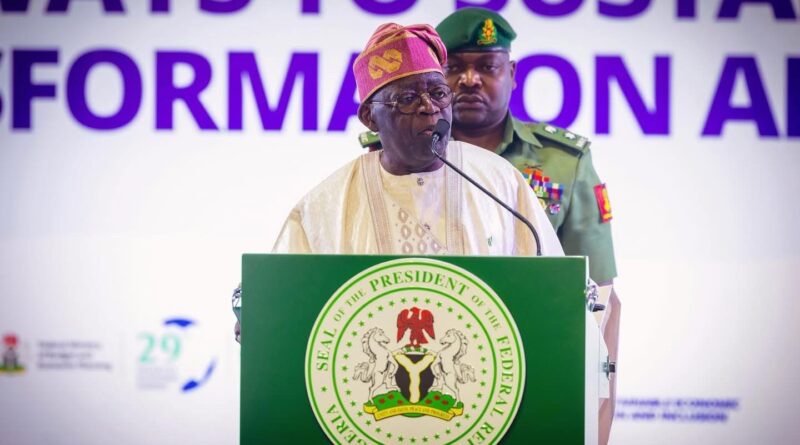
President Bola Tinubu has claimed that the difficult economic reforms undertaken by his administration saved Nigeria from economic collapse.
Tinubu held that the reforms have started yielding positive results across key sectors.
The President stated this on Friday when Vice-President Kashim Shettima and governors led by Chairman of the Nigeria Governors’ Forum (NGF), Gov. AbdulRahman AbdulRazaq of Kwara, paid him the traditional Sallah homage at his Lagos residence.
He thanked the governors for their support and sacrifices in sustaining public confidence during the implementation of the reforms.
“It’s a very great joy because as leaders in your various states and communities, you should be home receiving homages and other visitors.
“To find time to come here this evening is so refreshing and a blessing for all of us,” Tinubu said.
Reflecting on the challenges surrounding his emergence as president and the tough economic decisions taken since assuming office, Tinubu said the removal of fuel subsidy required courage and conviction.
The president said that in spite of litigations, criticisms and economic difficulties, the administration remained focused on preventing national bankruptcy.
“Instead of bankruptcy, Nigeria has survived. The economy has recovered. The impact is growing. Agriculture is booming, food is here,” Tinubu declared.
He commended the governors for persuading Nigerians to remain patient during the implementation of what he described as painful but necessary reforms.
“You kept the spirit. You kept the hope. You persuaded our people to be patient and endure these three years of painful reform where we put the economy on reset,” he said.
According to Tinubu, the positive impact of the reforms is already visible in the economy and infrastructure development across the country.
“Today, the benefits are showing. The economy has recovered. Macroeconomic indices are doing very well. Construction is ongoing in roads and infrastructure. The abandoned ones have been rehabilitated.”
Tinubu said the housing sector was improving steadily, while agriculture remained critical to achieving food sovereignty and economic prosperity.
“Housing is coming on very well. Agriculture will prosper again. We will achieve food sovereignty if we utilise the lands in your various states effectively,” the president said.
He noted that many state governments were no longer relying on federal interventions to pay salaries, attributing the improvement to better economic management.
The president also highlighted the economic potential of ongoing infrastructure projects, including the Sokoto-Badagry Super Highway corridor.
“Imagine how many dams on that corridor for irrigation, farming and electricity.”
Tinubu expressed gratitude to the governors for their continued faith in his leadership and support for the administration’s programmes.
Earlier, Shettima said the Eid-el-Kabir festival symbolised sacrifice, patience, courage and leadership, adding that Tinubu had demonstrated those virtues through his reform agenda.
“The Eid-el-Kabir teaches us that the path to greatness is not paved by convenience, but by the courage to give up what is easy so that what is necessary may be,” he said.
According to the vice-president, leadership demands sacrifice, courage and the willingness to make difficult decisions in the national interest.
“Leadership is sacrifice. Leadership is the willingness to bear the burden of difficult choices so that others may live in peace and hope,” he said.
Shettima added that governors across the country appreciated the impact of the administration’s reforms, especially improved allocations and fiscal stability.
Also speaking, AbdulRazaq commended the president for his efforts at building a peaceful and egalitarian nation.
He pledged the continued support of governors toward building a virile and prosperous Nigeria.
The event was attended by governors Babajide Sanwo-Olu of Lagos, Dapo Abiodun of Ogun, Mohammed Bago of Niger, Agbu Kefas of Taraba, Monday Okpebholo of Edo, Hyacinth Alia of Benue, Nasir Idris of Kebbi State, some deputy governors, among others.