
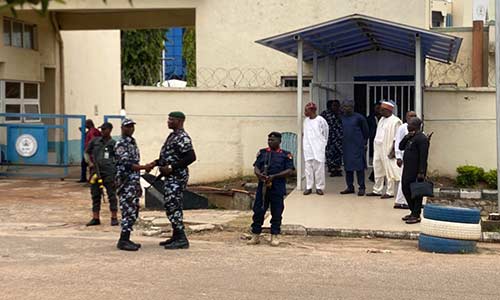
Leaders of the African Democratic Congress (ADC) were allegedly denied access to former Kaduna State Governor Nasir El-Rufai, who is currently in the custody of the Independent Corrupt Practices and Other Related Offences Commission (ICPC), in a development that has further intensified the growing controversy over the conditions of the former governor’s detention.
The ADC delegation that was reportedly turned away at the ICPC facility comprised three of the party’s most senior officials: the National Secretary, Rauf Aregbesola (former Governor of Osun State and former Minister of Interior); the National Publicity Secretary, Bolaji Abdullahi; and the Secretary of the ADC Manifesto and Policy Committee, Salihu Lukman (former Director-General of the Progressive Governors Forum).
The party leaders reportedly visited the ICPC detention facility on Friday in an attempt to see El-Rufai but were denied access. Details surrounding the circumstances of the denial including the specific reasons given by ICPC officials, whether the visit fell within or outside approved visiting hours, and whether the delegation was given any explanation remained unclear as of Friday afternoon.
The composition of the ADC delegation that attempted to visit El-Rufai is politically significant. Aregbesola, Abdullahi, and Lukman are all former members of the APC who have since moved to the ADC amid the broader political realignments that have characterised Nigerian politics in the lead-up to the 2027 elections. Their visit to El-Rufai — himself a former APC governor and ally-turned-critic of President Bola Tinubu underscores the deepening political solidarity between El-Rufai and the ADC leadership, even as the former governor faces multiple criminal trials.
The denial of access to three prominent political figures, including a former state governor and former federal minister, raises fresh questions about who is permitted to visit El-Rufai in ICPC custody and under what conditions.
The development comes days after the ICPC moved to address mounting public criticism of El-Rufai’s detention conditions by holding a press conference in which its spokesperson, Okor Odey, dismissed allegations that the former governor was being denied access to food, family members, and medical care.
Odey described the allegations as “false and misleading,” maintaining that the ICPC operates a structured visitation regime that permits authorised visitors including family members, lawyers, and medical personnel access to detainees under supervision.
According to Odey, visitors are allowed into ICPC detention facilities between 9:00 a.m. and 6:30 p.m. He stated that one of the incidents that generated public controversy occurred when El-Rufai’s wife arrived outside the approved visiting hours, implying that the denial of access on that occasion was a routine enforcement of institutional rules rather than a targeted restriction.
The ICPC spokesperson insisted that the commission was treating El-Rufai in accordance with established procedures and that the former governor’s rights as a detainee were being respected.
The El-Rufai family, however, has maintained a starkly different account of the detention conditions, alleging a pattern of restrictions that go beyond routine institutional rules.
The family alleged that the former governor was denied access to his personal doctors despite an earlier court order from the Kaduna High Court granting him unrestricted access to legal representatives and physicians. The existence of a court order specifically guaranteeing medical access makes the alleged denial particularly serious, as it would constitute disobedience of a court order if substantiated.
The family further claimed that the ICPC’s own in-house doctor had examined El-Rufai and recommended additional medical examination — but that access to follow-up medical care was subsequently blocked.
“When you see a doctor and you run tests, you are expected to see the doctor back so that he explains what the problem is. He was denied access to the doctor,” El-Rufai’s second wife, Hasiat, alleged.
The allegation that the ICPC’s own medical staff recommended further examination but the detainee was then prevented from receiving it raises concerns about whether institutional medical protocols are being overridden by security or administrative decisions.
The denial of access to the ADC delegation is the latest in a series of incidents involving disputes over who can visit El-Rufai and under what conditions.
Earlier in the week, during the continuation of El-Rufai’s treason trial at the Federal High Court in Abuja, the SSS lawyer, Oluwole Aladedoye, SAN, had complained to the court that El-Rufai’s family members — including two wives and a son — went to the SSS headquarters with journalists and publicly criticised the court’s bail conditions. Aladedoye accused the family of using social media and press engagements to portray the prosecution and security agencies as persecuting the defendant.
Justice Joyce Abdulmalik, who is presiding over the treason trial, dismissed the SSS’s complaint, stating that she paid no attention to social media narratives and directing that the trial should continue.
Members of the El-Rufai family, led by his eldest wife Asiya El-Rufai, had also protested at the SSS headquarters in Abuja over his continued detention and alleged breach of court orders, joined by Senator Lawal Adamu representing Kaduna Central and other supporters.
El-Rufai’s detention is complicated by multiple overlapping legal proceedings. He was arraigned on April 23, 2026, at the Federal High Court in Abuja on a five-count further amended charge bordering on treason and breach of national security, to which he pleaded not guilty. The prosecution’s case centres on allegations that he received an intercepted phone conversation involving National Security Adviser Nuhu Ribadu and publicly discussed its contents on Arise News Television.
Separately, El-Rufai faces cases in Kaduna stemming from his activities as governor. A judge overseeing one of his Kaduna trials denied him bail and ordered him to remain in ICPC custody. Until that ruling is reversed or set aside by a higher court, El-Rufai must remain in ICPC detention regardless of bail decisions in his other cases.