
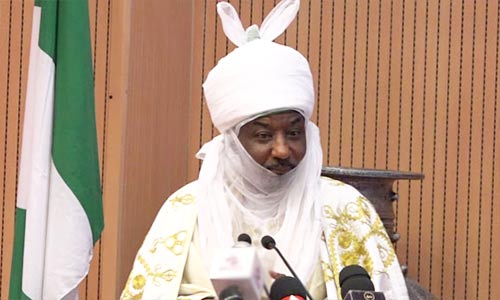
The Emir of Kano, Muhammadu Sanusi II, has questioned why Nigeria continues to borrow heavily despite the removal of fuel subsidy, pointing to a fundamental contradiction between the government’s claim that subsidy removal freed up trillions of naira and its simultaneous escalation of borrowing to record levels.
Speaking during an interview aired on News Central TV on Friday, the former Governor of the Central Bank of Nigeria maintained that while the subsidy regime was unsustainable and its removal was a necessary reform, the economic benefits should be visible nearly three years after the policy was implemented, and the fact that borrowing has increased rather than decreased raises serious questions about where the savings have gone.
“We’ve removed the subsidy. We’re now spending it. What we should not see is fiscal consolidation. You cannot remove wastages and continue borrowing. I’ve said this before. You need to see the benefits,” Sanusi stated.
“If you’re not paying the subsidy and you’ve got the money, why are we still borrowing and borrowing? What are we borrowing for?” the Emir asked, posing the question that millions of Nigerians have been asking since the reform was implemented in May 2023.
Sanusi’s intervention strikes at what has become the central economic paradox of the Tinubu administration.
The government removed the fuel subsidy in May 2023, describing it as a drain on public finances that consumed trillions of naira annually and left insufficient resources for infrastructure, education, health, and other developmental priorities. The reform was accompanied by the liberalisation of the exchange rate, another policy Sanusi has historically supported.
Senator Solomon Adeola, Chairman of the Senate Appropriation Committee, has claimed that Nigeria is saving over N10 trillion annually from subsidy removal, a figure that, if accurate, should represent a transformative fiscal windfall for a government that had previously argued it was borrowing primarily because subsidy payments were consuming its revenue.
Yet the opposite has happened. Instead of reducing borrowing, the government has increased it dramatically. In early April, the Federal Government increased its 2026 borrowing plan by N11.31 trillion, bringing total projected borrowing to N29.20 trillion, a figure that dwarfs the borrowing levels under previous administrations that operated with the subsidy in place.
Most recently, President Tinubu wrote to the Nigerian Senate seeking approval for an additional $516,333,070 external loan to finance the proposed Sokoto-Badagry Super Highway, adding to an already staggering debt portfolio.
Sanusi’s question, “what are we borrowing for?” when the government should have additional revenue from subsidy removal, is therefore not rhetorical. It demands a specific accounting of where the subsidy savings have gone and why the government’s appetite for borrowing has grown rather than diminished.
While affirming his long-standing support for subsidy removal and exchange rate liberalisation, Sanusi raised questions about the timing and implementation of the reforms.
“For me, removing subsidy or liberalising exchange rates, these are good interventions. Were they done at the right time? Those are certain questions. Were there other things that should be done that have not been done? These are other issues,” Sanusi stated.
The questions suggest that while the Emir agrees with the direction of the reforms, he has reservations about whether adequate preparation and supporting measures were put in place before the policies were implemented, and whether complementary reforms that should have accompanied subsidy removal, such as investment in public transportation, targeted social protection for the poorest citizens, and investment in local refining capacity, were executed with sufficient urgency.
Sanusi acknowledged improvements in Nigeria’s local refining capacity, particularly the operations of the Dangote Refinery, describing the reduced reliance on imported petroleum products as positive for the economy.
“I have always said the subsidy regime was unsustainable. We cannot continue supporting foreign refineries. We’re an oil-producing country. Keeping refineries open abroad while we’re not doing our own,” Sanusi stated.
The observation highlights one of the original justifications for subsidy removal: that Nigeria, as Africa’s largest oil producer, was effectively subsidising foreign refineries by importing refined petroleum products at a cost that included the profit margins of foreign refining companies. The growth of domestic refining capacity, led by the Dangote Refinery, addresses this structural absurdity.
However, the reduction in import dependency, while positive, does not explain where the fiscal savings from subsidy removal have gone, or why borrowing has increased rather than decreased.
Sanusi’s critique of the subsidy regime has been consistent over the years. At the Oxford Global Think Tank Leadership Conference less than a year ago, he described the subsidy system in characteristically sharp terms.
“That was not a subsidy; it was the worst form of derivative, an open-ended hedge,” Sanusi stated at the conference, explaining that the system effectively forced the government to absorb price shocks from global oil prices and exchange rate fluctuations for years, creating an open-ended fiscal liability that grew or shrank with international market conditions rather than any rational policy framework.
His description of the subsidy as a derivative rather than a social programme reframes the policy from a well-intentioned support for citizens into a speculative financial instrument that exposed the government to unlimited losses, a characterisation that many economists have endorsed.