
Follow our live coverage here.
LONDON – The United States does not want to fight, and Iran does not want to talk. That, in summary, is the current situation in the Middle East, where the military confrontation in the Gulf is now largely a war of attrition.
Still, it is unlikely the situation can last for much longer; either the Iranians blink and return to the negotiations brokered by Pakistan, or a new flare-up in fighting is in the offing.
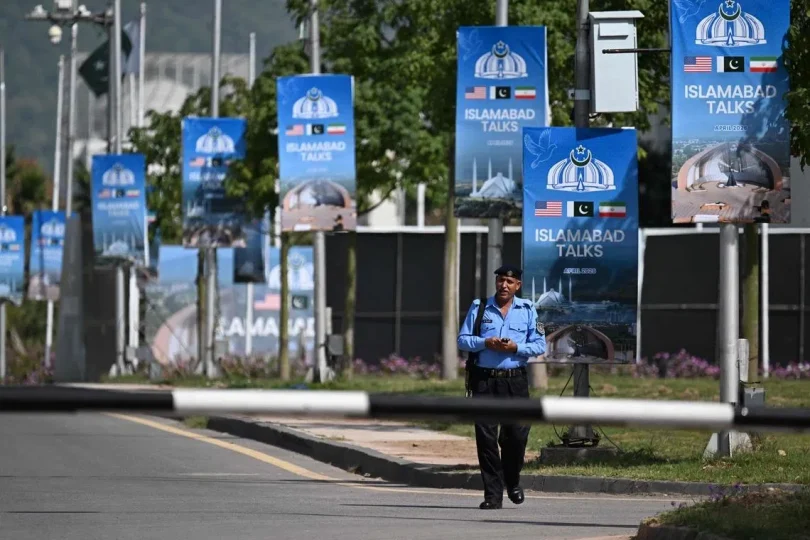
Since the start of this week, the Pakistani capital Islamabad has been ready to welcome top negotiators from Iran and the US for another round of talks, designed to pick up from the previous peace negotiations, which failed on April 11.
But at least for now, the Iranian position is that it will not consent to further discussions until the US lifts a naval blockade, which President Donald Trump imposed on the Strait of Hormuz, through which a fifth of the world’s oil and natural gas passes.
And Mr Trump, in turn, refuses to lift his blockade until the Iranians allow free and unhindered passage through the waterway.
For the moment, the US appears to have blinked first. Hours before a two-week ceasefire was due to expire on April 21, Mr Trump announced the ceasefire’s extension, allegedly at the behest of Pakistan.
Prime Minister Shehbaz Sharif of Pakistan duly thanked Mr Trump for “graciously accepting our request to extend the ceasefire to allow ongoing diplomatic efforts to take their course”.
The US decision came as a surprise because hours before the initial ceasefire was due to expire, Mr Trump told journalists he was minded to order the resumption of military attacks. “I expect to be bombing,” he said, adding that the US military “is raring to go”.
Although the US leader fervently denies it, it is clear Mr Trump is reluctant to resume fighting, partly because the war is deeply unpopular with US voters, but also because the military choices facing Washington are getting more complicated.
In his recent social media postings, Mr Trump highlighted an opinion poll which appeared to suggest that a slim majority – 52 per cent of the US electorate – want the US to “finish the job” of removing Iran’s nuclear capabilities, the ostensible reason for the current US offensive.
But that poll was conducted by Newsmax, a small cable TV and digital media company with an estimated audience of only 300,000 and a track record of airing far-right conspiracy theories. Most other national surveys conducted by mainstream US pollsters indicate that the President’s approval ratings are around the 40 per cent mark, the lowest they have been since the start of Mr Trump’s second term in office.
And with mid-term elections due in November, polls also indicate that dissatisfaction with the war and the high fuel prices it generates can result in Mr Trump’s ruling Republicans losing their four-seat majority in the House of Representatives.
Republican strategists are also beginning to worry that if the war continues, they might even lose their control of the Senate to the Democrats, something that until recently was dismissed as a near impossibility.
Unsurprisingly, Mr Trump is framing the current ceasefire as just a tidying-up exercise before he returns to managing domestic US concerns.
“Once short-term disruptions from Operation Epic Fury are fully behind us,” White House spokesman Kush Desai recently said, referring to the codename for the US operation against Iran, “Americans can count on more economic progress in store thanks to this Administration.”
The snag for Mr Trump is that the Iranians can also read US media reports and know that the longer the military showdown in the Middle East continues, the worse Mr Trump’s domestic position becomes.
This is why Iranian officials dismiss Mr Trump’s offer of an extended ceasefire as irrelevant. “The extension of the ceasefire by Donald Trump has no meaning,” an adviser to Mr Mohammad Bagher Ghalibaf, the influential Speaker of the Iranian Parliament who led the previous round of the negotiations with the US, said in a social media post on April 21.
That is also why Iran’s Islamic Revolutionary Guard Corps (IRGC) attacked and seized several tankers in the Strait of Hormuz on April 22. The objective here is to remind everyone that, if Iran is not allowed to export any oil by the US blockade, no other international customers would be able to get fuel either.
The Iranians are also seeking to boost the global price of energy commodities, so as to increase the political pressure on the US. Soon after IRGC gunboats fired at oil tankers, oil prices duly pushed through the psychologically important threshold of US$100 (S$127.40) a barrel.
Still, the Iranians cannot afford to play this game for much longer. They are now deprived of most revenue sources and will soon run out of storage space for the unsold oil they pump out. Once this happens, Iran will need to start closing down oil wells, a difficult, expensive and risky procedure.
Meanwhile, the US Navy continues to deploy more warships to the Middle East, including a third nuclear-powered aircraft carrier.
And while these deployments might be intended to give Mr Trump plenty of options, they cannot be sustained for long without exacerbating what is already a serious strain on the US armed forces. So, the White House will have to decide pretty soon on what it does with all this military might at its disposal.
The key question is whether the Iranians are simply playing for time in the hope of squeezing more concessions from the US – especially over Iranian claims to control the Strait of Hormuz – or whether the Iranian leadership is so divided, between hardliners who wish to oppose the US at all costs and moderates who want a settlement, that no clear Iranian negotiating stance can emerge.
US intelligence sources believe in the latter theory. US analysts say that President Masoud Pezeshkian and Mr Abbas Araghchi, the Iranian foreign minister, wish to settle but are coming under intense pressure from IRGC hardline elements.
Seen from this perspective, Mr Trump’s decision to extend the ceasefire is designed to help the moderates inside the Iranian leadership. Mr Trump made this even more explicit on April 22 when he publicly described Mr Araghchi as a “smart man”, adding that the US expects him to take part in future negotiations.
Either way, the current stalemate cannot last much beyond early next week. And although the Iranians believe they hold the upper hand, they also have a long history of underestimating US capabilities and responses.