
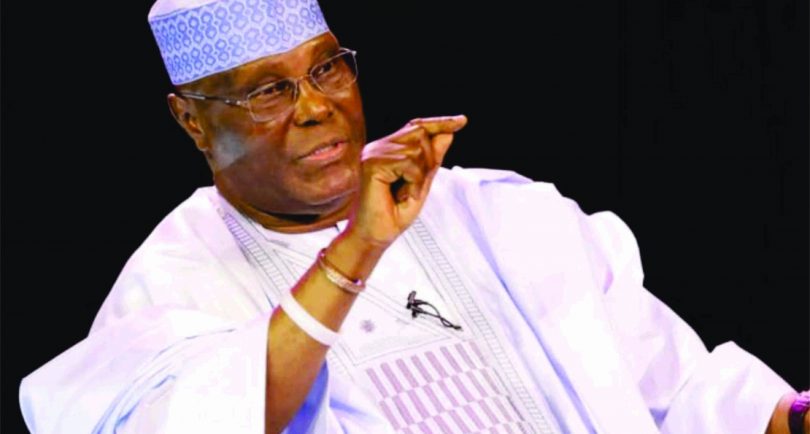
Former Vice President Atiku Abubakar has urged the National Assembly of Nigeria to urgently amend the Electoral Act, warning that a controversial provision could enable ballot manipulation and erode public trust in elections.
In a statement issued Wednesday by his aide, Phrank Shaibu, Atiku criticised Section 63 of the law, which permits a returning officer to count ballot papers lacking official marks at their discretion.
He argued that such latitude introduces subjectivity into a process that demands strict standards.
“The leadership of the National Assembly should have been more cautious than casual in handling provisions that touch the very heart of our democracy,” he said.
According to the former vice president, lawmakers failed to exercise sufficient caution in safeguarding the integrity of the electoral framework. He stressed that a ballot paper is a legal instrument whose validity must be clear-cut, not left to interpretation.
“A ballot paper is not an ordinary piece of paper—it is a legal instrument whose authenticity is central to the credibility of the entire electoral process,” he said.
Atiku described the clause as a direct threat to electoral credibility, noting that allowing discretionary judgment on ballot validity creates openings for abuse and could ultimately distort the will of voters.
“This is not a minor technical issue—it is a direct threat to electoral integrity.”
Other News
Corruption, misplacement of priorities cause of poor security funding in Nigeria –Atiku
Jonathan fires back at Atiku, defends record in office
Atiku: ‘We respect him, but it’s time to step aside’ — Umeh
He further pointed out that the provision is not new but was inherited from earlier electoral laws and retained without adequate safeguards in the current amendment.
Warning of broader consequences, Atiku said ambiguity in electoral laws invites disputes and undermines democratic stability. He urged the Independent National Electoral Commission to strengthen its operational guidelines to eliminate situations in which personal judgment could override objective criteria.
“A democracy cannot survive on ambiguity. A ballot must either meet the standard or it does not. The moment you leave such a critical decision to subjective judgment, you invite manipulation, dispute, and ultimately, chaos,” he said.
“At a time when Nigerians are demanding transparency and credibility, it is reckless to retain a clause that weakens confidence in the very foundation of democracy—the vote,” he added.
He also called on international observers and democratic partners to closely monitor Nigeria’s electoral legal framework, insisting that the credibility of future elections depends as much on the law as on its implementation.
Atiku added that President Bola Tinubu has a responsibility to subject critical legislation to thorough scrutiny before signing it into law.
“The world is watching. Nigeria must not send a signal that its electoral system can be bent by interpretation. The President, Bola Tinubu, also bears a duty to subject every critical legislation to rigorous scrutiny before appending his signature.
“Leadership demands vigilance. The document he assented to ought to have passed the most stringent integrity test,” Atiku
Tinubu had assented to the Electoral Act 2026 (Amendment) on February 18 at the Presidential Villa in Abuja, shortly after its passage by the National Assembly.