
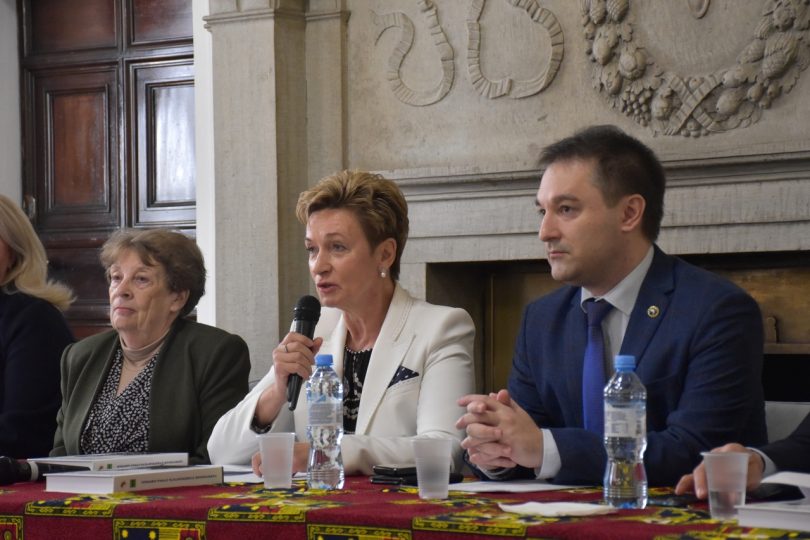
The Centre for Transition Economy Studies of the Institute for African Studies of the Russian Academy of Sciences held a two-day scientific conference under the theme: “Industrial Development Strategies of African Countries” on March 18-19. The conference was opened by Professor Irina Abramova, Director of the Institute for African Studies. More than 40 researchers and experts from Russia, South Africa, Nigeria, Egypt and North Macedonia took part in the event.
The conference focused on a wide range of significant issues related to Africa’s industrial development, the modernisation of the African production base, and the potential for Russian-African cooperation. The in-person part of the conference focused on the development of the manufacturing and extractive industries, special economic zones, energy and transport infrastructure, digitalisation, and the agro-industrial complex. The second day of the conference was conducted as an online discussion in English, featuring African colleagues on the localisation of production chains in Africa, covering both agricultural and mineral processing.
Topics of the Conference included:
Experts in African studies from Russia, as well as representatives of the Russian government and business circles involved in trade and economic cooperation with African countries, actively participated. One of the significant outputs presented at the plenary session of the conference was the full-text on the African Development Strategy database created by Professors D. A. Degterev and A. D. Novikov, together with the staff of the IAS. The database covers more than 400 official strategic planning documents across 53 countries on the continent for the period 1997–2025. It systematises them under six thematic areas: long-term and medium-term development strategies, industrial policy, ICT, agriculture and the water sector.
The plenary session featured nine reports covering key dimensions of Africa’s industrial development. There were issues of trade and industrial potential of the continent that were highlighted in the report on the export specificity of African machine-building industries: based on ITC Trade Map data (2019–2024) that shows duties of South Africa, Tunisia, and industrial production, including on intracontinental markets.
Institutional mechanisms of Russian-African economic cooperation were reviewed in the report on the activities of Intergovernmental Commissions: the number of these ICC increased from four (4) in 2023 to nine (9) in 2025, and the volume of investment funds to support African projects is planned to increase, at least, to Rouble 5 billion for 2026–2027.
The conceptual dimension of financing industrialisation was presented through a critique of universal Western narratives and the justification for the need for an “application finance strategy”—a country model that takes into account the economy of Africa. Practical aspects of Russia’s investment presence in Africa are characterized on the example of projects in the countries of the Alliance of Sahel States (AES) with an emphasis on the specific risks of the subregion (DM Sinitsyn, VEB.RF). Digitalisation and artificial intelligence development in sub-Saharan African countries were also analysed and presented at the conference.
Russian-African cooperation in the field of technologies and education was covered in the reports on the transfer of agrobiotechnologies through the Afro-Russian Centre for Technology Development in Kampala, within which, in 2025/2026, this period, in which concretely 467 citizens of African countries were trained in Russian universities (NA Goncharova, FGBU “Agroexport”).
The competitive struggle of foreign players for African markets and the possibilities of Russian participation were considered in the reports on the position of the continent on the world energy markets, supplies of ground vehicles, and activities of pharmaceuticals for Africa. The digital dimension of industrialisation was covered by the reports on the cyber potential of West Africa, the formation of data processing centres in the industrial strategy of South Africa, and the digitalisation strategies of Algeria and Morocco.
The theme of most speeches, at the conference, became a reflection on the ‘disconnection’ between the proclaimed goals of industrialisation and the actual structure of African economies: despite the widespread proliferation of pre-national strategic documents, industries in the continent’s total GDP has not exceeded 10–12% for more than two decades, and exports still comprise mainly unprocessed raw materials.
In this regard, a number of reports justify the need to transition from external financial models formed by international organisations to sovereign country strategies based on state political, industrial and human resources. Global South—including, to deepen Russian-African cooperation in the spheres of technology, education and investment.
A collective monograph is, however, planned for publication following the conference. The event included the presentation of the full-text database on African development strategies, prepared by the team of the Institute for African Studies of the Russian Academy of Sciences.