
Business
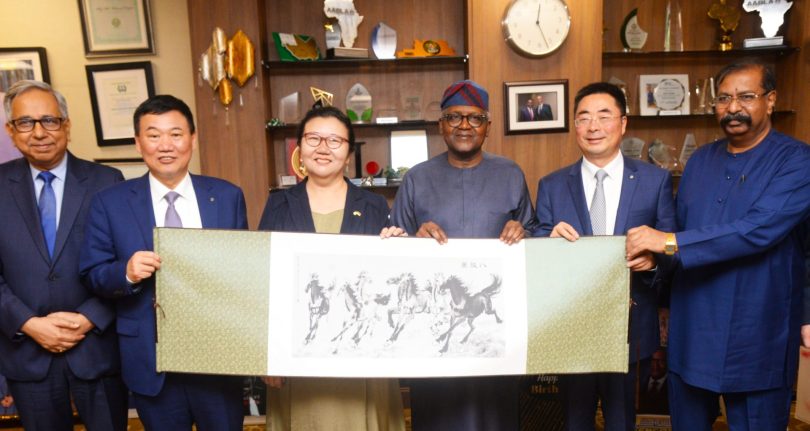
L-R: GMD/CEO, Dangote Cement Plc, Arvind Pathak; Chairman, Sinoma International Engineering Co. Ltd., Yin Zhisong; Consulate General of the People’s Republica of China, Yan Yaqing; President/CE, Dangote Industries Limited, Aliko Dangote; Chairman of the Board, Sinoma International Engineering Co. Ltd., Lin Zhisong and Vice President Oil & Gas, Dangote Industries Limited, Devakumar Edwin, during the Sinoma International visit to Dangote Head Office in Lagos
…asks Nigerians to pray for Aliko Dangote
PUNLIC Policy analysts, Government officials and other Stakeholders have in Lagos hailed the strategic foresight and industrial courage of the President and Chief Executive of Dangote Industries Limited (DIL), Aliko Dangote, describing the Dangote Petroleum Refinery as a transformative national asset deserving of collective appreciation by Nigerians.
This position was strongly articulated at the 2026 Bullion Lecture, powered by the Centre for Financial Journalism, where the Director‑General of the Raw Materials Research and Development Council (RMRDC), Professor Nnanyelugo Ike‑Muonso, declared that Nigerians owe Aliko Dangote a profound debt of gratitude for investing in the world‑class refinery.
Delivering the keynote lecture themed “From Resources to Prosperity: How Raw Materials Development, Value Addition and Innovation Can Catalyse Nigeria’s Industrial Renaissance,” Professor Ike‑Muonso said the refinery represents a decisive break from Nigeria’s long‑standing dependence on crude oil exports with minimal domestic value addition.
According to the RMRDC Chief, Nigeria had historically exported crude oil only to re‑import refined petroleum products such as Premium Motor Spirit (PMS), with little economic benefit beyond crude sales.
“That narrative has now changed. Instead of exporting crude and importing PMS alone, the Dangote Petroleum Refinery processes crude locally to produce PMS, diesel, dual purpose kerosene (DPK), and valuable by‑products for petrochemicals such as polypropylene. This represents complete domestic value addition.”
Professor Ike‑Muonso described the refinery as Nigeria’s most concrete example yet of how strategic industrial investment can unlock the full value of the country’s natural resources.

Against the backdrop of ongoing instability in the Middle East and its implications for global energy supply and price volatility, the RMRDC boss said the Dangote Petroleum Refinery has emerged as a stabilising force and an African‑led solution to global energy challenges.
“With the far‑reaching consequences of the Middle East crisis on global energy markets, the Dangote Petroleum Refinery stands today as a monumental demonstration of strategic foresight, industrial courage and African self‑reliance,” he said.
“Nigeria should, in fact, be praying for Aliko Dangote at this time.”
Professor Ike‑Muonso also presented comparative data on raw‑material value addition across countries, including the United States, India, Brazil, South Africa and Kenya, revealing that Nigeria records the lowest percentage of value addition.
He disclosed that the country loses an estimated $29 billion annually due to the export of raw materials without processing partly due to the energy deficit.
“Rather than exporting raw materials, Nigeria should be exporting processed raw materials and finished products,” he argued.
Identifying obstacles to achieving full value addition, the RMRDC Director‑General highlighted key structural challenges such as: Private infrastructure tax, resulting from companies’ reliance on self‑generated power; Logistics gaps, noting that only about 30 percent of Nigeria’s road network is paved; and Capability gaps within the industrial ecosystem.

He stressed that sustained industrialisation remains Nigeria’s most viable pathway to broad‑based economic prosperity, citing Dangote Industries’ investments as a model for the country.
Earlier in his remarks, Otunba Kelvin Dele Oye, Chairman of the Economic Research and Ethics Committee and former President of the National Association of Chambers of Commerce, Industry, Mines and Agriculture (NACCIMA), also commended Dangote’s industrial contributions.
He decried what he described as an imbalance in the exploitation of Nigeria’s raw materials by foreign investors, often without meaningful value addition to the local economy.
Otunba Oye called for deliberate government policies and stricter regulatoryvigilance to ensure that raw material exploitation benefits Nigerians, while enabling local investors to compete favourably with foreign players.
The event, which marked the 10th anniversary of the Bullion Lecture, also featured the unveiling and launch of a commemorative book titled “Pathways to Nigeria’s Socio‑Economic Transformation.”
The book, authored by Mr. Ray Echebiri, Chief Executive of the Centre for Financial Journalism, documents all lectures delivered since the inception of the Bullion Lecture series.
A.I
April 23, 2026
Tags: Aliko Dangote Mr. Ray Echebiri Otunba Kelvin Dele Oye RMRDC