
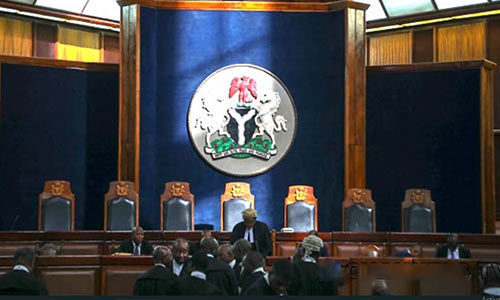
The Supreme Court of Nigeria has rejected the records of appeal sought to be transmitted by shortlisted candidates from a 2022 judicial appointment exercise in Abia State, enforcing Section 243(4) of the 1999 Constitution (as amended) which bars any decision of the National Industrial Court, whether interlocutory or final, from being appealed to the apex court, a ruling that lawyers and judicial analysts have hailed as a landmark enforcement of the constitutional amendment and that effectively ends a protracted legal battle blocking the appointment of new judges to the Abia State High Court bench.
The decision, delivered on Tuesday, April 22, 2026, means the Abia State Judicial Service Commission can now proceed to conclude the 2024 exercise for the appointment of High Court judges without further legal obstruction from the 2022 shortlisted candidates whose attempts to challenge the process through the courts have been exhausted at every level of the judiciary.
The dispute traces back to a 2022 exercise for the appointment of judges to the Abia State High Court, which was subsequently found by the National Industrial Court to have been “fraught with fraud.”
A group of candidates who had been shortlisted in the 2022 exercise sought to protect their positions and prevent a fresh process from superseding the one in which they had been shortlisted, despite the finding of fraud.
In 2024, the Abia State Government, through the Attorney General, filed suit at the National Industrial Court, Owerri Judicial Division, in NICN/OW/05/2024 titled Attorney General of Abia State v. Abia State Judicial Service Commission & 3 Ors, seeking judicial clarity on whether the Judicial Service Commission could proceed with a fresh 2024 appointment exercise.
The National Industrial Court made critical findings. It held that the 2022 exercise, which the trial court had found was fraught with fraud, was distinct from the 2024 exercise. It gave the Abia State Judicial Service Commission the judicial nod to commence and conclude the 2024 exercise for the appointment of judges. And it restrained the 2022 shortlisted candidates from interfering with or frustrating the new process.
Dissatisfied with the National Industrial Court’s decision, the 2022 shortlisted candidates, represented by Mr. O.O. Nkume Esq, filed an application for leave to appeal at the Court of Appeal, Owerri Judicial Division. It was noted that Mr. Nkume’s wife, Mrs. Ijeoma Nkume Esq, is herself among the 2022 shortlisted candidates, a fact that raises questions about the propriety of a lawyer whose spouse is a party to the dispute acting as counsel in the same matter.
On February 4, 2026, the Court of Appeal, in a decision delivered by Justice Ntong Festus Ntong JCA in Appeal No. CA/OW/300M/2024 titled Mr. E.E.J. Agwulonu v. Abia State Judicial Service Commission & 3 Ors, rejected the application for leave to appeal, effectively making the National Industrial Court’s judgment final at the appellate level.
Undeterred by the Court of Appeal’s rejection, the 2022 shortlisted candidates filed a Notice of Appeal at the registry of the Court of Appeal, Owerri Judicial Division, seeking to transmit records of appeal to the Supreme Court to challenge the Court of Appeal’s decision.
This is where Section 243(4) of the 1999 Constitution (as amended) became decisive.
The constitutional provision explicitly forbids any decision of the National Industrial Court of Nigeria, whether interlocutory or final, from being appealed to the Supreme Court. The section imperatively makes the Court of Appeal the final arbiter on industrial and labour-related matters, removing the Supreme Court’s jurisdiction entirely in such cases.
On Tuesday, April 22, 2026, the Supreme Court enforced this constitutional provision by rejecting the records of appeal sought to be transmitted, holding that it lacked jurisdiction to entertain the matter by virtue of the constitutional bar.
Section 243(4) represents a significant constitutional reform in Nigeria’s judicial architecture. Before the amendment, appeals on any decision from the National Industrial Court could be taken to the Supreme Court, creating a pathway that allowed labour and industrial disputes to consume the time and resources of the apex court.
The amendment was designed to reduce the Supreme Court’s caseload, expedite the resolution of labour and industrial disputes, and ensure that the Court of Appeal serves as the final court in an entire category of cases, freeing the Supreme Court to focus on constitutional and other matters of national importance.
The Supreme Court’s enforcement of the provision in the Abia judicial appointment case represents one of the clearest applications of the amendment, demonstrating that the constitutional bar is absolute and cannot be circumvented through creative pleading or persistent filing.
Legal practitioners and judicial analysts have welcomed the Supreme Court’s enforcement of Section 243(4) as a significant precedent.
Commentators noted that the ruling will prevent the Supreme Court from being flooded with appeals on labour and industrial matters where potential appellants do not have a right of appeal or have simply filed appeals to frustrate the opposite party and deny them the fruit of their judgment.
The observation is particularly relevant in the context of the Abia case, where the 2022 shortlisted candidates, having lost at the National Industrial Court, lost again at the Court of Appeal, and then attempted to access the Supreme Court despite a constitutional provision explicitly barring such access. The pattern suggests the appeals were designed to delay the 2024 appointment process rather than to pursue legitimate legal remedies.
The Supreme Court’s rejection of the records sends a clear message to litigants who attempt to use serial appeals as a delay tactic: where the Constitution bars further appeal, no amount of procedural manoeuvring can create a right that does not exist.
The Supreme Court’s decision puts to rest the question of whether the Abia State Judiciary can proceed and conclude the process of appointing judges to its High Court bench.