
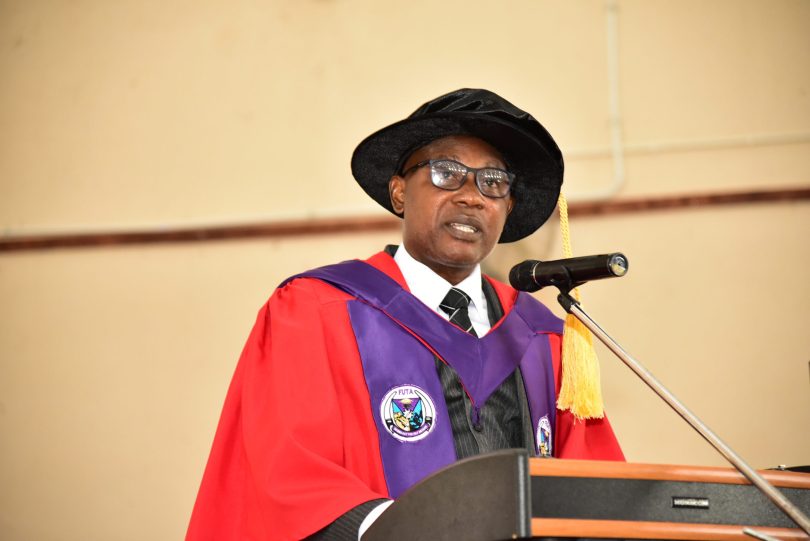
A Professor of Machine and Process Design, and Applied Ergonomics at the Federal University of Technology Akure, FUTA Sesan Peter Ayodeji, has called for a shift towards human-centred and process-driven innovation in Nigeria’s engineering sector, stating that technology alone cannot deliver sustainable solutions. Speaking while delivering the 197th inaugural lecture of the institution titled, “Human Factor, Manufacturing, and Technology: The Triple Helix Driving Our Journey into the Future,” on Tuesday, 28 April, 2026 Ayodeji said effective engineering systems must integrate human factors, operational processes and technology, stressing that innovation should be measured by its usability, adaptability and relevance to local realities.
The Don , a past winner of the Nigerian Prize for Science , faulted the growing emphasis on acquiring advanced tools without adequate consideration for the environments in which they are deployed, noting that machines and automated systems are only as effective as the conditions that support them.
Drawing from his research spanning ergonomics, anthropometric design, manufacturing systems, agro-processing and automation, the Professor emphasised the need for solutions that respond to real users and production conditions rather than theoretical efficiency models. He stated that, “A nation that wants a competitive industry must develop people, stabilise its processes, and apply technology with wisdom,” adding that manufacturing excellence can only be achieved when the human factor is respected, production systems are stabilised and technology is applied as a disciplined tool.
He further stressed that adopting the “triple helix” approach across teaching, research, industry and policy would move the country from episodic improvements to sustained competitiveness, resulting in safer, more productive systems and inclusive development, highlighting several patented innovations linked to his research, including systems for monitoring torqueing of bolts on telecommunication masts, plantain flour processing plants, body mass index measurement devices deployable on Android platforms, and packaging machines for particulates.
Beyond this, he outlined a forward-looking agenda for Nigeria’s engineering and industrial development. He called for research to be assessed based on real-world outcomes, while urging that funding and procurement systems be aligned with local relevance and measurable impact.
Ayodeji also advocated the creation of a Federal University of Technology, Akure-led translation pipeline to move innovations from laboratories to industry, as well as the acceleration of responsible digitalisation and artificial intelligence adoption through human-centred implementation. He stressed the need to strengthen manufacturing systems capacity, particularly in the areas of reliability, quality discipline and energy efficiency, and urged industry stakeholders to treat ergonomics as a productivity strategy rather than merely a safety requirement.
The professor further emphasised that appropriate technology and maintainability should define what is considered “advanced,” while calling for the development of a Nigerian-based anthropometry and engineering data infrastructure to support local design systems. He also urged stakeholders to institutionalise the “triple helix” model—integrating human factors, processes and technology—as a non-negotiable standard in engineering design, policy and practice.
Professor Ayodeji’s collaborative contributions to the development of engineering attracted national recognition in 2022 with the Nigeria Prize for Science for his work on the development of a process plant for plantain flour, with implications for food processing and agricultural value addition. In 2020, a research team at FUTA also led by him developed a cost-effective ventilator during the COVID-19 pandemic. The device is described by experts as a non-invasive Continuous Positive Airway Pressure ventilator produced largely from locally sourced materials.
In her remarks, the Vice-Chancellor, FUTA, Professor Adenike Oladiji, described the inaugural lecture as a reflection of the University’s commitment to impactful research and innovation. Oladiji commended Ayodeji for his contributions to engineering practice and national development, noting that his work exemplifies research that addresses societal needs and supports technological advancement. She reaffirmed the institution’s commitment to promoting research that is not only academically sound but also relevant to industry and national development priorities. She maintained that innovation should ultimately be judged by its functionality, ease of maintenance and its impact on human use, stressing that engineering solutions must be grounded in local needs.
The lecture underscored the need for a more practical and people-oriented approach to engineering development in Nigeria, with Ayodeji urging stakeholders to prioritise solutions that deliver measurable and lasting impact.