
The president had written to the Senate seeking approval to secure a $516,333,07 syndicated loan to support ongoing infrastructure financing plans.
In the correspondence addressed to Senate President Godswill Akpabio and read during Thursday’s plenary, the Federal Government outlined that the facility would be arranged through Deutsche Bank AG, backed by a partial risk guarantee from the Islamic Corporation for the Insurance of Investment and Export Credit.
The loan is intended to fund the already approved Sokoto–Badagry Super Highway project, a major transport corridor expected to enhance connectivity across several states.
According to Tinubu, the Federal Government will also contribute counterpart funding amounting to N265.5 billion to cover land acquisition, compensation, and related infrastructure.
He explained that the project aims to unlock economic activities along the North West–South West corridor by constructing a roughly 1,000-kilometre highway linking Sokoto, Kebbi, Niger, Kwara, Oyo, Ogun, and Lagos states, stretching from Illela to Badagry.
The president urged lawmakers to fast-track consideration and approval of the request.
Commenting on the proposal, Akpabio supported the move, stating that borrowing for capital projects and critical infrastructure is preferable when such investments deliver long-term economic value.
He described the highway as a transformative initiative capable of improving safety and boosting productivity, adding that strategic borrowing can be justified if it contributes to economic growth and eventual loan repayment.
Following the presentation, the Senate referred the request to its Committee on Local and Foreign Debts, directing it to submit its report within one week for further legislative action.
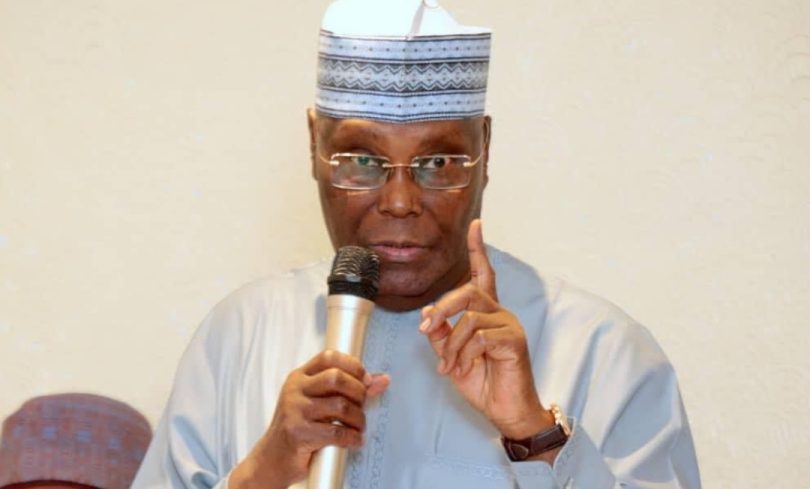
In a statement on Thursday by his Senior Special Assistant on Public Communication, Phrank Shaibu, Atiku acknowledged the necessity of infrastructure development particularly a project connecting the North-West to the South West but drew a sharp distinction between noble intentions and reckless fiscal decisions.
“At a time when Nigeria is already groaning under the weight of unsustainable debt, the resort to yet another foreign loan, without transparent terms, clear cost-benefit analysis, and a credible repayment framework, raises profound questions about prudence and accountability.
“What Nigerians expect is not just ambitious projects, but responsible financing. Development must not become a euphemism for deepening debt traps that generations yet unborn will be forced to repay.
“Nigerians have not forgotten the serious questions surrounding the opaque award process of the Lagos-Calabar Coastal Highway, where due process, competitive bidding, and value-for-money considerations were widely called into question. We must not replicate such a troubling precedent.
“Every kobo borrowed in the name of the Nigerian people must be matched with transparency, accountability, and strict adherence to procurement laws.
“Nigeria must build, but Nigeria must not borrow blindly. Progress anchored on opacity and debt accumulation is neither progress nor leadership, it is postponement of crisis,” he said.