
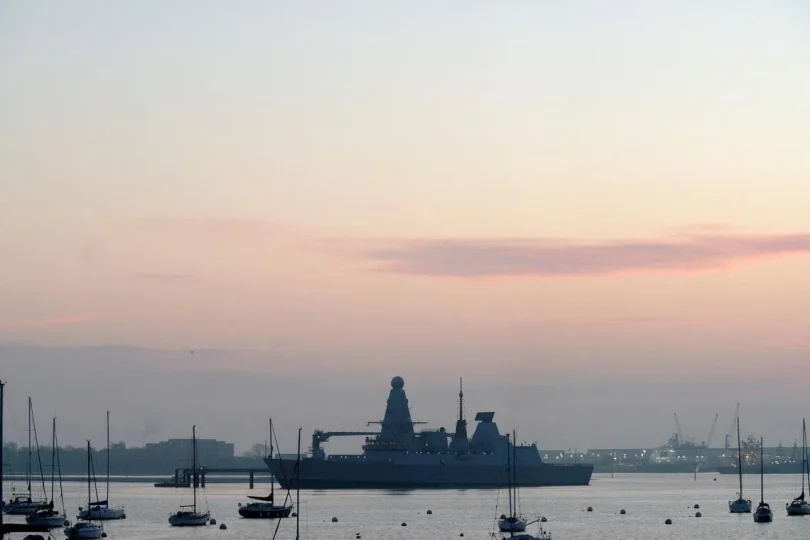
LONDON, April 16 – The Iran war has left Britain’s armed forces exposed, heaping pressure on Prime Minister Keir Starmer to act on his promises to invest in defence, after years of warnings from military bosses about the UK’s shrinking capabilities.
When a British military base in Cyprus was hit by a drone early on in the Iran conflict in March, Britain, whose navy was the largest in the world at the start of World War Two, took three weeks to deploy one warship to the eastern Mediterranean.
France, Greece and Italy sent warships to Cyprus within days.
Britain’s diminished military capacity has registered with U.S. President Donald Trump. He has dismissed Britain’s two aircraft carriers as “toys” while his defence secretary, Pete Hegseth, mocked what he called the “big, bad Royal Navy”.
Defending his record on the armed forces, Starmer said on Wednesday his government, in power for nearly two years, had put in place the biggest sustained increase in military spending since the Cold War.
Britain’s military now is about half the size it was then and its army is the smallest it has been since the early 19th century.
Below are details regarding the scale of the decline and the country’s current capabilities.
ROYAL NAVY
Britain’s Royal Navy has 38,000 personnel. It operates two aircraft carriers and a combined fleet of 13 destroyers and frigates.
This has shrunk from about 62,000 personnel, three aircraft carriers and about 50 destroyers and frigates in 1991.
The delays in sending a warship to Cyprus prompted criticism of the navy’s available surface fleet.
HMS Dragon, a Type 45 air defence destroyer, arrived in the eastern Mediterranean on March 23, while the Royal Navy has said since the outbreak of the Iran war that it is upgrading RFA Lime Bay to improve its minehunting and autonomous tech capabilities.
That deployment compares to the Gulf War in 1990-91, when the Royal Navy sent 21 surface ships and two submarines plus 11 Royal Fleet Auxiliary ships to the region.
The smaller fleet comes after decades of cuts to defence funding since the early 1990s, when about 3.8% of gross domestic product was spent on the military compared to the 2.3% spent in 2024.
Britain until December 2025 had a warship present in the Middle East for decades but that ended when HMS Lancaster was decommissioned in Bahrain just weeks before the start of the Iran war.
The Royal Navy’s ageing frigates need to be retired before replacements become available, while its destroyers are undergoing maintenance work. A fleet of 13 new Type 26 and Type 31 frigates is due to enter service in the coming years.
The Royal Navy is also being stretched by Russian threats closer to home, with British warships recently spending a month in the North Atlantic tracking Russian submarines.
About a fifth of Britain’s defence budget is spent on nuclear submarines. This includes the Trident nuclear deterrent, comprising four Vanguard-class submarines. Under the Continuous At-Sea Deterrence policy, at least one of those submarines is on patrol at sea at any time.
The Vanguard-class submarines will be replaced by the Dreadnought-class in the early 2030s.
ROYAL AIR FORCE
The RAF has over 150 fighter jets in service, two-thirds of which are Eurofighter Typhoons and the remainder Lockheed Martin F‑35s. It has a permanent staff of around 31,000 people.
In 1991, the RAF had about 700 fast-jet fighter aircraft and about 88,000 people. During the 1990-1991 Gulf War, it deployed 157 aircraft to the region, including over 80 fighter jets.
Before the start of the Iran war, Britain sent six F-35s to Cyprus and four Typhoons from 12 Squadron, a joint RAF and Qatar unit, to Qatar. It then sent four extra Typhoons to Qatar in early March after the U.S. and Israeli strikes on Iran began.
Unlike the Gulf War, when Britain was an active member of the U.S.-led coalition fighting Saddam Hussein’s Iraq, it is not directly involved in the current conflict with Iran, though Starmer has allowed what he calls defensive missions aimed at protecting residents of the region, including British citizens.
ARMY
Britain’s army strength is currently 74,000 full-time personnel, down from 148,000 in 1991.
The number of main battle tanks has dropped from a fleet of about 1,200 at the end of the Cold War to around 150 that are currently operational. REUTERS